Jim Dunn
He Put the Engine Behind the Driver. Everybody Else Eventually Decided Not To.
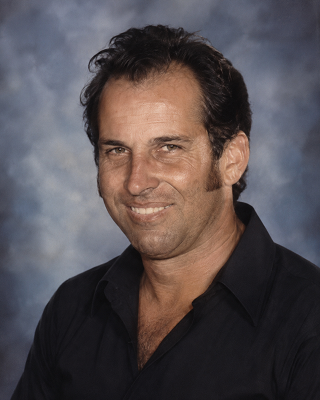
Jim Dunn spent his working life around two things that occasionally caught fire: the Los Angeles County Fire Department and nitromethane Funny Cars.
Being a professional firefighter gave Dunn a particularly realistic opinion about sitting directly behind several thousand horsepower with the engine, fuel system and blower in front of him. So in 1972 he did something about it.
He put the engine behind the driver.
The resulting Dunn & Reath Barracuda was difficult, unpredictable and eventually rejected by nearly everybody else in Funny Car. It also won an NHRA national event. No other rear-engine Funny Car ever has.
That was Big Jim in fairly concentrated form. He saw a problem, built what he thought would fix it, raced the thing hard enough to find out whether he was right and did not require a committee vote before trying again.
Big Jim Started Before Funny Cars Existed
Dunn started drag racing as a teenager in Southern California, long before Funny Car had a name. His father figured the boy liked machinery better than horses and bought him an old Ford.
Jim promised not to race it. That promise survived approximately until the first useful stoplight.
Street racing led to organized competition, and Dunn worked through increasingly serious machinery including fuel altereds and Top Fuel dragsters. His AA/Fuel Altered won class at the NHRA Winternationals in 1963 and 1964, and by the middle of the decade he had moved into Top Fuel.
The 1969 March Meet
Bakersfield’s March Meet could attract an absurd number of Top Fuel dragsters. In 1969, 125 entries showed up trying to make the field, and Dunn and longtime partner Joe Reath brought their Dunn & Reath dragster.
Jim won the race.
Winning when enough fuel dragsters showed up to populate a small town required surviving qualifying before eliminations even became the problem. Dunn had established himself as a serious Top Fuel racer.
Then he noticed Funny Car paid better.
Funny Car Made Better Financial Sense
Dunn moved into Funny Car in 1971 for one wonderfully practical reason: match-race appearance money.
A Top Fuel car at Lions had to run close to the national record just to qualify. Meanwhile, Funny Cars were being paid good money simply to appear because promoters knew they filled grandstands. Dunn did not need a marketing department to work out which arrangement looked healthier.
He asked Woody Gilmore to build a lightweight car with a simple high-gear-only drivetrain and easy access to the cylinder heads. Dunn also routed the headers over the frame rails instead of burying them where the crew had to fight them during between-round engine work.
The car ran well immediately. Jim Dunn had entered Funny Car because he had done the math, and the math was cooperating.
A Fireman Looked at the Engine Location
By 1971, Don Garlits had demonstrated what moving the engine behind the driver could do for Top Fuel safety. Dunn looked at Funny Car and saw the same basic problem: the engine was sitting in front of the driver, engines occasionally exploded, fuel lines broke and oil burned.
The firefighter in Dunn found the arrangement less charming than everyone else did.
Dunn and Reath commissioned Woody Gilmore to build a rear-engine Funny Car around a Plymouth Barracuda body. The layout put the driver ahead of the engine and gave him a better chance of staying out of an engine fire.
It solved that problem.
Then it invented some others.
The Thing Did Not Particularly Want to Go Straight
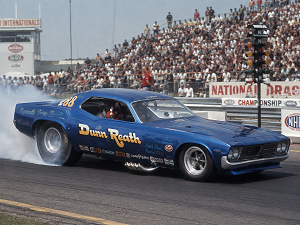
The rear-engine Barracuda debuted at Lions in early 1972 and immediately stood on the rear tires without completing the run. Excellent start.
Dunn and Gilmore added weight to the front before the Winternationals. Jim qualified 16th, upset Mike Burkhart in the first round and earned the event’s Best Engineered Car award.
The machine was safer in one important respect, but its short, unusual layout could become nervous without bothering to notify the driver first. Dunn learned to anticipate the car rather than wait for it to move.
He later joked that people asked why he had not crashed it. Fear was part of the answer. There are worse survival systems.
Then the Rear-Engine Car Started Winning
Dunn reached the final of the 1972 March Meet before a broken clutch component after the burnout handed Ed McCulloch a solo. He later won a Division 7 event at Bonneville Raceway.
Then came the NHRA Supernationals at Ontario Motor Speedway. Dunn’s rear-engine Barracuda was not the quickest Funny Car there, but it was still there in the final. Pat Foster red-lighted and Jim Dunn won.
The 1972 Supernationals remains the first and only NHRA national-event victory by a rear-engine Funny Car.
Hundreds of conventional Funny Cars have won since. The rear-engine winners list still says Jim Dunn and then runs out of names.
Success Did Not Mean the Idea Was Good Enough
Winning did not make the handling problem disappear. Dunn raced another improved rear-engine car during 1973 and continued to run well, with a best elapsed time around 6.44 seconds. The configuration also attracted match-race bookings because people wanted to see the strange thing.
But it remained unpredictable. With the driver sitting so far forward, changes in direction happened quickly and without much warning. Dunn returned to a conventional front-engine Funny Car in 1974.
The experiment lasted only two seasons. It had also done something no later attempt managed.
Win.
Then Hollywood Followed Him Around for a Summer
The rear-engine car gained another kind of immortality through the 1974 documentary Funny Car Summer. The film followed Dunn, his family and race team through racing, travel, mechanical work and family life without much attempt to make professional drag racing look tidy.
That suited Jim Dunn. He was a firefighter spending his days off running a nitro car, not polished material waiting for a public-relations department.
The movie became a cult favorite because it captured what racing looked like before hospitality suites and corporate talking points arrived to explain everything.
The Fireman’s Quickie
Dunn kept racing Funny Cars through the 1970s. In 1979 he gave one of them a name only a firehouse could have produced: Fireman’s Quickie.
It was a joke, and it sold a lot of shirts.
Dunn understood that Funny Car racing involved three jobs: make the car fast, make the car survive and give the spectators something they remembered on the way home. He was good at all three.
1981 Was Big Jim’s Last Great Year in the Seat
Early in 1981, Roland Leong needed somebody to assemble and test his Hawaiian Funny Car while Mike Dunn — Jim’s son — was racing in Australia. Big Jim climbed in.
At Orange County International Raceway, the car produced a controversial 5.85-second run, seven hundredths quicker than the accepted best. The number was thrown out and never entered the official record book, which at least gave everybody something to argue about.
Later that season Dunn reached the U.S. Nationals final against Raymond Beadle, who won. At the season-ending World Finals at Orange County, Dunn took the Funny Car title.
It was his second NHRA Funny Car national-event victory and his final win as a driver, nine years after the first. One came with the only rear-engine Funny Car ever to win. The other proved Big Jim could manage the ordinary kind too.
Retiring From Driving Did Not Mean Retiring
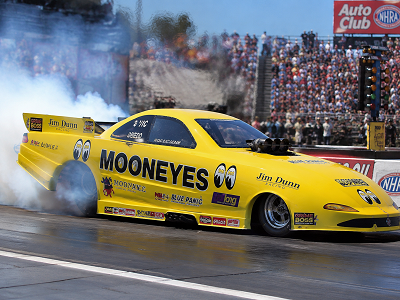
Dunn finally stepped out of the driver’s seat in 1991 and moved several feet to the crew-chief position. Jim Dunn Racing continued.
He spent the following decades putting drivers into competitive Funny Cars while operating with budgets considerably smaller than those of the sport’s powerhouse teams. Dunn developed a reputation for teaching drivers, making simple combinations work and refusing to spend money merely because somebody else had already spent it.
That did not create a giant multi-car organization. It created something in some ways harder: a small nitro team that refused to disappear.
Kenji Okazaki Made History With Him
Japanese racer Kenji Okazaki became one of Dunn’s most successful drivers. The pair reached the U.S. Nationals final in 1993, where John Force got the trophy.
In 1997, Okazaki won the Big Bud Shootout and later won at Englishtown, becoming the first Japanese driver to win an NHRA professional national event.
Big Jim had spent decades taking unconventional machinery and making it work. By then he was doing much the same thing with drivers.
Eventually Jim Won Indy Too
Dunn had been runner-up at Indianapolis as a driver in 1981 and again as an owner with Okazaki in 1993. The U.S. Nationals finally came his way in 1999 when Frank Pedregon drove Jim Dunn Racing’s Funny Car to victory.
Nearly three decades after Dunn entered Funny Car, Big Jim finally got the trophy from the biggest drag race in the country. He did it from the starting line instead of the driver’s seat.
That counted just fine.
The Little Team Could Still Bite
By the 2000s, professional Funny Car had become extremely expensive. Jim Dunn Racing remained comparatively small.
In 2008, Tony Bartone proved the operation could still win. At Seattle he worked through Gary Scelzi, Tony Pedregon and Mike Neff before beating Ron Capps in the final.
Big Jim had been racing for more than half a century. The little team could still ruin somebody else’s Sunday.
He Just Kept Showing Up
Drivers changed. Sponsors changed. Bodies changed. Funny Cars went from six-second machines to three-second machines.
Jim Dunn remained.
NHRA presented him with its Lifetime Achievement Award in 2024. That might have been a convenient point to retire, but convenience had never been much of a career plan. Jim and son Jon Dunn remained listed as crew chiefs for Jim Dunn Racing during the 2026 NHRA season.
The sport had changed almost beyond recognition since Dunn’s teenage races. Big Jim was still telling a nitro Funny Car what to do.
The Bottom Line
Jim Dunn won the 1969 March Meet in Top Fuel before moving to Funny Car because the match-race money looked better. Then the firefighter decided the engine belonged behind him.
His rear-engine Barracuda won the 1972 Supernationals and remains the only Funny Car of its layout ever to win an NHRA national event. Dunn later won the 1981 World Finals, taught generations of drivers, won Indy as a car owner and kept an independent Funny Car team alive while the cost of competing climbed into another universe.
That is the thread through the whole career. Big Jim never seemed especially interested in doing something the expensive way merely because everybody else had decided it was normal.
Jim Dunn never needed the rest of Funny Car racing to agree with his way of doing things. He only needed the car to qualify.
↑ Back to the Top, Before Big Jim Decides the Engine Is in the Wrong Place Again