Arnie “The Farmer” Beswick
GM Quit Racing. Arnie Kept Racing Pontiacs Anyway.
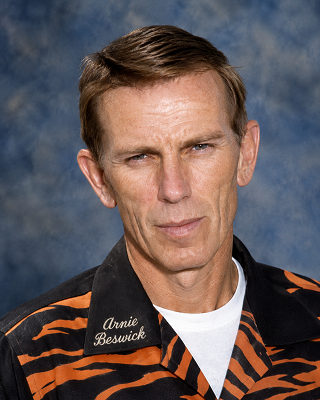
Detroit’s factory drag wars produced plenty of famous hired guns. Arnie Beswick was different.
He really was a farmer.
He also spent much of the 1960s hauling Pontiacs around the country and beating factory-backed Ford and Chrysler teams after General Motors had officially decided racing was somebody else’s problem.
His cars carried names such as Passionate Poncho, Grocery Getter, Mystery Tornado, Tameless Tiger, Super Judge and Boss Bird. He raced Super Stock, Factory Experimental and early Funny Cars, using stock wheelbases, altered wheelbases, superchargers, nitromethane and whatever else could keep aging Pontiac hardware competitive against Detroit’s newest machinery.
When Pontiac stopped supplying the ammunition, Arnie did not change armies. He just kept shooting.
For years, if a promoter wanted a serious Pontiac in the other lane from the factory Fords and Mopars, the phone call usually went to Morrison, Illinois.
The Farmer Part Wasn’t Marketing
Beswick grew up on his family’s farm near Morrison, Illinois, and developed an early fascination with machinery. Farm equipment was useful. Cars were more interesting.
He began racing in 1951 with a 1950 Oldsmobile Rocket 88 at an abandoned airstrip in Illinois. By the middle of the decade he was winning with Oldsmobiles, including class success at major early drag-racing events.
Then he tried Dodge Hemi power in 1956 and 1957. The Dodges were fast when the transmission linkage cooperated, and that qualifier eventually became annoying.
In 1957, Beswick helped a friend with a Pontiac and liked what he saw. For 1958, he bought one of his own.
The relationship lasted considerably longer than Pontiac’s factory racing program did.
Pontiac Became the Uniform
Beswick’s 1958 Chieftain proved quick and reliable enough that he ordered another Pontiac for 1959. Then the factory hardware became serious.
His 1960 Ventura came with a four-speed and a collection of high-performance pieces that pushed it well beyond the ordinary dealership combination. Beswick drove it from Illinois to Daytona Beach for the 1960 winter drag-racing program, won Stock Eliminator honors and drove it home.
Modern race teams use transporters with kitchens, lounges and enough spare parts to build another automobile. Arnie’s transporter was sometimes the race car.
By 1961 and 1962, his Passionate Poncho Super Duty Pontiacs had made him one of the best-known Super Stock racers in the country.
He was still farming between trips.
1963 Gave Him Three Different Ways to Cause Trouble
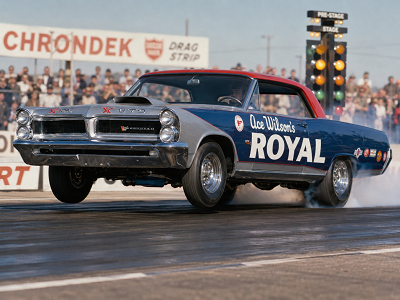
For 1963, Beswick obtained some of the most specialized machinery Pontiac ever allowed out the door: a lightweight 421 Super Duty Catalina from the famous “Swiss Cheese” program, a Super Duty Tempest station wagon that became the Grocery Getter, and a 421-powered Tempest/LeMans coupe originally sent through Mickey Thompson’s program.
The station wagon deserves a moment. Detroit had built a lightweight compact wagon with a Super Duty 421 so somebody could drag race it.
The early 1960s were occasionally magnificent.
At the Drag News Invitational, Beswick won A/FX with the Grocery Getter and B/FX with the Catalina.
Then GM changed everything.
GM Quit
In January 1963, General Motors reinforced its ban on direct factory racing involvement. Ford did not stop. Chrysler did not stop.
Arnie Beswick definitely did not stop.
He suddenly had the cars, knowledge and reputation without the steady stream of factory racing development that had helped create them. Many GM racers changed brands. Beswick kept racing Pontiacs.
Track promoters loved it because their match races were filling with Thunderbolts, Hemis and altered-wheelbase Mopars, and somebody needed to represent the GM crowd.
The Farmer became that somebody.
Daytona 1964 Was Arnie Against the Factories
Beswick arrived at the weeklong Daytona drag program in 1964 with his Super Duty Pontiacs facing Ford’s new 427 Thunderbolts and Chrysler’s increasingly serious factory machines.
His cars kept winning, so Ford protested. NASCAR officials tore Beswick’s engine down, found it legal and handed the pieces back.
Arnie put it together and continued racing.
By the end of the week, Beswick had taken the A/FX honors and collected enough cash and merchandise that one of the prizes was a new Ford convertible.
A Pontiac racer beating the factory Fords badly enough to take home one of their street cars is the sort of detail history occasionally gets exactly right.
A few months later, Beswick also captured the Drag News No. 1 Mr. Stock Eliminator title. But stock was already becoming an outdated description of what came next.
The Mystery Tornado Started Blurring the Rules
Beswick’s 1964 GTO became the Mystery Tornado. The car received a 421 Super Duty engine, then a supercharger and increasingly serious fuel as the Factory Experimental wars escalated.
On April 17, 1965, at York U.S. 30, the blown GTO ran roughly 9.96 seconds at 140 mph, widely credited as the first nine-second pass by a stock-bodied late-model door car.
Beswick was also trying to make GM’s new Turbo 400 automatic survive behind a blown Pontiac. Some transmissions lasted. Some were replaced after one run because everybody already knew what the second run was going to do to them.
This was research conducted with a stopwatch and a floor jack.
He Tried Working for Mercury
Early in 1965, Mercury offered Beswick a place in its factory Comet program. For a Pontiac independent facing factory Mopars, the offer made financial sense, so Arnie briefly changed brands.
The arrangement did not last. Beswick had built his career around operating independently, and before long he returned to the Pontiacs that had made his name.
The Farmer went back to work.
The Tameless Tiger Moved the Wheels
The altered-wheelbase Mopars had demonstrated that moving the axles forward improved weight transfer and traction. Beswick’s Pontiac needed the same help.
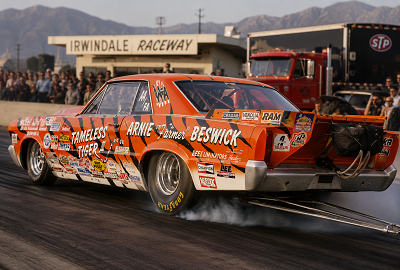
His 1963 Tempest/LeMans coupe was rebuilt with both axles moved forward nearly a foot. A supercharged, fuel-injected 421 went in front, orange-and-black tiger stripes went on the body, and the resulting machine became the Tameless Tiger.
It also developed a habit of running on the rear tires.
The combination became one of the most recognizable cars in the transition from Factory Experimental racing into Funny Car.
Ford and Chrysler had factory teams. Pontiac had a farmer with a blower.
Promoters kept calling the farmer.
Four or Five Tracks in One Week
Match racing became Beswick’s business. During the busiest years, he could appear at four or even five tracks in a week.
General Motors had largely abandoned direct factory racing while fans had not abandoned General Motors. A Ford-versus-Mopar show was good. Putting Beswick’s Pontiac in the other lane gave the GM crowd somebody to cheer for.
Arnie also understood the show. The Tameless Tiger carried the front wheels, made noise, looked outrageous and remained recognizably Pontiac.
Then the Funny Cars Became Real Funny Cars
Beswick kept evolving with the category. In 1966 he built a fiberglass-bodied GTO known as Star of the Circuit, using much of the earlier GTO frame with a tube-style front structure and straight axle.
By 1968 he had a one-piece flip-top GTO. For 1969 came the professionally built Logghe-chassis Super Judge, followed in 1971 by the smaller Firebird/Trans Am shape for Boss Bird.
The cars were becoming lighter, lower and farther removed from the showroom machinery that had started the factory wars only a few years earlier. Beswick followed the entire transformation while still trying to make old Pontiac racing hardware survive a schedule that could reach 75 to 100 dates a year.
A cracked crank did not care about brand loyalty.
The Shop Fire Ended the First Career
In April 1972, disaster arrived somewhere considerably less glamorous than a racetrack. Beswick’s newly built race shop on the farm caught fire.
It destroyed his race cars, engines, spare parts, tools, two race-car haulers and much of the equipment he needed to operate the farm. The racing equipment was largely uninsured.
There was no clever way around that. Arnie had to replace the equipment that earned his living before replacing the equipment that consumed it.
The Farmer went back to farming, and for years the Tameless Tiger was quiet.
Fourteen Years Later, the Tiger Came Back
Fans kept asking, and in 1986 Beswick returned to the track in a carbureted 455-powered 1963 Tempest.
Nostalgia drag racing was beginning to grow. People who had watched the factory wars wanted to see those cars again, and Arnie discovered they wanted to see him too.
He built a new version of the Tameless Tiger, using modern tires and equipment while recreating the look and attitude of his famous altered-wheelbase Pontiac.
Once again, promoters started calling.
Then Fire Found Him Again
On August 3, 2003, Beswick completed a run in his 1964-style Tameless Tiger GTO at Mid-America Raceway in Wentzville, Missouri. The car caught fire after the run.
Beswick suffered severe third-degree burns to his hands along with burns to his feet and face.
He was 73.
After skin grafts and weeks of recovery, Arnie was already talking about rebuilding the car. His own summary was about right: the Tiger had tried to tame him. He was still tameless.
The car was rebuilt.
So was Arnie.
The Hall of Fame Finally Got the Farmer
By then Beswick’s place in drag-racing history was not difficult to defend. He had raced through the early Stock classes, Super Stock, Factory Experimental and the birth of Funny Car, then returned decades later as one of nostalgia racing’s most recognizable figures.
In 1995 he became one of the early inductees into the Super Stock/Drag Illustrated Hall of Fame. In 2006, Arnie Beswick entered the International Drag Racing Hall of Fame.
The honors covered more than victories. They covered a career that survived the disappearance of Pontiac factory support, a shrinking supply of race parts, a shop fire and eventually a race-car fire that nearly ended the Farmer himself.
The Bottom Line
Arnie Beswick started drag racing in 1951 and became one of Pontiac’s defining racers before the muscle-car era had even arrived.
He won with Super Duty Pontiacs, hauled a Swiss Cheese Catalina and the Grocery Getter into the factory wars, beat Thunderbolts and Hemis at Daytona and carried Pontiac into Factory Experimental racing after GM quit supplying a proper factory team.
Then came the Mystery Tornado, Tameless Tiger, Star of the Circuit, Super Judge and Boss Bird. The machinery kept changing.
The badge usually did not.
Detroit called off Pontiac’s factory racing program in 1963. Arnie Beswick spent the next several years behaving as though nobody had remembered to tell the farmer.
↑ Back to the Top, Before Arnie Finds Another Pontiac to Supercharge