Hubert “The Georgia Shaker” Platt
Ford Gave Him Race Cars. Hubert Made Sure Everybody Saw Them.
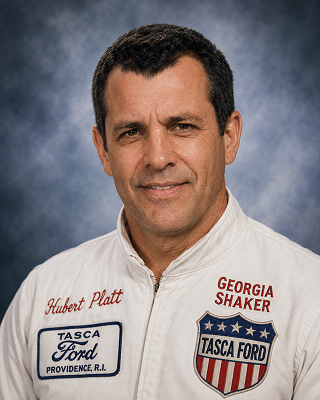
Hubert Platt could race a car, tune a car and sell a car without ever changing jobs. That made him extremely useful to Ford.
The Georgia Shaker raced lightweight Galaxies, Thunderbolts, Falcons, 427 Fairlanes, Cobra Jet Mustangs, SOHC match racers, Mavericks and Pintos. He moved through Super Stock, Factory Experimental, early Funny Car and Pro Stock while Ford’s drag program repeatedly changed direction underneath him.
Platt understood something Detroit needed badly during the muscle-car wars: a factory race car was not merely supposed to win. It was supposed to make the fellow in the grandstand want the street version parked in his driveway.
Ford eventually made him captain of its East Coast Drag Team. There were faster ways to conduct a sales seminar, but very few involved 427 cubic inches and a wheelstand.
The Shaker Started Before the Drag Strip
Hubert Carlyle Platt was born December 8, 1931, in Conway, South Carolina, and grew up around Myrtle Beach. His first car was a battered 1939 Ford coupe bought when he was 15, and he learned mechanical work because the car provided plenty of practice.
He later drove a 1950 Ford business coupe hauling moonshine between Georgia and South Carolina. After Army service, Platt moved to Atlanta in 1958. The moonshine work ended, but the interest in going fast did not.
Hubert and his brother Huston began racing around the Southeast. Hubert ran Chevrolet gassers, including a 1938 coupe, before moving into the growing Super Stock wars.
By then he had found a safer way to get paid for driving hard.
Chevrolet Gave Him the First Georgia Shaker
Platt moved from a 1961 Impala into a 409-powered 1962 Biscayne, then joined forces with “Dyno Don” Nicholson and Atlanta’s Nalley Chevrolet operation.
For 1963, the team received lightweight Z11 Impalas with Chevrolet’s 427 W-series engine. Platt’s car carried the name that would follow him for the rest of his career: Georgia Shaker.
The arrangement did not last long. General Motors reinforced its withdrawal from direct factory racing during 1963, leaving racers such as Platt with expensive equipment, useful skills and considerably less factory support.
Ford was heading the other direction.
White Lightning Turned Him Blue Oval
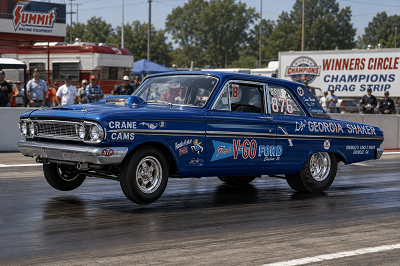
Platt finished the 1963 season driving a lightweight 427 Ford Galaxie called White Lightning. The change of brand proved considerably more permanent than Chevrolet fans might have hoped.
For 1964 came the Fairlane Thunderbolt, one of Ford’s most effective answers to the factory Super Stock wars. Dearborn Steel Tubing squeezed the 427 high-riser into a Fairlane while removing enough ordinary passenger-car equipment to make the finished product only loosely interested in carrying groceries.
Platt became one of the Thunderbolt’s prominent racers and developed a reputation for hard launches, wheelstands and giving promoters something worth putting on the poster.
The car fit him nicely. So did Ford.
The Smallest Georgia Shaker Was Homebuilt
By 1965, Chrysler’s altered-wheelbase Hemis were changing Factory Experimental racing. Platt wanted a lighter Ford that could fight back, but Ford and Holman-Moody were not interested in building the Falcon he had in mind.
So Hubert built it himself.
Working in his home garage, Platt started with a six-cylinder Falcon and incorporated pieces from his Thunderbolt program. The result became the 427-powered Smallest Georgia Shaker.
The compact Falcon combined enormous Ford power with Platt’s willingness to leave the starting line with the front tires serving mainly as decoration. Southern match-race crowds loved it, and the car became one of his signature machines.
Factory backing was useful. Hubert was not helpless without it.
The Mustang Started Looking Funny
Factory Experimental cars were evolving so quickly that yesterday’s clever solution could be obsolete by next weekend.
By 1966, Platt had moved into one of Ford’s long-nose Mustang match racers. Holman-Moody built the stretched machine around Ford’s 427 SOHC “Cammer,” and Paul Harvey Ford backed the program.
The nitro-burning Mustang ran into the 8.40s at more than 170 mph. At the 1966 NHRA World Finals, Platt reached the Experimental Stock/X/S final before red-lighting against Gene Snow.
He came back at the 1967 Winternationals and won A/XS with the same basic machine, one of the victories Platt later remembered most fondly. He also called the long-nose Mustang the best race car he ever drove.
By then the factory door-car wars had become nitro racing whether Detroit’s accountants liked the description or not.
Ford Decided Stock Wasn’t So Bad After All
The first generation of Funny Cars was spectacular, expensive and increasingly disconnected from anything sitting in a dealership. Ford eventually shifted more attention back toward cars customers could recognize.
Platt adapted again.
He helped Ford develop and test the R-code 427 Fairlanes in 1966 and raced one seriously in 1967. The Fairlane used conventional production proportions, carburetors, gasoline and a Top-Loader four-speed.
After the stretched Mustang, it probably seemed almost civilized.
Platt set an NHRA SS/C record with the Fairlane and remained one of Ford’s most visible eastern racers.
Then the 428 Cobra Jet arrived.
The Cobra Jet Arrived at Pomona
Ford attacked the 1968 Winternationals with a fleet of specially prepared Mustang fastbacks carrying the new 428 Cobra Jet.
The driver list looked like Ford had collected everybody who had been troublesome during the previous five years: Gas Ronda, Dyno Don Nicholson, Al Joniec, Hubert Platt and several more.
Platt reached the SS/E class final against Joniec. Joniec won the class and then Super Stock Eliminator, giving the Cobra Jet exactly the public debut Ford wanted.
Platt’s runner-up helped prove that the result was not one unusually happy Mustang. The new combination was genuinely competitive.
Ford dealers now had something useful to discuss with customers.
Ford Made Him Captain
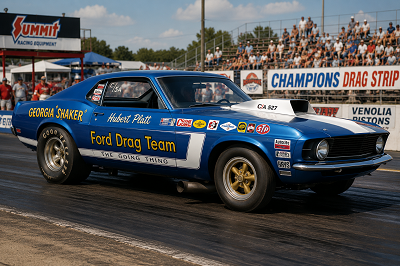
Ford began developing a formal factory drag-team program in late 1968. By 1969, Platt was captain of the East Coast Ford Drag Team with Georgia racer Randy Payne as his teammate, while Ed Terry headed the western operation.
The eastern team used 428 Cobra Jet Super Stock cars for sanctioned racing and a 427 SOHC Mustang for match-race duty. During the week, Platt and Payne appeared at dealerships conducting clinics, answering questions and explaining Ford performance equipment. On weekends, they demonstrated the machinery at drag strips.
The operation was marketing with timing lights.
Platt was unusually good at the assignment because he could explain how the car worked and then make everybody watch it work.
Randy Payne Got the Other Lane
Payne became a genuine racing partner rather than simply another driver on the payroll. The pair could take Ford’s traveling program into a dealership during the week and a match race during the weekend, shifting between Cobra Jet stockers and the faster SOHC machinery depending on the booking.
Platt later said the Ford Drag Team contract made him more money than anything else he had done in racing. Detroit had learned that racing victories were useful advertising, but putting the racers directly in front of customers could be even better.
Hubert could do both without changing his personality much.
Pro Stock Gave Him Another Class to Learn
NHRA created Pro Stock in 1970, turning the best production-bodied match racers into a professional eliminator.
Platt entered the inaugural Winternationals with a Ford but did not make the brutally competitive 16-car field. He stayed with the class as it developed, campaigning Mustangs, Mavericks and later Pintos into the 1970s.
The technology had changed again. Pro Stock demanded carefully developed engines, clutch combinations, chassis setup and repeatable reaction times rather than theatrical wheelstands.
Platt adjusted because that was what he had been doing since the Z11 Chevrolet disappeared underneath him in 1963.
He Knew Who Bought the Tickets
Platt’s competitive record explains only part of his reputation. He was one of the early racers who understood that spectators were the reason promoters could afford to book race cars.
He shook hands, told stories, signed autographs and made sure people remembered the Georgia Shaker after they left the track.
At Lions Drag Strip, after wheelstands damaged both of his cars, Platt reportedly got on the public-address system and complained that he did not have a third one available to break for the crowd.
If the equipment had already ruined the evening, it could at least provide a punch line.
1977 Was Enough
Platt retired from active racing in 1977 after a career that had stretched from Southern gassers and Z11 Chevrolets through some of Ford’s most important factory drag programs.
He later worked as a welding foreman and owned the Sugar Hill Drive-In, while nostalgia racing eventually brought him back around the sport as one of the recognizable survivors of the factory wars.
Platt entered the NHRA Division II Hall of Fame in 1986, the Super Stock & Drag Illustrated Hall of Fame in 1995, the inaugural East Coast Drag Times Hall of Fame class in 2002 and the Georgia Racing Hall of Fame in 2006.
Hubert Platt died from cancer on September 26, 2015, at age 83. By then the Georgia Shaker name had been attached to more than half a century of drag-racing history.
The Bottom Line
Hubert Platt began with gassers and Z11 Chevrolets, then switched to Ford when GM abandoned factory racing. He drove Galaxies and Thunderbolts, built the Smallest Georgia Shaker Falcon in his own garage, raced a nitro-burning SOHC Mustang while Funny Car was taking shape and helped introduce the 428 Cobra Jet.
Ford eventually handed him an even bigger assignment: take the cars around the country and show customers why they should buy one.
Platt was racer, tester, salesman and entertainer in an era when Detroit needed all four jobs performed by the same fellow.
Ford supplied the machinery. The Georgia Shaker supplied the noise.
Platt spent enough time in the middle of Detroit’s factory horsepower wars to turn up more than once when the racing got especially interesting.
➤ See the Cobra Jet Ambush at the 1968 Winternationals in Racing Shenanigans
↑ Back to the Top, Before Hubert Finds Another Ford to Put on the Rear Tires