Bud Moore
He Called Himself a Country Mechanic. NASCAR Called Him a Champion.

Bud Moore described himself as a country mechanic.
Technically, that was true in roughly the same way a battleship is a fishing boat because both of them float.
Moore became a championship crew chief, then a championship car owner. His NASCAR teams won 63 premier-series races, two championships and 43 poles while putting some of the best drivers in stock-car history behind the wheel.
Ford also sent him road racing, where Bud Moore Engineering helped deliver the 1970 Trans-Am manufacturers’ championship with the Boss 302 Mustang.
The title never needed much improvement. If something with a Ford engine had to go fast for several hundred miles without scattering expensive pieces across the racetrack, the country mechanic was usually qualified.
Before the Race Shop Came Normandy
Walter Maynard Moore Jr. was born May 25, 1925, in Spartanburg, South Carolina. Before racing had much opportunity to occupy him, World War II did.
Moore was drafted into the United States Army in 1943 and served with D Company, 1st Battalion, 359th Infantry Regiment, 90th Infantry Division. For the D-Day invasion, his unit was attached to the 4th Infantry Division, and on June 6, 1944, Moore landed at Utah Beach.
He was nineteen years old.
Moore fought across Europe and was wounded repeatedly. By the end of the war he had earned five Purple Hearts and two Bronze Stars. Decades later, when offered a trip back to Normandy for the fiftieth anniversary of D-Day, Moore declined. He had left too many friends there.
Race cars eventually became the public story. They were never the hardest thing Bud Moore had done.
Back Home, He Went Racing
Moore returned to Spartanburg after the war and went into the automobile business. Stock-car racing was growing quickly across the Carolinas, and Spartanburg was becoming one of its important centers. Cotton Owens, David Pearson and plenty of other racers operated close enough that finding somebody willing to make a perfectly serviceable automobile less sensible was rarely difficult.
Moore was not interested in becoming the famous driver. He was interested in why the car broke, why it slowed down and what had to be changed before somebody climbed back into it.
That made him useful.
He built and prepared cars, developed a reputation for reliability and eventually became crew chief for Buck Baker. In 1957, Baker won the NASCAR Grand National championship.
The fellow making sure the car lived long enough to collect the points was Bud Moore.
Then Bud Put His Own Name on the Door
Moore formed his own NASCAR operation in 1961 and put Joe Weatherly in much of the equipment. Weatherly was fast, experienced and carried enough personality for several race teams, which left Bud free to concern himself with the machinery.
Weatherly won nine races in 1961, most of them in Moore’s No. 8 Pontiac, and finished fourth in the championship despite running only part of the schedule.
For 1962 they went after the whole thing. Weatherly won nine races, posted 45 top-ten finishes in 52 starts and beat Richard Petty by more than 2,000 points for the championship.
Bud Moore Engineering had been operating in NASCAR’s top division for about two years.
Apparently the learning period was over.
1963 Was a Stranger Championship
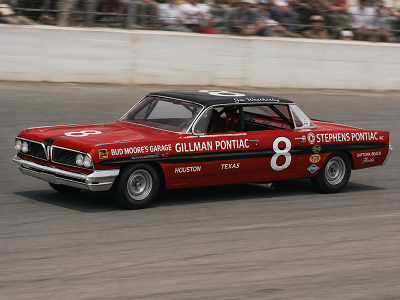
The 1963 season did not follow anybody’s preferred championship recipe. Moore reduced his schedule, which meant Weatherly sometimes borrowed rides from other owners just to keep collecting points.
Some of those cars were competitive. Some were apparently issued primarily so the driver would have somewhere to sit.
Weatherly made them work. He won three times and defended the championship against Richard Petty, who won 14 races.
Moore’s operation had now been central to consecutive championship seasons. Then, in January 1964, Weatherly was killed in a crash at Riverside.
The team had lost its champion.
Bud kept racing.
Billy Wade Won Four in a Row
Moore put Billy Wade in his cars for 1964. Wade had been NASCAR’s Rookie of the Year the previous season but had never won a premier-series race.
Then July arrived.
Wade won at Old Bridge, Bridgehampton, Islip and Watkins Glen — four consecutive races in ten days.
They were the first four NASCAR victories of his career.
They were also the last four.
There are easier ways to fit an entire winning career onto one page of a calendar.
Ford Kept Giving Bud Difficult Assignments
Moore became one of Ford’s trusted racing operators during the company’s Total Performance years, which meant the shop did not remain politely inside NASCAR.
In 1967, Bud Moore Engineering entered the SCCA Trans-Am series with Mercury Cougars against Mustangs, Camaros and the rest of Detroit’s increasingly expensive argument over whose showroom cars were supposedly responsible for what happened on a racetrack.
The Cougar effort came painfully close to the championship, and Moore remained involved as Ford developed its small-block road-racing program.
Then Dearborn handed him the Boss 302.
The Boss 302 Wasn’t Just a Street-Car Sticker Package
For 1970, Bud Moore Engineering fielded Boss 302 Mustangs for Parnelli Jones and George Follmer. They were not there to improve brochure photography.
Jones won five races. Follmer added another. Those six victories delivered Ford the 1970 Trans-Am manufacturers’ championship.
Moore’s shop had now won major championships in stock-car racing and road racing with machinery that required very different answers to the same basic question: how do you make the car faster without making it quit?
The country mechanic had quietly become one of Ford’s racing engineering departments.
Buddy Baker Brought the No. 15 Back
By the mid-1970s, Moore’s familiar No. 15 Ford was back near the front with Buddy Baker. Baker was exceptionally good on superspeedways, which paired nicely with a car owner who had spent years learning how to keep machinery alive while traveling very quickly.
Across 1975 and 1976, Baker won three consecutive Talladega races in Moore’s Ford. The first ended a Cup win drought for Bud Moore Engineering that stretched back to 1966.
If a race shop needs to announce that it has become competitive again, Talladega is a reasonably visible place to do it.
Then Bobby Allison Needed a Race Team
By 1978, Bobby Allison had gone two full seasons without winning a NASCAR race.
Bud Moore called.
The problem disappeared quickly. Allison drove Moore’s No. 15 Ford to five victories in 1978, finished second in the championship and finally won the Daytona 500 after 34 previous races at the speedway without a victory.
Allison supplied the stubborn driver. Moore supplied a Ford capable of still being underneath him when Daytona reached the part that mattered.
Driver and car owner eventually entered the NASCAR Hall of Fame together in the Class of 2011.
Dale Earnhardt Drove a Ford for Bud Moore
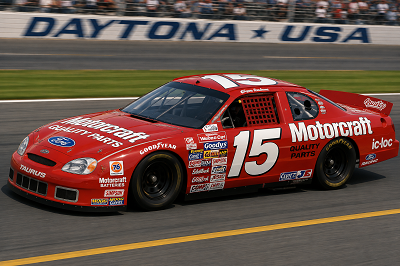
There are photographs capable of confusing younger NASCAR fans. One of the better examples shows Dale Earnhardt in a blue-and-yellow Wrangler Ford.
That was Bud Moore’s car.
Earnhardt drove the No. 15 for Moore through 1982 and 1983 after the Rod Osterlund operation changed ownership and Earnhardt’s first brief return to Richard Childress did not yet provide the equipment he needed.
He won at Darlington in 1982. In 1983, he won at Nashville and took his first career Talladega victory with a last-lap pass of Darrell Waltrip.
Those were the only seasons of Earnhardt’s Cup career spent primarily in a Ford.
Then he returned to Richard Childress.
That arrangement eventually worked reasonably well.
Ricky Rudd Was Tough Enough for Bud
Ricky Rudd replaced Earnhardt in the No. 15 for 1984. Before the Daytona 500, Rudd suffered a violent crash in the Busch Clash that left his face badly swollen.
He raced anyway, with his eyes taped open.
That probably explains most of what anybody needs to know about why Ricky Rudd and Bud Moore fit together.
Rudd won five races for Moore and became another in a long line of drivers who seemed particularly comfortable in an operation where toughness was treated less as advertising copy than as basic shop equipment.
Sixty-Three Wins Took a Lot of Drivers
The list of people who drove Bud Moore equipment reads like somebody emptied a Hall of Fame into the garage: Joe Weatherly, Buck Baker, Fireball Roberts, David Pearson, Buddy Baker, Bobby Isaac, Benny Parsons, Bobby Allison, Dale Earnhardt, Ricky Rudd and Geoffrey Bodine among them.
Twelve NASCAR Hall of Fame drivers eventually spent time in Moore-owned machinery.
The shop’s final premier-series victory came at Sonoma in 1993. Moore remained involved in NASCAR through 2000, ending an ownership career that stretched across four decades.
NASCAR credits his organization with 959 starts, 63 victories, 43 poles and 298 top-five finishes.
The cars changed. The engines changed. Aerodynamics changed enough that Bud’s early stock cars and later ones could almost have belonged to different sports.
The job description stayed remarkably simple.
Bring the car back near the front.
The Hall of Fame Got the Country Mechanic
Bud Moore was elected to the NASCAR Hall of Fame as part of its Class of 2011. He entered with David Pearson, Bobby Allison, Lee Petty and Ned Jarrett.
That is a fairly crowded room for a fellow who insisted he was just a country mechanic.
The Hall recognized the championships, 63 owner victories and decades of engineering work. Moore died November 27, 2017, at age 92.
The Bottom Line
Bud Moore was crew chief for Buck Baker’s 1957 championship before putting his own name on the shop. His team helped Joe Weatherly win consecutive championships, survived the loss of its champion and kept winning with generations of drivers.
When Ford wanted a Trans-Am championship, Bud built Boss 302 Mustangs and delivered one. Bobby Allison finally won Daytona for him. Dale Earnhardt won in his Ford. Ricky Rudd raced for him with his eyes taped open.
None of that seems especially surprising once the common piece is identified.
The driver changed. The series changed. Sometimes even the kind of racing changed.
Bud Moore kept building machinery that worked.
“Country mechanic” was accurate.
It just left out most of the qualifications.
↑ Back to the Top, Before Bud Decides Something Needs Reinforcing