Dale Earnhardt
The Intimidator Didn’t Need to Hit You. Seeing the Black No. 3 Was Often Enough.
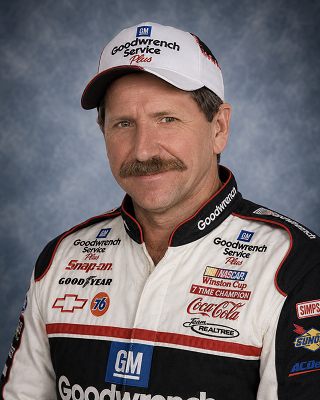
Dale Earnhardt had a bumper and knew how to use it. That is the part everybody remembers, mostly because bent sheet metal photographs better than racecraft.
Anybody can run into another race car. Earnhardt became The Intimidator because the fellow ahead knew he might. Put the black No. 3 in somebody’s mirror with ten laps left and suddenly there were extra chores: protect the bottom, watch the draft, don’t leave half a lane and try not to wonder exactly how much room Earnhardt believed he had been promised.
The reputation worked because the driving underneath it was real. Earnhardt won 76 NASCAR Cup races and seven championships. He could win on short tracks, intermediates and road courses, and at Daytona and Talladega he seemed to understand the air around a stock car better than plenty of people paid to explain it afterward.
Dale Earnhardt turned pressure into racecraft. The bumper was only one of the tools.
Racing Was the Family Trade
Earnhardt was born in Kannapolis, North Carolina, in 1951. His father, Ralph Earnhardt, was already a successful stock-car racer, so Dale did not grow up wondering what race cars were for. He grew up wanting one.
Years of local racing eventually led to a full NASCAR Cup season with Rod Osterlund in 1979. Earnhardt won at Bristol, finished seventh in the championship despite missing races after a serious Pocono crash and was named Rookie of the Year.
The following season was considerably less subtle.
Champion in Year Two
Earnhardt won five races in 1980 and held off Cale Yarborough for the Cup championship. Rookie of the Year one season, champion the next. That looked suspiciously like the beginning of a tidy career progression.
NASCAR corrected that immediately.
Osterlund sold the team during 1981. Earnhardt left the new ownership and finished the season with Richard Childress Racing, but Childress knew his operation was not yet strong enough to give a defending champion what he needed. Earnhardt spent 1982 and 1983 driving Fords for Bud Moore.
Then Richard Childress called him back. That reunion changed both careers.
The No. 3 Became His
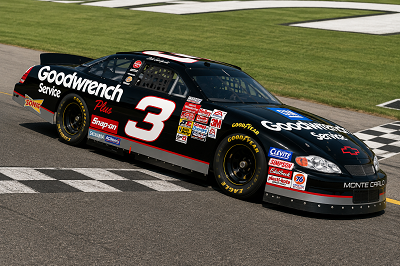
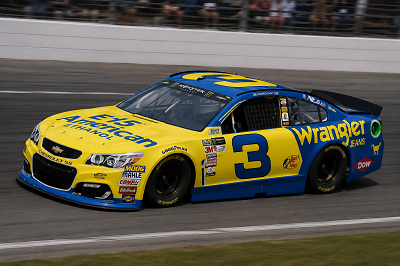
Earnhardt returned to Richard Childress Racing in 1984 and stayed there for the rest of his Cup career. The number was 3. At first the Wrangler Chevrolet was blue and yellow. Then GM Goodwrench arrived and the car became black.
That was convenient. The paint finally matched the reputation.
Earnhardt and Childress won the championship in 1986. Earnhardt won 11 races and another title in 1987, then added championships in 1990, 1991, 1993 and 1994.
Seven altogether. Richard Petty finally had company.
Six of those championships and 67 of Earnhardt’s 76 Cup victories came in Childress’ No. 3. Plenty of racers had used the number before him. After a while, everybody else was merely borrowing it.
The Intimidator Wasn’t Just a Nickname
Earnhardt raced close enough to make another driver’s mirrors useful. The trick was not simply knocking somebody out of the way. Do that often enough and the entire garage eventually starts returning favors, usually with interest.
Earnhardt’s better weapon was making the possibility part of the other driver’s calculation. A fellow protecting against the No. 3 might enter the corner differently, leave the preferred line, use more tire than necessary or glance in the mirror once too often.
Earnhardt did not always have to create the mistake. Sometimes the fellow ahead created it for him.
And if that failed, the bumper had not gone anywhere.
The Pass in the Grass Wasn’t a Pass
The 1987 Winston All-Star Race at Charlotte supplied one of the photographs that helped build the legend. Bill Elliott had dominated much of the race and had the faster car late. Earnhardt had the lead, which he considered a perfectly adequate substitute.
The two leaned on each other until Earnhardt’s Chevrolet shot onto the grass, slewed sideways and somehow returned to the pavement still pointed generally toward the next corner.
He never surrendered the lead and eventually won. The move became known as the “Pass in the Grass,” despite the small technical problem that Earnhardt did not actually pass anybody.
The photograph was better than the arithmetic: the No. 3 was racing through scenery where a stock car had no useful business being and still refused to give up the position.
Daytona Kept Finding New Ways to Say No
Earnhardt was exceptionally good at Daytona, which made his inability to win the Daytona 500 increasingly ridiculous. He won qualifying races, the Busch Clash and the summer race — almost everything the speedway offered except the trophy everybody remembered.
In 1990, Earnhardt dominated the 500 and led 155 laps. He was still leading on the final lap when debris cut a tire. Derrike Cope won. Earnhardt finished fifth.
Even by Daytona standards, that was rude.
In 1997, Earnhardt rolled violently while fighting near the front. He climbed from the wreck, noticed all four tires were still inflated and decided the race car had apparently not received permission to quit.
The crew got it off the wrecker, repaired enough of it to return to the track and sent Earnhardt back out. He finished 31st — worthless in the standings and extremely useful for the legend.
Then Daytona Finally Ran Out of Excuses
Earnhardt arrived at the 1998 Daytona 500 making his twentieth attempt. He had four runner-up finishes and had gone 59 Cup races without a victory, so reasonable people had begun asking whether the forty-six-year-old Intimidator was finally slowing down.
Then he led 107 of 200 laps, including the final 61.
When the race ended under caution, Daytona had finally run out of ways to interfere. Dale Earnhardt had won the Daytona 500.
As the No. 3 rolled toward Victory Lane, crew members from competing teams came onto pit road to congratulate him. These were the same people who normally spent Sunday trying to beat him, outsmart him or repair whatever had happened while racing beside him.
For one trip down pit road, everybody quit.
Bristol Was Less Sentimental
Earnhardt’s reputation was never going to survive entirely on Daytona hugs. Terry Labonte helped restore the normal arrangement.
The two already had history from Bristol in 1995, when Earnhardt hit Labonte on the final lap and sent him crashing after Labonte crossed the finish line for the victory. Four years later, they found each other again.
Labonte had fresh tires and caught Earnhardt late in the 1999 night race. He took the lead at the white flag. Earnhardt reached his bumper in Turn Two, Labonte spun and Earnhardt won.
The grandstands were not unanimous in their appreciation.
Earnhardt said he had meant to “rattle his cage,” not turn him around. The precise mechanical difference between rattling and wrecking remained available for discussion.
He Could See the Air
The intimidation reputation can hide how technically good Earnhardt was in the draft. At Talladega, that mattered more than any bumper.
Drivers described him as being able to “see the air” — understanding where a drafting line would form, when it would move and which car needed a push before the opportunity became obvious to everybody else.
His final Cup victory makes the point better than a seminar could. At Talladega in October 2000, Earnhardt was running 18th with five laps remaining.
Then the black No. 3 started moving.
Earnhardt worked the draft with Kenny Wallace and Joe Nemechek, cut through the pack and reached the lead. Five laps. Eighteenth to first. Career victory number 76.
His last.
If somebody insists Dale Earnhardt was merely a fellow who shoved other cars around, Talladega is a useful answer. The bumper does not explain that one.
He Built a Team Behind Him
Earnhardt was also preparing for a future beyond driving the No. 3. Dale Earnhardt Inc. grew into a major NASCAR operation while he was still trying to win races for Childress.
Dale Earnhardt Jr. won consecutive Busch Series championships for DEI in 1998 and 1999, then moved into Cup in 2000 and won twice as a rookie. Steve Park added another Cup victory for the organization.
Earnhardt was no longer simply driving somebody else’s race car. He was building the operation that would continue after he finally climbed out — while still finishing second in the 2000 Cup standings at forty-nine.
The fellow was apparently unwilling to choose between planning for retirement and trying to win an eighth championship.
Daytona Ended the Story
On February 18, 2001, Dale Earnhardt started another Daytona 500. His own DEI cars were running first and second near the end, with Michael Waltrip leading Dale Earnhardt Jr. Earnhardt was behind them, fighting through the final lap.
In Turn Four, the No. 3 made contact with other cars and struck the outside wall. Dale Earnhardt was killed in the crash. He was forty-nine.
Waltrip won the race. Earnhardt Jr. finished second. The owner of both cars never reached Victory Lane.
Earnhardt’s death came during a period when NASCAR had already lost several drivers in serious crashes. It accelerated changes already beginning inside the sport. Head-and-neck restraints soon became mandatory, while NASCAR pushed harder on barrier technology, cockpit protection and systematic crash investigation.
NASCAR did not become safe. Racing does not offer that option. But the old argument that unnecessary danger somehow proved toughness finally began losing ground.
Dale Earnhardt’s place among Those We Lost changed the sport almost as profoundly as the races he had won.
The No. 3 Never Became Just Another Number
Earnhardt finished his Cup career with 676 starts, 76 victories and seven championships. NASCAR named him one of its 50 Greatest Drivers in 1998, and when the NASCAR Hall of Fame inducted its first class in 2010, Earnhardt went in with Richard Petty, Junior Johnson, Bill France Sr. and Bill France Jr.
There was never much need to debate that invitation.
The harder part to measure came afterward. Black No. 3 hats still mean something. “Rattle his cage” still means something. A driver charging through Talladega traffic still gets compared with Earnhardt.
That is what happens when a racer stops being merely one of the people in the record book and becomes part of the language used to describe everybody who follows.
The Bottom Line
Dale Earnhardt was aggressive. Seven championships are not generally won by politely waiting for everybody else to finish using the preferred groove.
But calling him aggressive misses the interesting part. Earnhardt understood traffic, the draft, tires, pressure and exactly how much room another driver was likely to surrender.
Eventually he understood that his reputation could create that room before he ever asked for it.
Sometimes he won with the bumper. Sometimes he won with the air. Sometimes he won because the fellow ahead looked in the mirror and saw exactly who was coming.
Dale Earnhardt did not become The Intimidator because he hit people.
He became The Intimidator because after a while, he didn’t always have to.
Dale Earnhardt supplied Racing Shenanigans with plenty of material whenever a little contact, a stubborn refusal to lift or somebody else’s preferred piece of racetrack became part of the discussion.
➤ See Earnhardt and Labonte settle two Bristol finishes in Racing Shenanigans
➤ See the Pass in the Grass that wasn’t really a pass in Racing Shenanigans
↑ Back to the Top, Before the No. 3 Shows Up in the Mirror