Ray Nichels
When Detroit Wanted to Go Racing Without Admitting It Was Racing, Somebody Had to Build the Cars.
Ray Nichels was exactly the sort of fellow Detroit found useful during the years when automobile companies wanted to win races while occasionally insisting they were not really racing.
Nichels Engineering solved that contradiction by building the cars anyway.
Pontiac used his northwest Indiana shop as a factory stock-car operation from the late 1950s into 1963. When General Motors backed away from racing, Chrysler discovered that the same telephone still worked and hired Nichels to build Dodges and Plymouths.
The badges changed. The results followed the shop.
Nichels-prepared cars won in NASCAR, USAC, ARCA and IMCA. Paul Goldsmith won consecutive USAC stock-car championships in 1961 and 1962. Don White added another in 1967. Nichels Engineering accumulated 70 USAC stock-car victories, while its own NASCAR entries won 11 Grand National races.
Before all of that, Ray had already built Indianapolis cars, put Pat O’Connor on the Indy 500 pole and helped set high-speed records at Monza.
Nichels was not merely a NASCAR owner who knew how to weld. His shop was one of the places where Detroit’s engineering ideas stopped being paperwork and became race cars capable of embarrassing another corporation.
He Was a Crew Chief at Fifteen
Raymond Nichels was born in Chicago in 1922 and grew up around the family businesses in northwest Indiana.
In 1938, at fifteen, he went on the road as crew chief for the midget cars campaigned by his father, Rudy.
Fifteen.
At that age, plenty of boys are still demonstrating creative ways to damage the family automobile. Nichels was already responsible for preparing one somebody intended to race.
The drivers around the Nichels midgets included Tony Bettenhausen, Johnnie Parsons and Paul Russo. World War II interrupted racing, and Nichels served in the U.S. Coast Guard as a mechanic before returning afterward.
Midgets taught him how to build light machinery that stayed together.
Indianapolis supplied a larger test bench.
Basement Bessie Had One Small Design Problem
In 1950, Nichels and longtime friend Paul Russo built an Indianapolis roadster in the basement of Russo’s Hammond, Indiana, home.
The car became known as Basement Bessie.
Building a race car in a basement works perfectly well until somebody remembers that race cars eventually need to leave the basement.
They partially disassembled Bessie, carried the pieces outside and put the car back together.
Then they took it to Indianapolis.
Russo started the 1950 Indianapolis 500 nineteenth and finished ninth.
A race car assembled beneath somebody’s house had just finished in the top ten at Indy.
The shop’s standards increased from there.
In 1957 He Owned Both Poles
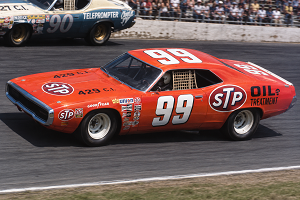
By the middle 1950s, Nichels was firmly established in championship-car racing.
At Indianapolis in 1957, the SUMAR Special prepared by Nichels put Pat O’Connor on the pole for the Indianapolis 500. That earned Ray recognition as the year’s Indy 500 pole mechanic.
During the same season, Nichels prepared Pontiacs for Daytona Speed Weeks. Banjo Matthews won the pole on the old beach-and-road course, and Cotton Owens won the Grand National race.
Nichels became the only mechanic credited with winning the pole at both Indianapolis and Daytona in the same year.
Most race shops would have considered that sufficient mileage for one season.
Ray went to Italy.
Then He Went to Monza to See What Broke First
Nichels had also worked with Firestone’s high-speed testing program, preparing Chrysler Hemi-powered Kurtis-Kraft machinery for drivers including Sam Hanks and Pat O’Connor.
In 1957, the Americans went to Monza for the Race of Two Worlds on the Italian track’s enormous high-banked oval.
O’Connor and the Nichels-prepared machine set a new track record.
That background matters because Ray was about to become best known for stock cars. He did not arrive there because Indianapolis machinery had become too sophisticated.
He brought Indy-grade fabrication, endurance work and high-speed testing into a form of racing still pretending that production automobiles were basically what everybody had started with.
The toolbox was already fairly complete.
Bunkie Knudsen Needed Pontiac to Stop Looking Boring
During the 1950s, Pontiac had a marketing problem.
The cars were respectable.
Respectable is a fine quality in a banker.
It is less helpful when trying to sell performance cars to young fellows who have recently discovered that gasoline can be converted directly into noise.
Pontiac general manager Semon “Bunkie” Knudsen wanted racing to change the division’s image. Nichels had already shown at Daytona that he knew what to do with a Pontiac once somebody removed the requirement to treat it politely.
Nichels Engineering became, in effect, Pontiac’s factory stock-car shop from 1956 through 1963.
Detroit supplied the hardware.
Ray’s shop discovered how much faster it could become before something objected.
The Pontiac Years Got Serious Quickly
Nichels cars competed across NASCAR and USAC instead of limiting themselves to one sanctioning body’s rulebook.
The principal partnership was with Paul Goldsmith. He won 10 USAC stock-car races in 1961 and the championship, then won eight more races and another championship in 1962.
Nichels-built Pontiacs also appeared throughout NASCAR under other teams and drivers. Joe Weatherly won the 1962 NASCAR championship in a Pontiac built by Nichels Engineering and prepared by Bud Moore.
That arrangement tells quite a bit about factory racing in the period.
The car could belong to one team, be built by another, receive factory pieces through another door and show up Sunday looking completely innocent.
Detroit was not racing, naturally.
It merely had an unusual number of very fast contractors standing near racetracks.
Then They Tried Twenty-Four Hours at Indianapolis
Nichels understood that speed was useful only if the machinery remained assembled long enough to collect the result.
In 1961, he prepared two production-based Pontiacs for a 24-hour endurance-record attempt at Indianapolis Motor Speedway.
The driver roster included Paul Goldsmith, Marvin Panch, Fireball Roberts, Len Sutton, Rodger Ward and Joe Weatherly. The mechanics included Cotton Owens, Smokey Yunick and Bud Moore.
In other words, Nichels had gathered enough racing talent to operate several successful shops and start a respectable number of arguments.
The cars covered more than 2,500 miles in 24 hours at averages above 107 mph and established endurance records.
The operation later repeated the basic exercise at Darlington.
A builder can claim his machinery is durable.
Nichels preferred to keep driving it until everybody got tired of waiting for something to break.
GM Quit Racing. Chrysler Knew What Had Become Available.
In 1963, General Motors withdrew official factory support from racing, ending the Nichels Engineering relationship with Pontiac.
The shop did not remain unemployed for long.
Chrysler racing boss Ronnie Householder knew Nichels from the Indiana racing world and understood exactly what had just appeared on the market.
Nichels Engineering became Chrysler’s house stock-car builder, developing Dodges and Plymouths for factory-backed competition.
The name on the grille changed.
The fellows underneath the car did not forget how racing worked.
A.J. Foyt Gave Chrysler a Nice Fourth of July
At the 1964 Firecracker 400 at Daytona, A.J. Foyt drove a Nichels Dodge. Bobby Isaac drove another.
Foyt won.
Isaac finished second.
The first two cars across the line had both come through Ray Nichels’ shop.
Five weeks earlier, Foyt had won the Indianapolis 500. Now he was winning a NASCAR race at Daytona in Nichels-built Chrysler machinery.
The old Indy mechanic appeared to be adapting to stock cars without serious emotional distress.
In 1966 They Added Metal Until the Stopwatch Approved
The first-generation Dodge Charger looked slippery sitting still.
At NASCAR superspeedway speed, its rear end was not always equally enthusiastic about remaining acquainted with the pavement.
For the 1966 Firecracker 400, Dodge engineers and Nichels Engineering worked with a rear spoiler on Sam McQuagg’s No. 98 Charger.
McQuagg led 126 of 160 laps and won by more than a minute.
The spoiler became one of NASCAR’s early major applications of the device in superspeedway competition.
The engineering process was not particularly mysterious: identify an aerodynamic problem, add metal where the air needed persuasion and see whether the stopwatch agreed.
It did.
The rest of NASCAR noticed.
USAC Might Have Been the Bigger Demonstration
NASCAR supplied much of the publicity, but Nichels Engineering was even more dominant in USAC stock-car competition.
USAC credits Nichels as an entrant with 70 stock-car victories between 1961 and 1972.
Paul Goldsmith accounted for 22. Don White won 36 races for Nichels and captured the 1967 USAC Stock Car championship.
Goldsmith’s 1961 and 1962 titles plus White’s 1967 championship gave the operation three USAC crowns.
Seventy victories is enough that calling Nichels Engineering a successful shop starts sounding unnecessarily cautious.
They were not visiting USAC.
They were helping define what a winning USAC stock-car operation looked like.
Talladega Gave the Daytona a Strange First Victory
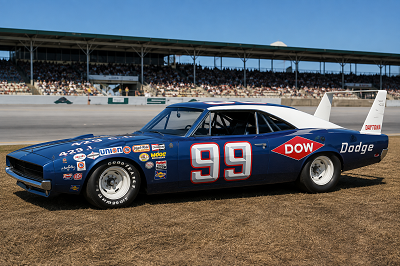
By 1969, Chrysler’s superspeedway war had produced the winged Dodge Charger Daytona.
Then the inaugural NASCAR race at Talladega turned into one of the sport’s larger administrative disputes when many leading drivers withdrew over tire-safety concerns.
NASCAR ran the race anyway.
Richard Brickhouse climbed into the Nichels Engineering No. 99 Dodge Daytona originally intended for Charlie Glotzbach and won.
It became Brickhouse’s only NASCAR Grand National victory and the first major NASCAR win for the Charger Daytona.
There are cleaner ways to introduce a famous race car.
History has never promised to wait until the public-relations department is ready.
The Shop’s Fingerprints Were Everywhere
Counting only races officially entered under Ray Nichels’ name misses much of the operation’s importance.
Nichels Engineering built cars, developed parts and supplied information that flowed into other teams throughout the factory-racing era.
Drivers associated with Nichels machinery included A.J. Foyt, Paul Goldsmith, Bobby Isaac, Don White, Richard Brickhouse, Fireball Roberts, David Pearson, Junior Johnson, Buddy Baker, Bobby Allison and Dan Gurney.
The shop’s own NASCAR record was substantial enough: 11 victories, 12 poles and more than 60 top-five finishes.
The harder number to calculate is how many other winning cars contained some piece of Nichels Engineering knowledge.
When Detroit needed a stock car built correctly, Ray’s shop was one of the places the telephone rang.
Eventually Detroit Stopped Calling
The factory era changed during the early 1970s. Chrysler reduced its racing involvement, NASCAR rules evolved and the period when one independent engineering shop could operate as a manufacturer’s unofficial competition department began disappearing.
Nichels Engineering’s long factory-building era wound down.
Ray did not need another decade of victories to prove what the shop had been.
He had started as a fifteen-year-old midget mechanic, built an Indianapolis car in a basement, earned the Indy pole, set records at Monza, became Pontiac’s house builder and then changed manufacturers without changing the basic result.
That is a fairly complete mechanical education.
The Halls Eventually Found Him
Nichels died on November 25, 2005, at eighty-three.
Recognition continued afterward. He entered the National Midget Auto Racing Hall of Fame and the USAC Hall of Fame, and in 2021 he was inducted into the Motorsports Hall of Fame of America.
The résumé covers Indianapolis, speed records, NASCAR, USAC and factory programs for two different Detroit manufacturers.
Plenty of mechanics can make one combination fast.
Nichels spent decades changing cars, engines, manufacturers, rules and sanctioning bodies without losing the basic result.
The Bottom Line
Ray Nichels never became famous because of a driving style, television interview or victory-lane celebration.
Racers knew him because the machinery kept arriving ready to work.
His shop put a car on the Indianapolis 500 pole and a Pontiac on the Daytona beach-course pole in the same year. Pontiac hired him to make its cars look serious. When Pontiac quit racing, Chrysler hired the same shop and started winning with Dodges and Plymouths.
Three USAC stock-car championships. Seventy USAC victories as an entrant. Eleven NASCAR victories from his own operation. Daytona wins, Talladega, endurance records and enough famous drivers to fill several Hall of Fame ceremonies.
Detroit could describe its racing programs with whatever language made management comfortable that year.
Ray Nichels had a simpler assignment.
Build the car. Make it live. Make it faster than the other factory’s car.
The badges kept changing.
Nichels Engineering kept understanding the job.
↑ Back to the Top, Before Detroit Decides It Isn’t Racing Again