
Gary Ormsby
He Spent Years Almost Getting There. Then the Castrol Car Became the One Everybody Had to Catch.
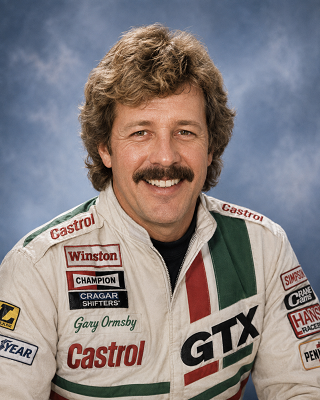
Gary Ormsby was not the fellow who exploded onto the national scene and immediately rearranged Top Fuel. He had already been racing fuel dragsters for more than twenty years before most fans began thinking of him as a championship threat.
He raced in the 1960s with Northern California’s hard-running Sacramento crowd, tried Funny Cars, stepped away from Top Fuel for several years, came back and won occasionally.
Then he built one of the most ambitious streamliners drag racing had seen and watched it prove that aerodynamic brilliance still has to carry its own weight.
Eventually Gary Ormsby and crew chief Lee Beard stopped trying to make the dragster look like tomorrow and concentrated on making it run there.
In 1989, the result finally arrived: six NHRA victories, a 4.91-second national record, nearly 295 mph and the NHRA Top Fuel world championship.
Gary Ormsby’s career was built less on one sudden breakthrough than on refusing to quit improving until the car everybody had been overlooking became the car everybody had to beat.
He Had Already Been Around a Long Time
Gary Lewis Ormsby was born in 1941. He began racing fuel dragsters in the early 1960s and became part of Northern California’s thriving drag-racing scene.
This was long before polished national touring teams, enclosed transporters and engineering departments became normal Top Fuel equipment. Racers built cars, towed them, tuned them, broke them, then went home and tried to figure out which of those activities had caused the other one.
Ormsby became a successful regional Top Fuel racer but never turned that first period into an NHRA championship career. For 1973 and 1974, he even joined the Funny Car crowd, driving the McCord & Ormsby Vega.
Top Fuel eventually pulled him back, then he stepped away from the class altogether for almost three seasons.
By the early 1980s, Gary Ormsby looked more like a capable racer from an earlier period than the fellow about to become one of Top Fuel’s defining names.
1983 Was the Second Beginning
Ormsby returned to Top Fuel in 1983, just as the class was changing rapidly. Joe Amato was becoming a championship force, Don Garlits was about to remind everybody that old racers sometimes came back with new ideas, speeds were climbing and clutch technology was improving.
The days when simply owning a competitive nitro combination was enough were disappearing.
Ormsby teamed with crew chief Lee Beard. Beard later described the operation they inherited rather plainly: outside Northern California, hardly anybody knew who Gary Ormsby was.
They started building from there. Ormsby’s return produced an immediate surprise victory at the Popular Hot Rodding Championships, then came the first NHRA national-event victory.
He Started 1984 by Beating the Champion-to-Be
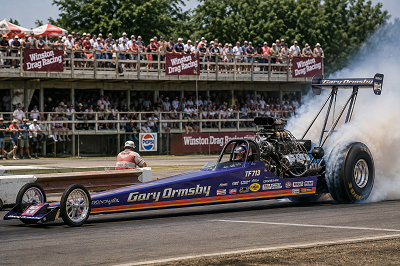
At the 1984 Winternationals, Ormsby reached the Top Fuel final against Joe Amato and won. It was his first NHRA national-event victory.
Amato went on to win the season championship. Ormsby finished fourth.
That became roughly the pattern for the next several years. The Castrol GTX car was good, sometimes very good, but Amato, Garlits, Dick LaHaie and others kept collecting more of the trophies and championship points.
Ormsby and Beard were building a serious Top Fuel team. It just had not become the best one yet.
Then They Tried to Build Tomorrow’s Dragster
In 1986, Top Fuel suddenly became fascinated with streamlining. Don Garlits arrived with his enclosed-cockpit Swamp Rat XXX.
Ormsby’s team went considerably farther.
The Castrol GTX streamliner wrapped the dragster in extensive Indy-car-inspired bodywork, covering the engine and rear tires in an attempt to reduce aerodynamic drag. It looked like something Top Fuel had been saving for the next decade.
Its first public demonstration lasted approximately until Ormsby touched the throttle. At the 1986 Winternationals, an ignition problem caused a blower explosion during the car’s first burnout. The bodywork around the engine helped make the resulting mess especially memorable.
Welcome to the future. Please bring a broom.
The team repaired the car and kept developing it.
The Streamliner Wasn’t Stupid. It Was Heavy.
The Castrol car did show promise. At the 1986 Cajun Nationals, Ormsby reached the final against Garlits, producing the only all-streamliner Top Fuel final of the brief streamliner era.
Garlits won.
The larger problem remained: every pound of aerodynamic bodywork still had to be accelerated for a quarter-mile. The fully enclosed Castrol car carried more weight and complexity than the aerodynamic advantage could consistently repay.
The team experimented again in 1987 with bodywork enclosing the front wheels. The car handled badly, Beard took the fancy pieces off, and Ormsby soon won at Englishtown with the more conventional configuration.
Sometimes engineering progress consists of discovering which clever idea needs to go back on the shelf.
The Car Got Simpler. The Team Got Better.
Removing the streamliner body did not mean Ormsby and Beard stopped experimenting. It meant they concentrated their effort where the elapsed-time clocks rewarded it: clutch, fuel, engine, chassis and consistency.
The combination improved steadily, and by 1989 Top Fuel itself was changing underneath them. Eddie Hill had broken the four-second barrier the previous year. A four-second run was no longer a laboratory experiment. It was becoming what a championship car needed to do.
Ormsby and Beard were ready.
1989 Started With a Win
Ormsby opened the 1989 NHRA season by winning the Winternationals. That was a useful beginning, and it was not a fluke.
At Houston’s SuperNationals, Ormsby met Joe Amato in the final. Amato ran quicker, but Ormsby got there first.
His 5.09 beat Amato’s 5.03 on a holeshot.
It was Ormsby’s second consecutive victory of the season. The fellow who had spent several years running around the edge of the championship fight had moved directly into the middle of it.
Then Dallas Got Silly
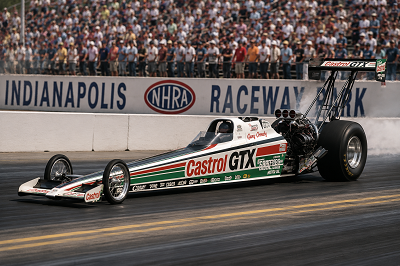
The Chief Nationals at Texas Motorplex became the performance statement of Ormsby’s championship season. The four-second barrier had fallen only eighteen months earlier.
Ormsby qualified at 4.91 seconds and reached nearly 295 mph. Both ends of the NHRA national record belonged to the Castrol team.
Then Ormsby did something nobody had done before: he ran in the fours during all four rounds of eliminations.
Four rounds. Four four-second runs. And the event victory.
That was the difference between occasionally having a quick dragster and owning one that had learned how to repeat the performance.
The team had spent years becoming competitive. Now it was setting the pace.
The Championship Finally Belonged to Gary Ormsby
Ormsby won six of the 19 NHRA national events in 1989. Joe Amato won four, while Dick LaHaie and Darrell Gwynn remained serious threats.
But Ormsby kept accumulating round wins. The Castrol GTX operation had become everything Beard and Ormsby had been trying to build since 1983.
At the end of the season, Gary Ormsby was the NHRA Top Fuel world champion.
He had started racing fuel dragsters in the early 1960s. Nearly three decades later, he had finally reached the top of the class.
There are quicker routes. None of them make the arrival feel quite the same.
There Was Something the Pits Didn’t Know
The championship season had another side that almost nobody in the sport knew about. During 1989, Ormsby was diagnosed with cancer.
He kept the illness private while the team kept racing and Ormsby kept winning. The championship celebrations therefore took place while the driver was already dealing with something considerably more serious than Joe Amato in the other lane.
He did not want the illness to become the story.
For the moment, it didn’t.
1990 Turned Into Ormsby Against Amato
If 1989 established Ormsby as champion, 1990 proved the season had not been a one-year accident.
Ormsby won six races again. So did Joe Amato. Between them, they won twelve of the season’s 19 events.
The championship came down to the final race at Pomona, and then it came down even farther.
Ormsby arrived trailing Amato by 254 points. He qualified No. 1 and earned low-elapsed-time bonus points, shrinking the gap enough that one particular result could create a tie.
Both drivers kept winning rounds until the entire season arrived at the final.
Joe Amato versus Gary Ormsby.
Winner takes the championship.
One Red Light Ended the Title Defense
Ormsby staged last, then left first.
Too first.
The red light came on, and the championship belonged to Amato.
Ormsby’s dragster smoked the tires shortly afterward, so the red light probably did not change the eventual race result. Amato ran a 4.93 anyway.
That was how close Ormsby came to consecutive championships: one final round at the final race against the man who had been his principal championship rival for years.
The Castrol team had stopped being a fifth-place operation. It had become one half of Top Fuel’s best rivalry.
He Was Still Making the Record Book Faster
Ormsby’s 1990 season produced more than a championship fight. At Topeka, he ran 4.881 seconds at 296.05 mph.
Both numbers represented the leading edge of Top Fuel performance. The class was approaching 300 mph, and Ormsby looked like one of the men most likely to get there first.
Then the calendar turned to 1991.
During preseason testing at Firebird International Raceway, Ormsby’s new dragster suffered a violent blowover. He survived and returned to competition.
But the illness he had kept private was becoming harder to outrun.
The Last Season Never Got a Proper Ending
Ormsby continued racing during the first part of 1991. His final NHRA national event came at Memphis in May, where he reached the semifinals before losing to Don Prudhomme.
Later that month, Ormsby won a match race at Topeka against Lori Johns.
Then he began missing races, and the racing world finally learned why. Cancer treatment had weakened him badly enough that continuing to drive was no longer realistic. In August, failing health forced him to sell the Top Fuel operation.
Gary Ormsby died on August 28, 1991. He was forty-nine.
Only twenty-one months had passed since he had finished his championship season.
The Team Kept His Name on the Car
The dragster did not disappear immediately. Pat Austin took over driving duties, and Gary Ormsby’s name remained on the car.
A few weeks after Ormsby’s death, Austin nearly won the U.S. Nationals with it. Later that season he won at Topeka.
The equipment and crew Ormsby had assembled remained capable of winning.
That may have been the final proof of what he and Lee Beard had built. It was no longer merely a fast driver having a good season.
It was a championship-level race team.
The Bottom Line
Gary Ormsby’s Top Fuel career did not follow the usual legend script. There was no immediate national domination, no teenage prodigy story and no single invention that changed everything overnight.
He raced for years, went away, came back, built a team and tried an aerodynamic revolution that didn’t work well enough.
Then he removed the fancy bodywork and kept improving the race car underneath it until the team produced a machine capable of running four consecutive four-second passes while winning a national event.
In 1989, Gary Ormsby became world champion. In 1990, the championship came down to one final round.
Then time ran out far sooner than the racing suggested it should have.
Gary Ormsby spent most of his career getting closer. By the time he finally reached the top, Top Fuel had to get faster just to keep up with him.
↑ Back to the Top, Before Gary Finds Another Hundredth