1971 Plymouth GTX — The Last Stand
The Muscle Car Wasn’t Dead Yet. But You Could Hear the Door Closing.
By 1971, Detroit’s muscle-car party was starting to come apart.
Insurance rates were climbing. Emissions rules were tightening. Compression ratios were dropping. Buyers who had spent the late 1960s checking horsepower numbers were suddenly checking premiums.
Plymouth still had one more round in the chamber.
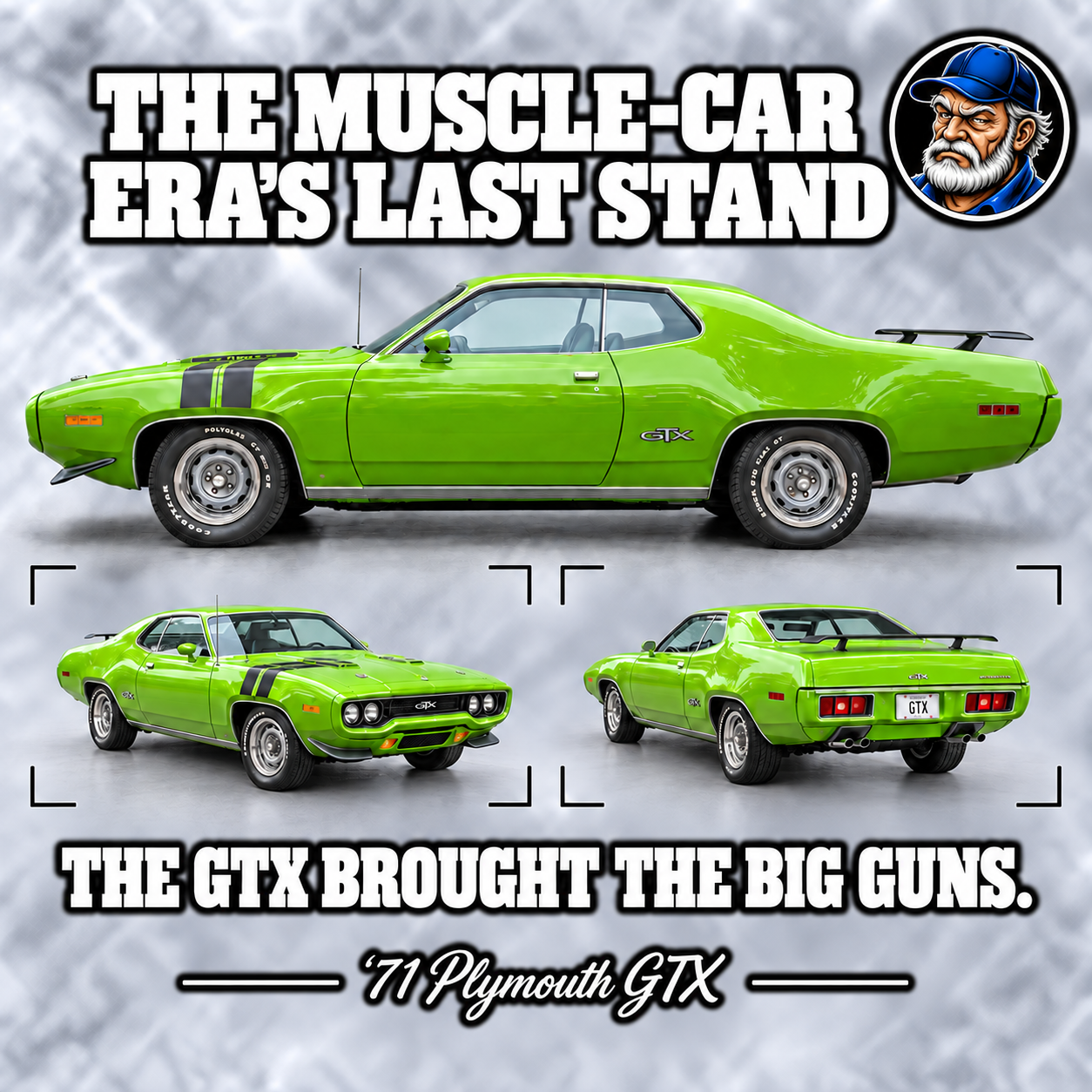
The GTX came back for 1971 with all-new bodywork, a standard 440 under the hood and enough attitude left to remind everybody what the name had meant since 1967. It would also be the last year the GTX stood on its own as a separate model.
That makes the ’71 different: it wasn’t the beginning of anything, but the last full-strength version before the floor started dropping out from under the whole market.
Plymouth had completely redesigned its B-body cars for 1971. The old squared-off shape gave way to a rounder fuselage look with deeply sculpted sides, a recessed grille, loop-style bumper treatment and a high rear deck. The Road Runner and GTX now shared the Satellite family’s basic shell, but the GTX still sat above the Road Runner as the more expensive, more polished muscle car.
The engine lineup made the point better than the trim did.
A 440-cubic-inch V8 remained standard equipment. Buyers could still step up to the 440 Six Barrel, and if the wallet was thick enough, the 426 Street Hemi was still sitting on the option sheet. The standard 440 carried a 375-horsepower rating, the Six Barrel 385 and the Hemi 425.
That was serious hardware in a year when serious hardware was getting harder to find.
The old formula was still right there in the showroom: big-block torque, rear-wheel drive, heavy-duty transmission, fat tires and enough cubic inches to make the insurance agent reach for another form.
But the warning signs were everywhere. The regular 440’s compression had already come down, and the whole industry was moving toward lower-compression engines that could live with emissions requirements and lower-octane fuel. The Hemi and high-performance 440 combinations were about to disappear from Plymouth’s B-body lineup altogether.
Buyers were disappearing too, and only 2,942 GTXs were built for 1971, down sharply from the previous years. The cheaper Road Runner had been stealing thunder from the GTX ever since 1968, but by 1971 the problem was bigger than two Plymouths fighting over the same customer. The whole market for expensive, big-engine intermediates was shrinking.
That’s what makes the ’71 GTX interesting.
It still looked like Plymouth believed in the old game.
The car could still be ordered with the engines that had defined Mopar performance. You could still put a 440 Six Barrel under the hood. You could still check the box for a Hemi. The body might have been all new, but the basic argument hadn’t changed much: put a lot of engine in a midsize car and let the rear tires sort out the details.
The trouble was the calendar.
For 1972, the GTX name survived only as an option package on the Road Runner rather than a separate model. The standalone GTX was finished, and it had happened mighty fast.
In 1967, Plymouth had introduced the GTX as its upscale performance intermediate, with a 440 standard when plenty of cars still made you pay extra for serious big-block power. Then the Road Runner arrived in 1968, cheaper and simpler, and suddenly the GTX had competition sitting on the same showroom floor.
By 1971, Plymouth was still offering both, but the market that had once made room for them was disappearing underneath their tires.
Calling the ’71 GTX a last stand isn’t just nostalgia. It really was the final year you could walk into a Plymouth dealer and buy a GTX as its own model with the old high-performance engine hierarchy still intact: 440 standard, Six Barrel available, Hemi still waiting at the top if you had the money and the nerve.
A year later, the separate GTX was gone.
The muscle-car era didn’t end on one particular afternoon, and nobody at Plymouth shut off the lights and hung a sign saying the fun was over. It faded through insurance surcharges, emissions rules, lower compression, changing buyers and engines quietly disappearing from order sheets.
The 1971 GTX just happened to still be standing there with the old hardware when the market started walking away.
The muscle-car era made one last stand. The GTX brought the big guns.