1972 De Tomaso Pantera — Italian Exotic. Cleveland Heart.
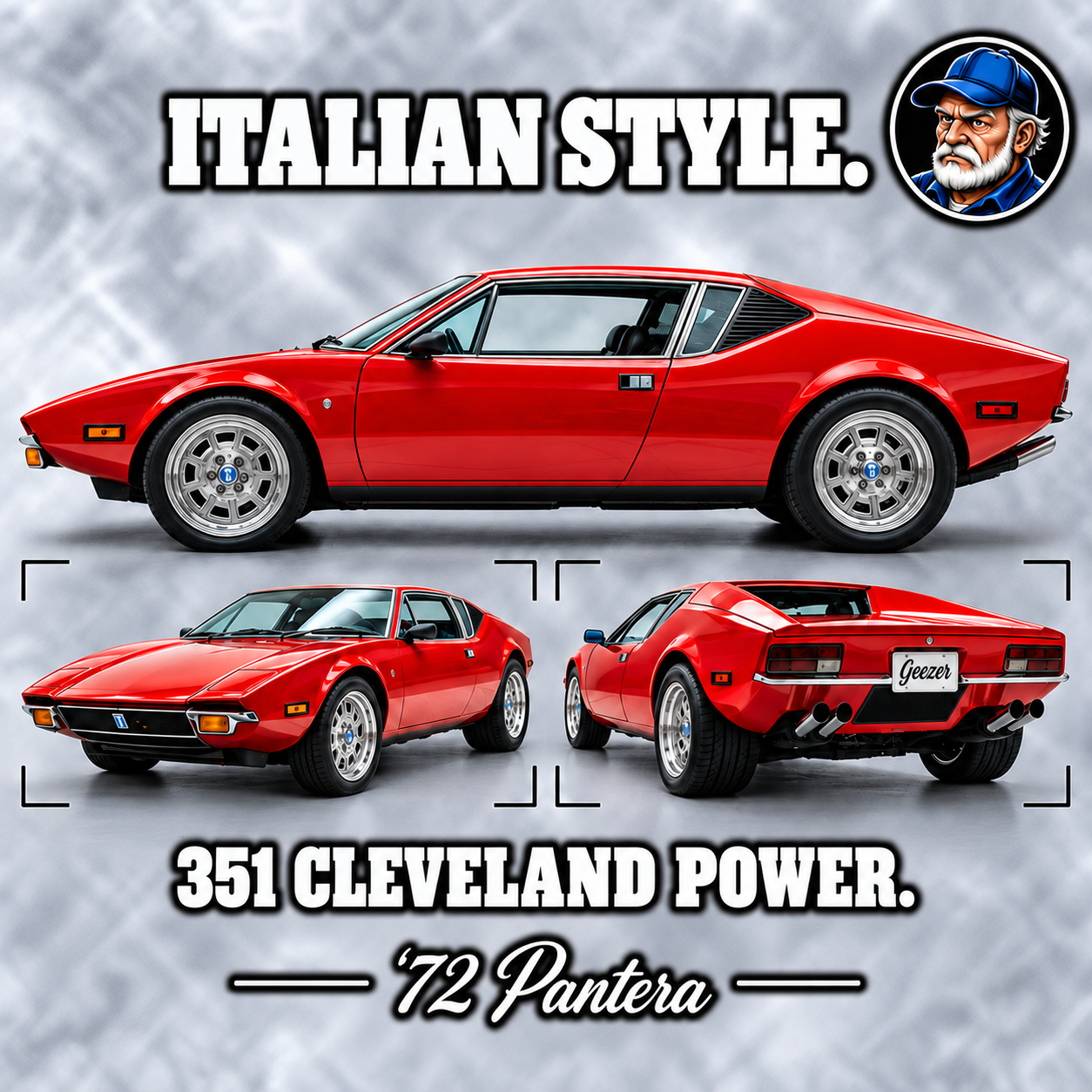
Italian Exotic. Cleveland Heart.
In the early 1970s, Ford decided it wanted something exotic.
Not another Torino with stripes or another Mustang with a bigger engine. An actual mid-engine sports car.
The problem was that designing one from scratch takes time, money and a willingness to explain to management why you’re spending both on a car almost nobody is going to buy, so Ford went shopping. That led straight to Alejandro De Tomaso.
De Tomaso already knew how to build low-volume Italian performance cars, and the Pantera gave Ford something it didn’t have anywhere else in the lineup: a low, sharp, mid-engine exotic that looked like it belonged outside a hotel in Monaco instead of beside a Country Squire at the grocery store.
Tom Tjaarda at Ghia handled the styling, and the shape did most of the explaining before anybody opened the engine cover. Low nose, cab pushed forward, wide stance, engine behind the seats — nothing about it looked like a normal Ford product.
Then you opened the back and found a 351 Cleveland.
That’s where the whole idea got interesting.
Ford didn’t just want an Italian exotic. It wanted one Americans could actually buy through a Lincoln-Mercury dealer and, at least in theory, get serviced without shipping the thing back across the Atlantic every time it developed an attitude.
The Cleveland was a big part of that plan. Instead of some temperamental little Italian engine that required a mechanic with three specialized tools and a cousin in Modena, the Pantera used a Ford V8 American mechanics already understood.
For the U.S. market, the 351 was rated at roughly 310 horsepower in the early cars, which was plenty in a car weighing around 3,100 pounds.
And the rest of the package wasn’t pretending.
The engine sat behind the driver and sent its power through a five-speed ZF transaxle. Independent suspension sat at all four corners, four-wheel disc brakes handled stopping duty, and the steel unit-body construction wrapped it all in something properly exotic.
This wasn’t a Ford engine stuffed into a pretty shell and left at that.
It was the real thing.
Ford’s contribution was supposed to make that real exotic easier to live with.
A buyer could walk into a Lincoln-Mercury dealership, past the Continentals and Montereys, and buy a Pantera. One side of the showroom might have a big luxury sedan with enough hood to land an airplane on. The other could have an Italian mid-engine sports car with a Cleveland V8 behind the seats.
That dealer network was supposed to be the advantage.
The Pantera wouldn’t just be exotic.
It would be accessible.
At least that was the plan.
Early Panteras developed a reputation for fit-and-finish problems, electrical gremlins, cooling trouble and enough cabin heat to remind the driver exactly where the engine was located.
Those weren’t little complaints when the whole sales pitch depended on making an exotic car easier to own. A buyer willing to tolerate temperamental behavior from some tiny Italian manufacturer might shrug and call it character. A customer who bought his car through Lincoln-Mercury tended to expect the doors to fit properly.
That’s where Ford’s clever idea started arguing with itself.
The Pantera was exotic because it wasn’t built like an ordinary Ford, but Ford was trying to sell it to people who expected Ford-level support.
The price didn’t help, either.
At around $10,000, the Pantera cost serious money in the early 1970s. A Corvette was considerably cheaper, easier to understand and backed by dealers that already knew what to do with one.
The Pantera was stranger, more exotic and a much bigger leap of faith.
When everything was working properly, though, the idea made sense.
The 351 Cleveland supplied the kind of broad V8 power American drivers understood, the ZF gave it five gears, and the mid-engine layout delivered the balance and proportions people expected from European exotica. Top speed was knocking around the 150-mph neighborhood.
That was serious machinery, not some fake exotic with wire-wheel covers and a fancy badge.
The problem was turning a real exotic into something Ford could sell by the thousands.
Ford distributed the Pantera through Lincoln-Mercury dealers through 1974, with roughly 5,700 cars sold during the arrangement. That was enough to make the car familiar, but not enough to make Ford’s mass-market exotic experiment work the way the company had hoped.
Ford eventually walked away, but De Tomaso kept building the Pantera in various forms for years afterward.
That says plenty about the basic car.
Ford’s distribution experiment ran its course. The combination itself didn’t.
And that’s what makes the Pantera such an oddball. It looked every inch the Italian exotic — low, wide, mid-engined and sharp enough to make almost anything else in the Lincoln-Mercury showroom look ancient.
Then somebody lifted the engine cover and there sat a 351 Cleveland.
Somehow, that was exactly right.
Italian exotic. Cleveland heart.