1973 Pontiac Trans Am — SD-455
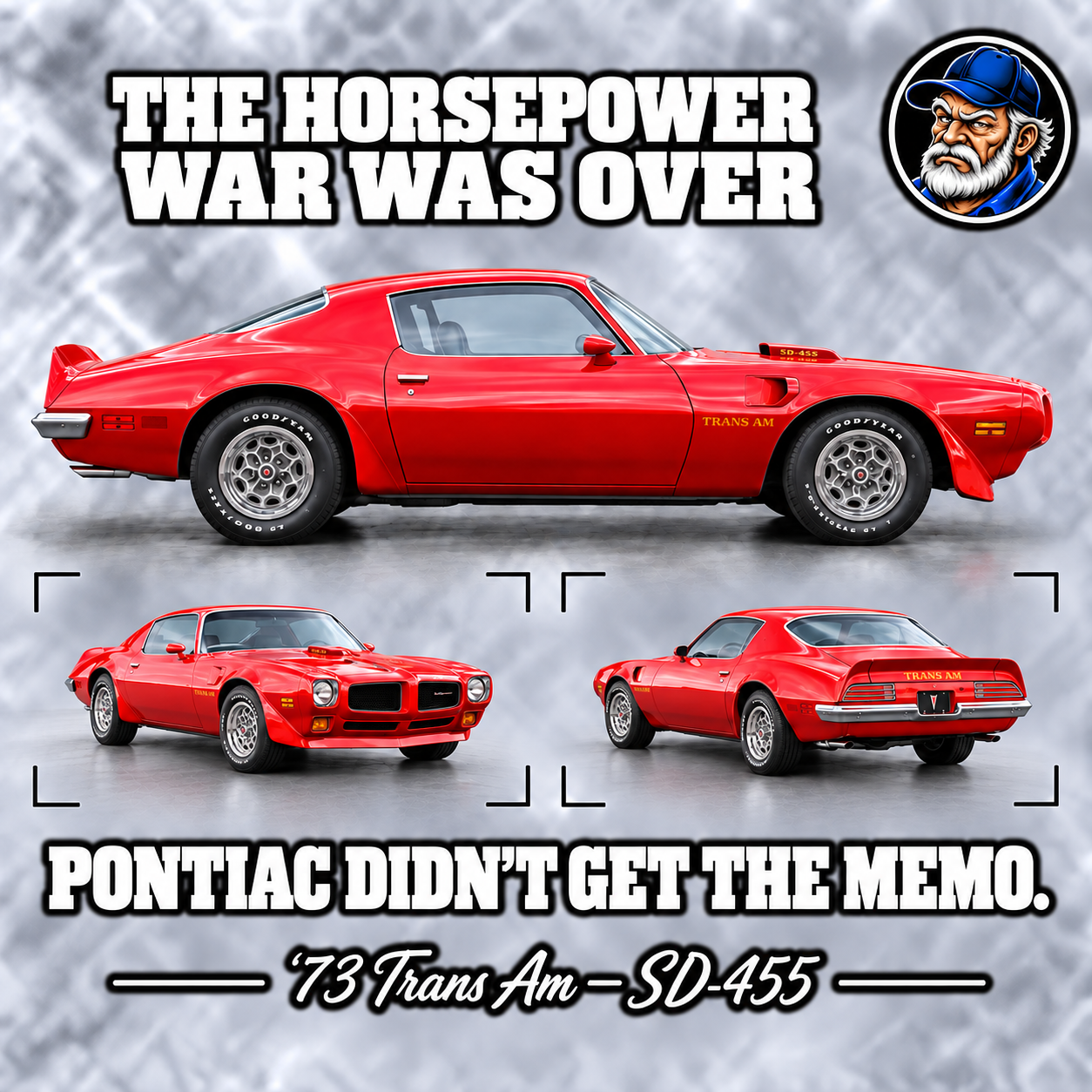
Everybody Else Was Backing Off. Pontiac Built This.
By 1973, the horsepower war was supposed to be over.
Compression ratios had dropped. Emissions equipment was multiplying. Insurance companies had already taken a swing at anything with a big engine and a young driver. Most of Detroit had figured out that the easiest way through the new decade was to quit fighting the old battles.
Pontiac apparently missed the memo, because the result was the Super Duty 455.
On paper, it looked like another low-compression 455 trying to survive the early 1970s. In reality, Pontiac’s engineers had taken what they’d learned from racing and built one of the toughest production V8s the division ever offered.
That’s what makes the SD-455 different.
Pontiac didn’t simply bolt a bigger carburetor onto an ordinary 455 and put a decal on the shaker. The Super Duty block carried four-bolt mains, reinforced bulkheads and heavier webbing around the lifter valley. Inside were forged connecting rods, forged pistons and a nitrided crankshaft, along with the kind of bottom-end hardware that told you the engineers expected somebody to use all 455 cubic inches instead of just polishing the air cleaner.
The cylinder heads were serious pieces too, with large round exhaust ports and breathing hardware rooted in Pontiac’s earlier performance work. A Rochester four-barrel sat on top, and although emissions requirements kept compression down around 8.4:1, this thing was built to survive a lot more abuse than the average smog-era V8.
Pontiac originally talked about 310 horsepower, but certification and emissions reality got involved. The camshaft had to be softened, and the production rating settled at 290 net horsepower.
That number looks almost ordinary until you remember what everybody else was selling in 1973.
Chevrolet’s strongest Camaro engine was well below it, and plenty of once-proud muscle cars had already turned into stripes, spoilers and memories of better engines. The SD-455 still had 455 cubic inches, roughly 390 lb-ft of torque, and enough real performance to make that 290-horsepower number look mighty conservative.
And that was the trick Pontiac pulled off.
Instead of pretending 1969 could be brought back, the engineers built an engine that worked under the new rules. Low compression didn’t have to mean weak, and emissions requirements didn’t have to mean the argument was over.
The SD-455 went into the Firebird Formula and Trans Am, and the Trans Am was exactly the sort of chassis that deserved it.
By then Pontiac had already spent years turning the second-generation Firebird into something more sophisticated than the average straight-line muscle car. The steering, suspension and basic balance gave the engine somewhere to use its power besides the space between two stoplights.
That mattered, because the muscle-car world itself was changing.
The old formula had been simple enough: stuff the biggest engine possible into an intermediate, put enough tire under it to keep the rear axle somewhere near the pavement, and worry about corners later.
The Trans Am was headed somewhere else. It could still roast the tires, but it also wanted to turn, stop and behave like the whole car had been engineered instead of just the engine bay.
The Super Duty finally gave that chassis an engine worthy of the rest of the package.
Production was tiny. Only 252 Super Duty Trans Ams were built for 1973, along with 43 SD-equipped Formulas. The engine returned for 1974, but the entire two-year SD-455 run amounted to only 1,296 cars.
That wasn’t enough volume to change Detroit, but it was enough to make the point.
Pontiac’s performance glory days were already disappearing. The executives and engineers who had built the division’s 1960s reputation were moving on, corporate priorities were changing, and the industry was headed toward catalytic converters, tighter emissions rules and engines that would soon struggle to crack 200 horsepower.
Right in the middle of that retreat, Pontiac built the SD-455.
Not a decal package. Not a warmed-over cruiser trading on an old name. A reinforced, round-port, forged-rod 455 that looked at the early 1970s and refused to behave like the decade had already won.
That’s why the 1973 SD-455 matters more than its production numbers.
It wasn’t the biggest muscle-car engine ever built, and it didn’t carry the wildest factory horsepower rating. It mattered because of when Pontiac built it and what Pontiac managed to keep alive inside it.
Most of Detroit was figuring out how to make old performance names survive with less performance underneath them. Pontiac built a new engine tough enough to keep fighting.
The horsepower war was over. Pontiac didn’t get the memo.