
1962 Oldsmobile Jetfire — Turbo V8. Keep the Alcohol Tank Full.
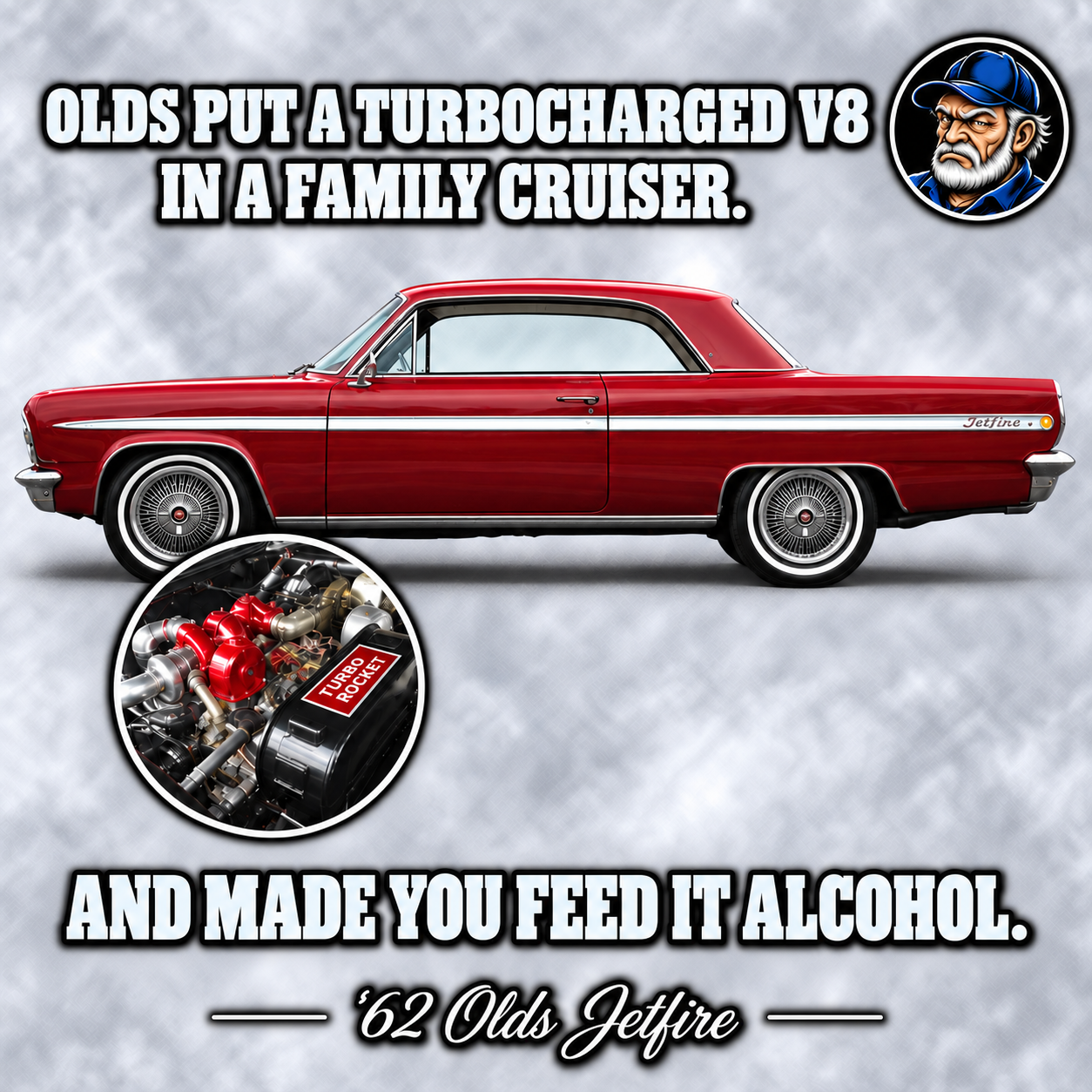
Turbo V8. Keep the Alcohol Tank Full.
Oldsmobile had a perfectly respectable compact in the F-85. Then somebody decided respectable wasn’t enough. For 1962, Oldsmobile took the F-85’s 215-cubic-inch aluminum V8, bolted on a turbocharger and created the Jetfire.
That was no small move. Turbochargers were nowhere near normal passenger-car hardware in 1962, especially in the sort of compact Oldsmobile expected ordinary people to drive to work, take shopping and hand over to the neighborhood mechanic when something started making a noise. Oldsmobile wasn’t building a race car; it was trying to make turbocharging behave like regular production hardware.
That’s where the trouble started. A turbocharger stuffs more air into the engine. More air lets the engine burn more fuel and make more power, but the extra cylinder pressure also raises the chance of detonation when the engine is under boost. Let that get out of hand and all the clever engineering under the hood starts getting expensive in a hurry.
Oldsmobile needed a way to keep the extra cylinder pressure from turning the little aluminum V8 into scrap, so it gave the Jetfire another system to look after. Under boost, the engine received a water-and-alcohol mixture that helped control detonation.
Naturally, Detroit couldn’t just call it water and alcohol.
Oldsmobile called it Turbo-Rocket Fluid.
That sounded considerably better than, “Keep this bottle full or the fun stops.”
The idea itself was clever. The owner now had a separate reservoir under the hood carrying fluid the turbo system actually depended on. If the supply ran low, the system cut back the boost rather than letting the engine keep pushing toward trouble.
That’s good engineering, but it’s also another thing the owner has to remember—and there was the Jetfire’s real problem.
Oldsmobile had built a system sophisticated enough to protect itself, but it had dropped that system into a world still accustomed to carburetors, ignition points and machinery a decent mechanic could usually understand by staring at it for a while. The Jetfire was asking everybody to learn something new.
The owner had to understand that the extra reservoir wasn’t decoration. The mechanic had to understand what the turbo and fluid system were doing before deciding which part had gone bad. And when either one didn’t understand it, the easiest repair could become making the unusual hardware disappear.
Some owners neglected the fluid, some mechanics weren’t familiar with the system, and more than a few Jetfires eventually lost turbo-related equipment because removing the complicated pieces looked easier than learning why they were there.
That’s what makes the Jetfire story better than simply saying Oldsmobile built an early turbo car. The basic concept wasn’t nonsense. The turbo made power, the fluid system addressed the detonation problem, and the protection system backed the boost off when the fluid wasn’t there.
The weak link was everything surrounding the engineering.
Oldsmobile had built a car that expected more from its owner and mechanic than an ordinary 1962 F-85 did. That’s a hard sell when the whole thing is sitting in a regular Oldsmobile showroom.
A fellow buying an exotic car might expect special procedures. A fellow buying an Oldsmobile compact probably expected to put gasoline in it, change the oil and let the dealer worry about the rest.
The Jetfire didn’t quite work that way.
Oldsmobile kept it for only 1962 and 1963. That short run makes the car look like a failed experiment if all you do is count model years, but look at what Oldsmobile was actually trying to accomplish and the story gets more interesting.
It had put a turbocharger on a production aluminum V8, installed the whole package in an ordinary compact, devised a water-and-alcohol system to control detonation, and built in protection for the engine when the owner forgot to keep that system supplied.
That’s a lot of new thinking to hand somebody with a 1962 owner’s manual.
The Jetfire’s mistake wasn’t being too strange to work. It was expecting the rest of the world to catch up quickly enough to make the clever parts easy to live with.
That’s why the engineering can’t be separated from the car. The turbo system wasn’t some odd accessory hanging off an otherwise ordinary F-85.
It was what made the Jetfire a Jetfire.
Turbo V8. Keep the alcohol tank full.