1967 Mercury Cougar — Mustang Grew Up. Got Expensive.
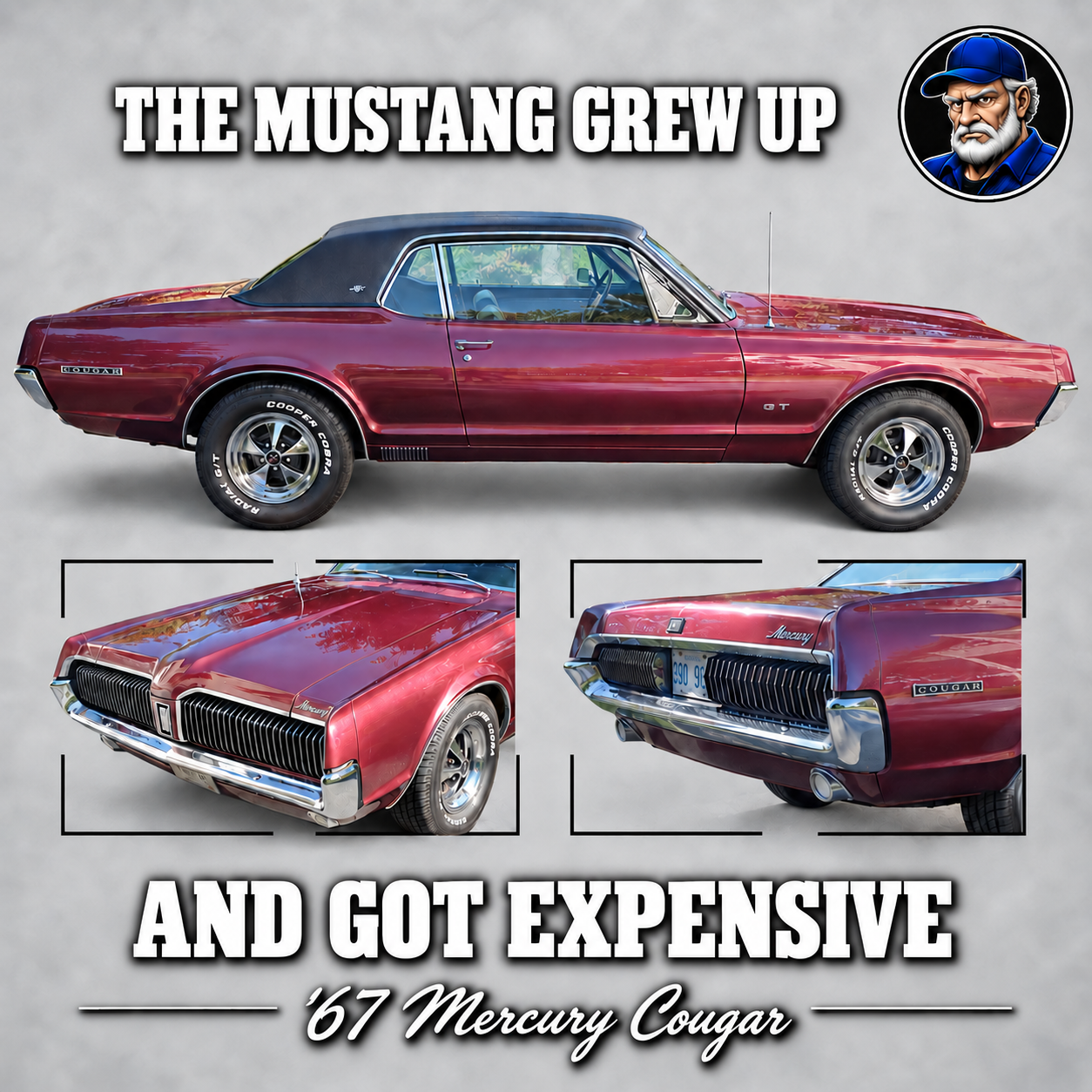
Mustang Grew Up. Got Expensive.
Ford had already proved there was a huge market for a sporty little car with a long hood, short deck and enough options to let buyers build it mild or wild.
That car was the Mustang, and by 1967 Mercury wanted a piece of the same action.
But Mercury couldn’t just slap a cat badge on a Mustang and charge more money for it. If the Cougar was going to sit above Ford’s pony car, it had to look, feel and drive like somebody had spent the extra cash somewhere besides the sales brochure.
So Mercury stretched the formula.
The Cougar rode on a wheelbase three inches longer than the Mustang’s and wore completely different sheet metal. The extra length gave it a little more room and a more substantial stance, while the styling pushed the whole thing in a cleaner, more formal direction.
Mercury added some theater, too. Hidden headlights sat behind a full-width grille up front, while sequential turn signals flashed across the taillamps one section at a time out back.
Neither one made the car faster, and that didn’t matter. They made it look expensive, which was exactly part of what Mercury was selling.
The Mustang had become the car everybody knew. The Cougar was aimed at the fellow who liked the same basic formula but didn’t necessarily want to look like he’d bought the same thing as every other kid in town.
Mercury backed that up inside. More sound insulation helped quiet the cabin, the trim was richer, and the overall feel was less bargain sporty car and more personal-luxury coupe with some muscle hiding underneath.
That last part mattered, because Mercury wasn’t about to let all that nicer trim turn the Cougar into a rolling sofa.
Every 1967 Cougar came with a V8. The standard 289 made 200 horsepower, a four-barrel 289 stepped that up to 225, and buyers wanting something considerably less polite could order the 390 with 320 horsepower.
That was the right move. Mercury could make the Cougar quieter, longer and more expensive, but it still had to give the fellow writing the check a reason to grin when he put his foot down.
The GT package pushed the idea farther with heavier-duty suspension, better brakes and the 390, turning the Cougar into something more serious than an upscale commuter with fancy taillights.
And if the regular Cougar still wasn’t rich enough, Mercury had the XR-7. Woodgrain trim, extra gauges, toggle switches and more upscale interior touches nudged the car even farther toward the personal-luxury crowd without giving up the V8 underneath.
That put the Cougar in a clever spot between the ordinary pony car and the bigger personal-luxury machines.
A Mustang buyer might be younger, more price-conscious, or more interested in building a performance car out of the option sheet. A Cougar buyer could want the same proportions and V8 power while also wanting the car to feel like he’d moved up in the world.
Mercury charged accordingly. The Cougar cost several hundred dollars more than a comparable V8 Mustang, which wasn’t pocket change in 1967.
Apparently enough buyers thought the difference was worth it. Mercury sold more than 150,000 Cougars in the first model year, and Motor Trend named it Car of the Year.
That sales total is what proves the idea worked.
The Cougar didn’t beat the Mustang at being a Mustang, because it wasn’t supposed to. Mercury found the space just above it: longer wheelbase, quieter cabin, more formal styling, richer trim and V8 power across the board.
Calling it just a fancy Mustang misses the point. The two cars shared plenty underneath, and that was the smart part. Mercury didn’t waste money reinventing everything just so it could brag about being different. It spent the effort where the buyer could see, hear and feel it.
The result still had enough Mustang in it to be fun, but enough Mercury around it to justify the extra money.
The Mustang was still the young fellow’s dream car. The Cougar was what he bought when the paycheck got better and he still wasn’t ready to give up having fun.
The Mustang grew up. Then Mercury sent it a bill.