1969 Dodge Charger Daytona
The Wing Wasn’t for Show
Detroit spent most of the 1960s settling arguments with bigger engines. By 1969, Dodge had a problem another Hemi wasn’t going to fix.
The Charger had plenty of horsepower. The air was getting in the way.
At NASCAR speeds, the regular Charger’s recessed grille caught too much air, while that beautiful tunneled rear window left turbulence rolling around behind the roof. It looked terrific sitting in the driveway, but the wind wasn’t particularly impressed. Dodge tried cleaning things up with the Charger 500, giving it a flush grille and a smoother rear window. That helped, but Ford was still giving Dodge plenty of grief on the superspeedways.
The engineers needed something better, and they weren’t going to find it under the hood.
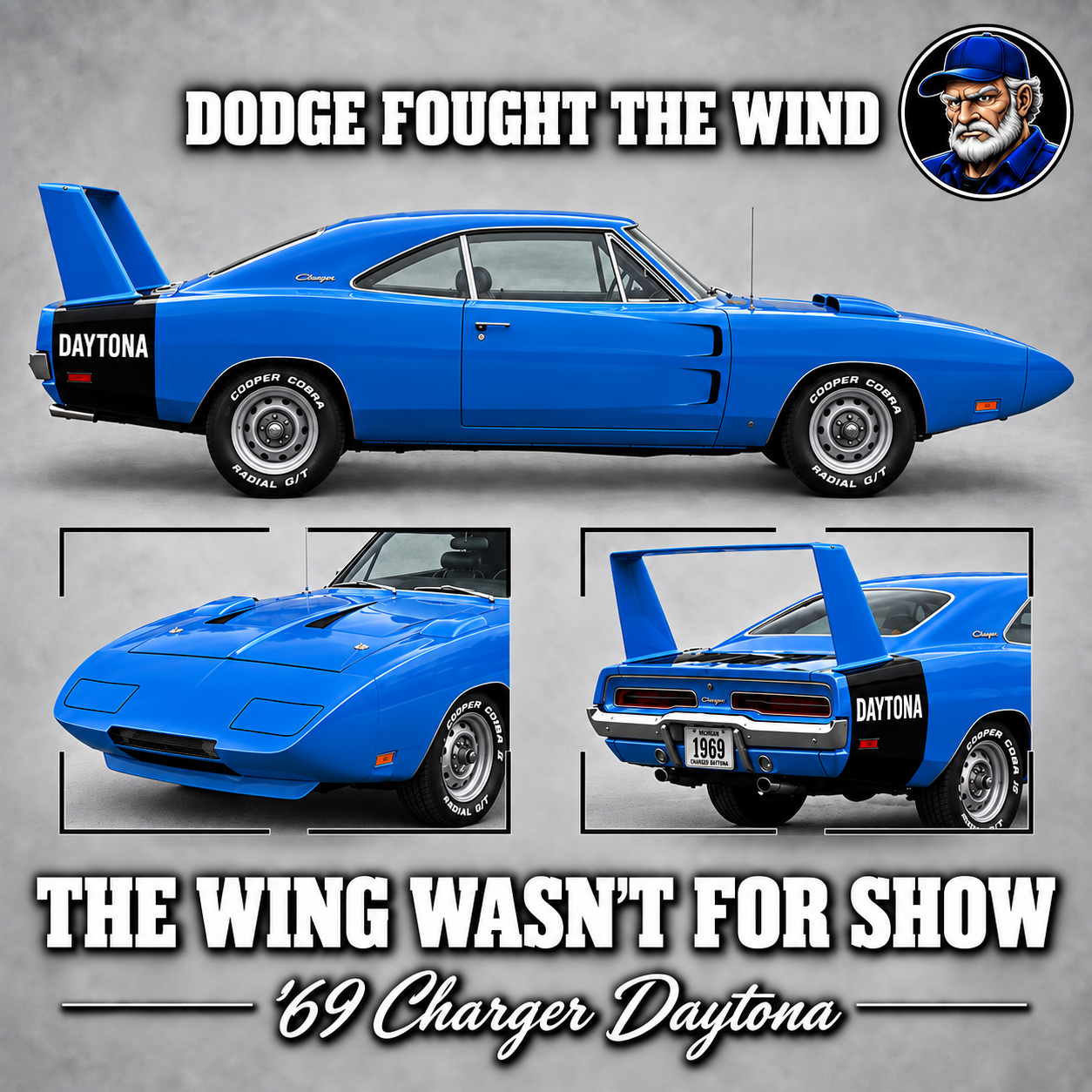
The answer was the 1969 Charger Daytona, complete with an 18-inch pointed nose cone, revised rear-window area, and a rear wing tall enough to make the whole thing look like it had wandered out of a race shop without anybody’s permission. It wasn’t pretty by conventional standards, and Dodge wasn’t trying to win a beauty contest. Every one of those changes had a job to do.
The pointed nose replaced the Charger’s blunt front end with a shape that could slip through the air with less resistance. That’s important when you’re chasing 200 mph. Double a car’s speed and aerodynamic drag increases roughly fourfold. The horsepower needed to overcome that drag goes up about eightfold. Another fifty horsepower might sound impressive at the dealership, but it won’t buy much speed when the body keeps wasting what you’ve already got.
And Dodge couldn’t just worry about drag. The engineers had to control what the air was doing underneath the car, too. They fitted a spoiler beneath the nose to help keep the front end planted. A car that slips through the wind isn’t much use if the front tires start getting light when the driver needs to turn.
The Daytona kept the Charger 500’s smoother rear-window treatment, then paired it with the pointed nose and rear wing. Cleaning up one end of the car wasn’t enough; Dodge had to get the air behaving from the front bumper clear to the back.
And then there was that enormous rear wing.
It wasn’t there to impress the neighbors. The horizontal airfoil pushed down on the rear of the car, helping the tires stay planted, while those towering vertical supports helped keep it tracking straight. At nearly 200 mph, you don’t want the back end wandering around while you’re trying to hold your line through a banked turn.
Here’s where the story gets interesting. For years, people have claimed Dodge made the wing so tall because the trunk lid needed room to open. The trunk certainly opened, but wing designer John Pointer later explained that he’d raised the wing into cleaner air above the turbulence coming off the body. Put an airfoil down in that disturbed airflow and it can’t deliver the same useful downforce. Other historical accounts describe trunk clearance as a factor in the final arrangement, so the explanations don’t agree completely. According to the man who designed it, though, getting the wing into clean air was the reason for its height.
Of course, NASCAR wasn’t about to let Dodge build one special race car and call it a production model. If Dodge wanted to race that body, it had to build at least 500 street versions.
Dodge built 503.
That put the Daytona’s outrageous nose and wing on cars ordinary customers could buy, and Dodge wasn’t sending them out with some wheezing little engine, either. The standard 440 Magnum carried a factory rating of 375 horsepower. Buyers wanting the full treatment could order the 426 Hemi with its advertised 425 horsepower.
The car made its NASCAR debut at Talladega in September 1969, where Richard Brickhouse drove one to victory. There was a catch, though. Many established drivers boycotted the race over tire-safety concerns, so it wasn’t the full-strength contest Dodge had hoped for.
But the Daytona’s speed wasn’t just a product of that unusual race.
On March 24, 1970, Buddy Baker drove a racing Daytona around Talladega at an officially timed 200.447 mph, becoming the first stock-car driver to break 200 mph on a closed course. That wasn’t somebody bragging about what the speedometer said. It was an officially timed lap, and Dodge had the number to prove its engineers knew what they were doing.
Bobby Isaac also won the 1970 NASCAR Grand National championship driving for the K&K Insurance Dodge team. He didn’t run the Daytona at every race, but the winged Charger was part of the team’s superspeedway program. The championship belonged to the whole season, not one particular body style, but the Daytona had earned its place in the operation.
Plymouth joined the argument with its own pointed-nose, winged Road Runner Superbird for 1970. The aerodynamic arms race was getting serious, and NASCAR wasn’t interested in letting it carry on indefinitely. For 1971, the sanctioning body restricted those special aerodynamic cars to engines no larger than 305 cubic inches.
The wings weren’t banned outright. Teams could still run them with smaller engines, but giving up their big-block power took away much of the advantage. Most teams went back to conventional bodies that could run larger engines, and Detroit’s wildest aerodynamic experiment was effectively finished.
The Daytona lasted just one model year, but it had already made its point.
Dodge didn’t need another fifty horsepower.
It needed to stop wasting the horsepower it already had fighting the wind.