1969 Pontiac Grand Prix — Smaller Car. Longer Hood.
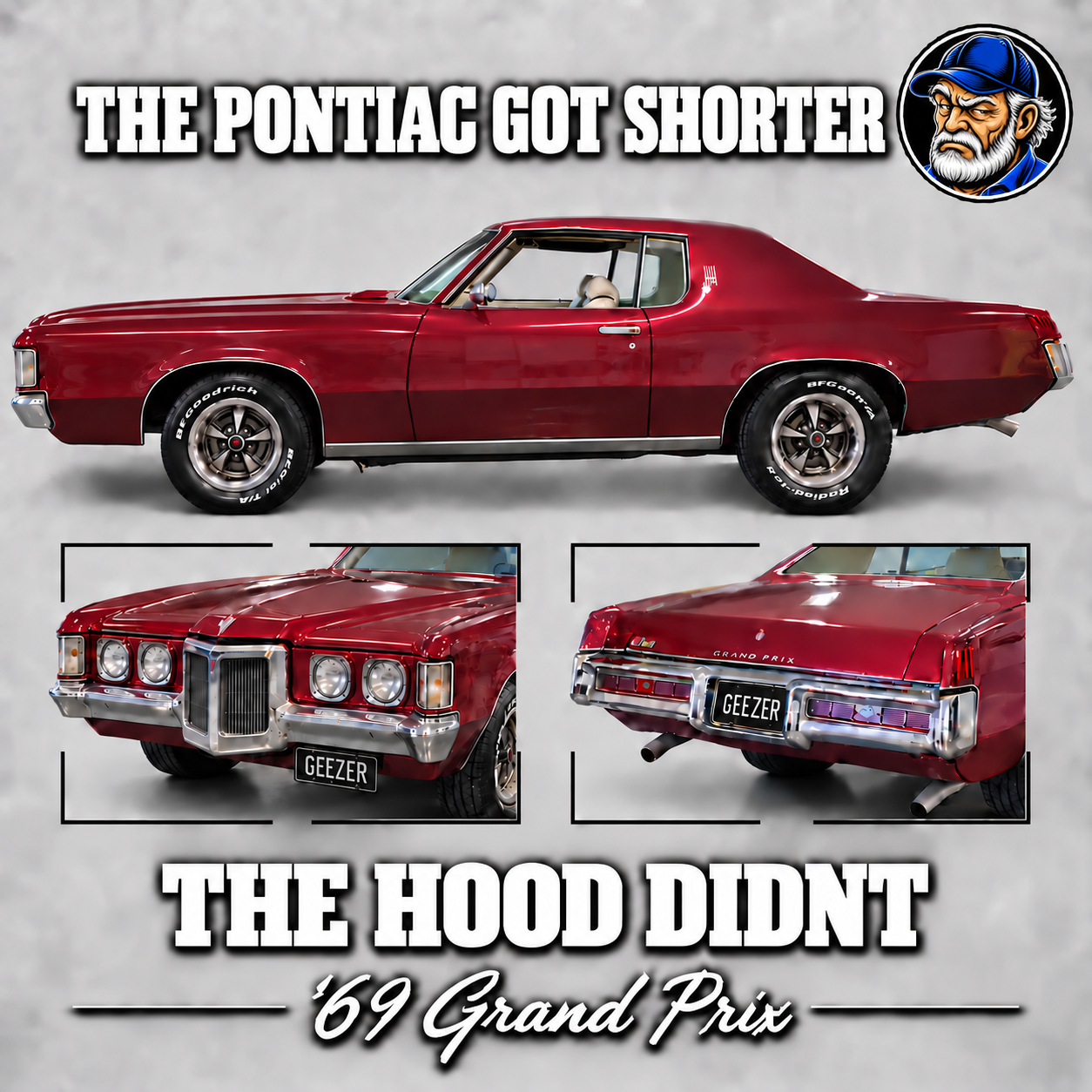
Smaller Car. Longer Hood.
By 1968, the Pontiac Grand Prix had a problem.
It was still handsome, still had buckets and V8 power, and still wore the right badge on the grille. Buyers just weren’t showing up like they used to.
Pontiac sold only about 31,000 Grand Prixs for 1968, which was a pretty clear message for a car that had once helped define the personal-luxury market.
The old formula was getting tired.
John DeLorean and Pontiac didn’t answer by making the next Grand Prix bigger. They did the opposite.
For 1969, Pontiac moved the car away from its full-size roots and built it around a stretched intermediate platform with a 118-inch wheelbase. The new car was shorter overall than the one it replaced, lighter, and much more tightly wrapped around the driver.
Then Pontiac gave it a hood that looked like it belonged on something twice as long.
That was the visual trick: shrink the basic package, then stretch the proportions until the car looked dramatic enough to stop traffic.
The new Grand Prix carried a long hood, short rear deck and sharply pointed nose that made the whole thing look like it was leaning forward while sitting still. Compared with the old Grand Prix, it was a much more concentrated package, but that hood stretched so far ahead of the windshield the driver could’ve started wondering whether the front bumper was in another county.
Pontiac was selling drama, and the 1969 Grand Prix finally looked like its own machine instead of a dressed-up big Pontiac.
Inside, the same idea kept going.
Bucket seats and a full center console put the driver in his own little compartment, while the instrument panel wrapped around him with gauges and controls close at hand.
Pontiac called it the Command Seat idea, and for once the advertising department had a point. You didn’t sit in the new Grand Prix and stare across a dashboard that looked like somebody had borrowed it from a family sedan. The whole thing was arranged to make the fellow behind the wheel feel like the car had been built around him.
That was a bigger change than just making the Grand Prix smaller.
Pontiac was changing what the car was for.
The Model J handled the basic personal-luxury job, while the SJ package pushed harder toward performance with more equipment and bigger power. The standard 400-cubic-inch V8 made 350 horsepower, the 428 stepped up to 370, and the 428 H.O. reached 390.
Put 390 horsepower behind six feet of hood and the styling started looking a little less theatrical.
Period testing showed a properly equipped 428 H.O. Grand Prix capable of running the quarter-mile in the low 14-second range. That’s plenty quick for something wearing enough interior trim to convince the neighbors you’d bought a luxury car.
Pontiac would even sell you one with a manual transmission.
Most buyers didn’t bother. They wanted the comfort, the automatic and the big V8 doing the work without asking anybody to row gears, but the fact that a stick was available tells you what Pontiac thought the Grand Prix ought to be.
Not a limousine.
Not a boulevard cruiser with all the excitement ironed out of it.
And not just a bigger GTO.
Pontiac had carved out its own spot: long hood, short deck, bucket-seat cockpit, serious V8 power and enough luxury to make the car feel expensive without sanding off all the fun.
Then the sales numbers came in.
Pontiac built 112,486 Grand Prixs for 1969, up from roughly 31,000 the year before.
That was the proof.
Pontiac hadn’t simply changed the sheet metal. It had changed the proportions, the architecture and the driving environment around a more focused idea.
Make the car smaller underneath, make it look bigger where the buyer could see it, and make the driver feel like the whole machine belonged to him.
That’s why the absurdly long hood matters.
It wasn’t just styling excess.
It was the signature of the whole comeback.
Smaller car. Longer hood. Bigger comeback.