1948 Tucker 48 — The Car That Became Bigger Than the Company
The Car That Became Bigger Than the Company
The Tucker 48 didn’t ease into the room.
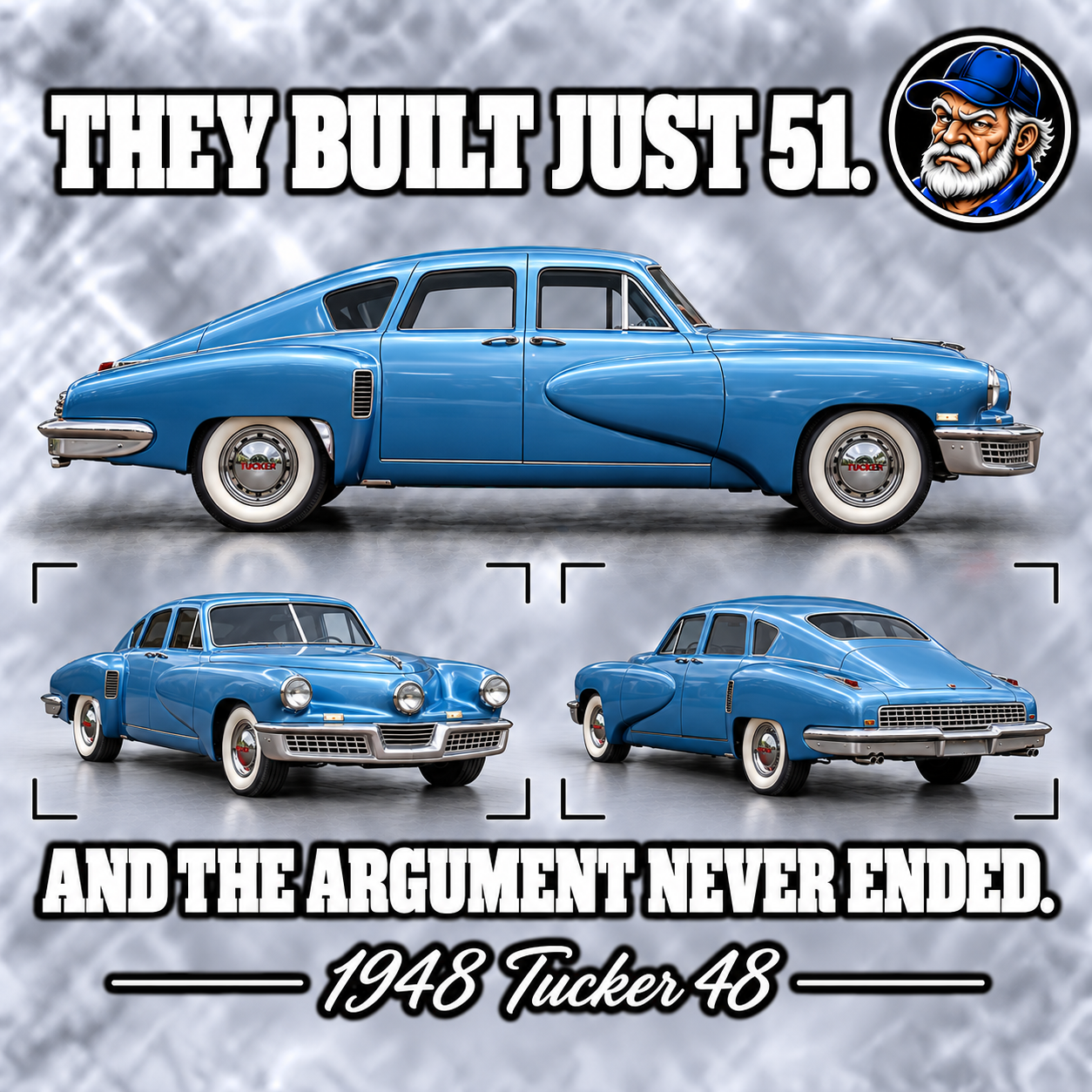
It arrived with three headlights, an engine in the rear, a low fastback body and enough new ideas to make half the industry look like it had overslept.
Preston Tucker wasn’t interested in warming over another prewar sedan and calling the chrome new. He wanted a car that looked different, worked differently and made buyers wonder why everybody else was still doing things the old way.
So he went after the usual American-car recipe with both hands. The engine went in the back, the body sat low, all four wheels got independent suspension, and then Tucker stuck a headlight in the middle that turned with the steering because apparently two headlights had become a lack of imagination.
That center light became the thing everybody noticed first. Tucker called it the Cyclops Eye, and instead of staring straight ahead with the other two, it swiveled with the front wheels to throw some light into a turn.
In 1948, that was enough to make a fellow stop on the sidewalk.
The rest of the car gave him plenty of reason to stay there.
Alex Tremulis shaped the production body into a long, low fastback on a 128-inch wheelbase, with the roof flowing toward a tail that looked like it was hiding something. It was. Tucker had put most of the mechanical business back there where American buyers weren’t used to finding it.
The production car used a rear-mounted, horizontally opposed six adapted from an Aircooled Motors helicopter engine. It displaced 335 cubic inches, made 166 horsepower and produced 372 lb-ft of torque.
That’s a mighty unusual answer to the question, “What should we put in the new family car?”
Tucker wasn’t building the sort of machine that made the service department yawn and reach for the same wrench it had used yesterday.
Power went through a four-speed preselector transmission, all four wheels were independently suspended, and the whole layout ignored the American habit of putting the engine up front and sending power all the way to the other end of the car.
Then Tucker started worrying about what happened when the shiny new car hit something.
Detroit wasn’t ignoring safety completely, but it sure wasn’t selling cars by talking about crashes over dinner. Tucker leaned into the subject anyway.
The windshield was designed to pop out in a collision instead of becoming one more hard object for the occupants to meet. The dashboard and doors were padded, sharp interior trim was kept down, and Tucker even promoted a protected area ahead of the front passenger where somebody could duck if a crash looked unavoidable.
That last idea sounds pretty peculiar now.
The padded surfaces and attention to sharp hardware don’t sound peculiar at all.
That’s the Tucker in a nutshell. Some ideas were clever, some were unfinished, and a few sound like they came from a fellow who had been staring at the drawing board too long after everybody else went home.
But he was trying.
And that distinction gets lost once the Tucker story turns into legend.
Only 51 cars were built, including the prototype. That’s barely enough automobiles to fill a decent used-car lot, yet those 51 have carried an argument for more than seventy years.
Depending on who’s telling it, Preston Tucker was either the visionary the government and big automakers couldn’t stand, or a promoter who raised money faster than he could turn promises into a functioning automobile company.
The real story is less convenient than either camp would like.
Tucker raised money in unconventional ways, including selling dealership rights before full production was underway. The Securities and Exchange Commission investigated the company, and Tucker and several associates eventually went to trial on fraud charges.
They were acquitted.
That settled the criminal case. It didn’t put money back in the bank, erase the headlines, restart suppliers or magically turn a struggling factory into Detroit overnight.
By then the company had been chewed on from every direction: financial strain, production delays, lawsuits, the investigation and the simple problem of trying to start an automobile company when automobile companies eat money like a furnace eats coal.
Tucker needed time to sort the car, build enough of them to learn what broke and convince buyers the whole operation would still be there when they came back for parts.
Time was the one thing he didn’t have.
Production stopped before the Tucker 48 ever got the chance to become ordinary.
That’s where everybody starts choosing sides.
One crowd says Tucker was strangled before he got a fair shot. Another says the company was too ambitious, too thinly financed and carrying too many unproven ideas at once.
Maybe there’s enough truth around the edges of both arguments to keep the fight going another seventy years.
The car doesn’t need the fight.
Take away the courtroom drama, the movie, the conspiracy stories and all the fellows still trying to solve the case from a lawn chair at a car show. What’s left is still one mighty strange automobile.
The engine was in the rear. All four wheels were independently suspended. The center headlight turned with the steering. The body sat low, the safety thinking was unusual, and almost nothing about the thing looked like Tucker had asked what everybody else was doing before he started.
Most importantly, he actually built the darned cars.
Not thousands. Not enough to prove Tucker would’ve become another Ford, Chevrolet or anything close to it. But 51 is a long way from a sketch on a napkin and a salesman promising the moon.
The Tucker 48 made it into steel, rubber and glass. It ran down the road, confused mechanics, fascinated buyers and disappeared before the industry had much chance to decide whether Preston Tucker was crazy, brilliant or just several years early.
People are still arguing.
The car is still sitting there with three headlights, probably enjoying every minute of it.
Tucker built only 51 cars. He somehow managed to build a legend big enough for all of them.