Don Schumacher
He Built a Funny Car Empire, Left for 23 Years, Then Came Back and Built a Bigger One
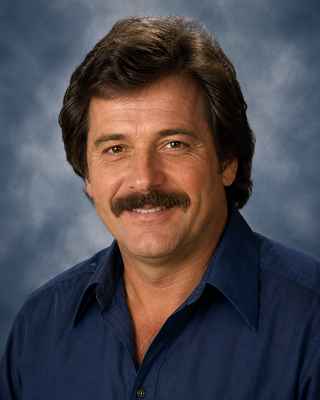
Most racing careers are fortunate to get one useful peak. Don Schumacher managed two of them separated by more than two decades and spent the time between proving he knew how to run something besides a race team.
The first time around, Schumacher was one of the busiest Funny Car racers in America. His Stardust machines chased match races across the country, he won the 1970 U.S. Nationals, collected five NHRA national-event victories and became as good at selling a race team as he was at driving one.
Then he quit and stayed gone for 23 years.
When Schumacher returned to racing in 1997, it was because his son Tony wanted to race Top Fuel. That family project eventually became Don Schumacher Racing, an operation that accumulated 19 NHRA world championships and 367 national-event victories during Don’s lifetime.
The first Schumacher operation was a handful of Funny Cars hustling match-race bookings. The second became one of the largest professional drag-racing teams ever assembled. Different scale, same fellow looking at one race car and wondering why there couldn’t be more of them.
The Shoe Started on the Street
Don Schumacher was born November 4, 1944, in Grand Rapids, Michigan, and grew up in the Chicago area. He later explained his introduction to drag racing with admirable efficiency: he drove too fast on the street.
Organized drag racing provided a place where that particular personality defect came with trophies.
Schumacher began competing seriously during the 1960s and quickly moved toward the new Funny Car category, where factory-looking bodies were being stretched over specialized race cars powered by supercharged nitro engines. Nobody had completely decided what a Funny Car was supposed to be yet, and Schumacher was perfectly willing to help with the experiment.
Match Racing Was the Real Business
Modern professional drag racers organize their seasons around a national schedule. In the late 1960s and early 1970s, a successful Funny Car team could make much of its living somewhere else: match races.
Promoters booked famous cars into local strips because those names put people in the grandstands. A good team might race several nights in one week and spend most of the remaining time driving to the next track. From 1968 through 1974, Schumacher competed in roughly 560 match races and is credited with winning about 70 percent of them.
That required machinery that could be repaired repeatedly, a crew willing to live on the road and a driver who understood that Saturday night’s crowd did not care how tired everybody had been on Friday. Don understood the arrangement very well.
The Stardust Cars Made Him Famous
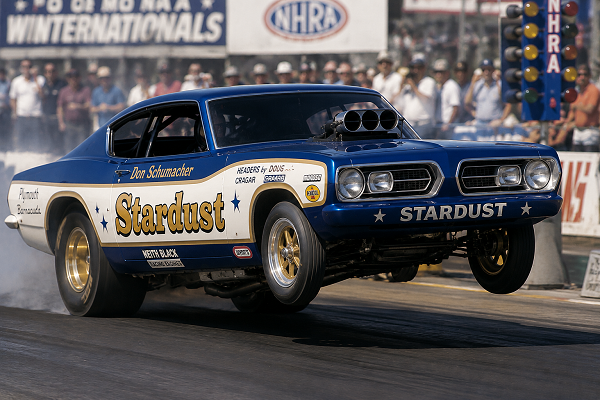
Schumacher’s best-known early cars carried sponsorship from the Stardust Hotel & Casino in Las Vegas. The arrangement suited Funny Car rather well. Las Vegas understood promotion. So did Don Schumacher.
The Stardust cars became major match-racing attractions, and Schumacher expanded beyond a single entry so the operation could satisfy bookings in more than one place. Drivers in Schumacher-owned cars included Raymond Beadle, Bobby Rowe, Arnie Behling, Clare Sanders and Cliff Zink.
A racer with one car could appear at one track. Schumacher was already thinking like a fleet operator.
Indy 1970
The national-event record caught up with Schumacher’s match-racing reputation at the 1970 U.S. Nationals. He worked his way through Funny Car eliminations and won Indianapolis, collecting the first of his five NHRA national-event victories.
It became the signature trophy of his driving career. The match-race crowd already knew who Don Schumacher was. Now the record book had caught up.
He Wasn’t Just Holding the Steering Wheel
Schumacher’s early operation did not have separate departments for ownership, engineering, tuning and driving. Don handled most of those jobs himself: owner, crew chief, driver and mechanic, with a couple of crewmen helping.
That was the department chart.
Schumacher experimented constantly with engines, clutches, chassis setup and aerodynamics. His cars became known for being well prepared at a time when keeping a nitro Funny Car intact for an entire weekend was a legitimate engineering accomplishment.
He also paid close attention to what happened when things went wrong, which was not an academic concern in an early Funny Car.
Fire Was Part of the Job Description
Early Funny Cars could trap the driver beneath a fiberglass body while burning nitromethane and oil turned the cockpit into a place nobody wanted to remain. Schumacher helped develop a roof-mounted escape hatch that gave the driver another way out when raising the body was impossible.
He also moved the activation control for the onboard fire-suppression system to the brake handle, allowing a driver to brake and activate the extinguishers while keeping the other hand on the steering wheel.
Both ideas look obvious after somebody has thought of them. Useful safety improvements often do. The trick is being the fellow who thinks of them before the next fire.
The Wonder Wagon Kept Changing
Schumacher understood sponsorship before professional drag racing became particularly sophisticated about it. Late in 1972, Interstate Bakeries backed the Wonder Wagon program promoting Wonder Bread.
The first version used a Vega panel-wagon body. It was distinctive and troublesome enough that distinctive eventually lost the argument.
For the 1973 U.S. Nationals, Schumacher debuted a radically different John Buttera-built Vega coupe. The car was extremely low and incorporated a flow-through grille, enclosed side windows, wheel discs, a louvered rear window and other aerodynamic tricks intended to clean up the air around a Funny Car.
The familiar red, yellow and blue Wonder Bread graphics made sure nobody missed the sponsor. The race car remained considerably less useful for sandwiches.
It was Schumacher’s early formula in one fiberglass shell: make it recognizable enough to sell and serious enough to win.
1972 and 1973 Added More Hardware
Schumacher’s success was not confined to NHRA. He won the 1972 Coca-Cola Cavalcade of Stars Funny Car championship and the 1973 AHRA Funny Car world championship, along with nine IHRA event victories during his driving career.
By 1974, one of his best runs was a 6.18 at 241.95 mph. The Shoe was still competitive.
Then he walked away.
The Battery-Charger Business Needed Him More
Schumacher’s father had founded Schumacher Electric, a Chicago-area manufacturer best known for battery chargers. By 1974, the family business needed Don’s attention, and he had a young family that had already spent enough time watching him disappear down highways behind race-car trailers.
Schumacher retired from driving, and this was not one of those racing retirements that lasted until somebody offered a better engine next Tuesday. He stayed gone.
He concentrated on Schumacher Electric and helped turn it into an international operation. Racing could wait.
Then his son complicated the arrangement.
Tony Wanted to Race
Tony Schumacher had grown up around the remnants and stories of his father’s racing career. Eventually he wanted one of his own.
Don approached the project the same way he approached business. Do not build something that can merely participate. Build an organization capable of winning.
Schumacher returned to active team ownership in 1997. Don Schumacher Racing made its NHRA national-event debut with Tony at the 1998 U.S. Nationals, and by the end of 1999 Tony Schumacher was the NHRA Top Fuel world champion.
Things escalated from there.
One Dragster Became an Army
The single-car operation expanded into multiple Top Fuel dragsters and Funny Cars, then into other NHRA professional categories. The roster eventually included championship drivers such as Tony Schumacher, Gary Scelzi, Ron Capps, Matt Hagan, Jack Beckman and Antron Brown.
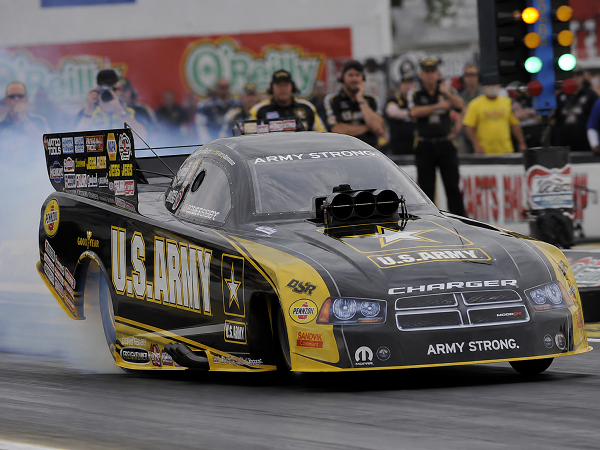
Tony alone won eight Top Fuel championships. For years his U.S. Army dragster became one of the most recognizable cars in the sport, while DSR Funny Cars collected championships and national-event trophies on the other side of the pit.
At its largest, Schumacher’s organization could arrive with enough professional race cars to look less like a team than its own sanctioning body.
Don had started by putting extra Stardust Funny Cars on the road because one car could not make two match races. Twenty-three years away from racing had not removed the instinct.
The Team Changed Professional Drag Racing
Schumacher brought the business discipline of Schumacher Electric into the race shop. Sponsorship programs included serious corporate hospitality and marketing operations, while DSR invested heavily in engineering, fabrication and component development.
The organization looked far more like a large professional motorsports company than the small independent nitro teams Schumacher had known in the 1970s. That scale did not make him universally popular with competitors trying to fight the same war with smaller checkbooks.
For some independent teams, Don Schumacher could be about as welcome as another round of qualifying. He did not build DSR to make the competition comfortable.
The Safety Work Came Back Too
Schumacher never lost his interest in driver protection. Decades after adding escape hatches and better fire controls to Funny Cars, DSR funded development of an enclosed cockpit canopy for Top Fuel dragsters.
The system placed a protective structure around the driver’s head rather than leaving the helmet completely exposed behind the engine, and other teams adopted it.
The technology was considerably more sophisticated than cutting an escape hatch into a Funny Car roof. The question behind it had not changed: what can be fixed before somebody gets hurt?
Nineteen Championships
By the time of Schumacher’s death, Don Schumacher Racing had accumulated 19 NHRA world championships and 367 national-event victories. The championships included 11 in Top Fuel, seven in Funny Car and one in Factory Stock Showdown.
Schumacher also became the only team owner to win races in all four NHRA professional categories: Top Fuel, Funny Car, Pro Stock and Pro Stock Motorcycle.
Those totals included the five NHRA trophies Don had won himself more than half a century earlier. By then, the driver had become a very small statistical portion of his own racing organization.
The Halls Eventually Ran Out of Reasons to Wait
Schumacher entered the International Drag Racing Hall of Fame in 2007, the International Motorsports Hall of Fame in 2013 and the Motorsports Hall of Fame of America in 2019. NHRA presented him with its Lifetime Achievement Award in 2022.
The honors covered both halves of an unusual career: the Funny Car driver who won Indy and the owner who returned after 23 years and built a modern drag-racing dynasty.
Don Schumacher died on December 20, 2023, at age 79.
The Bottom Line
Don Schumacher could have disappeared from racing in 1974 and still deserved a place in Funny Car history. He won Indy, collected five NHRA national-event victories, ran hundreds of match races, won major touring championships and helped improve Funny Car safety while the category was still inventing itself.
Then he spent 23 years doing something else and came back because his son wanted to race.
That second operation eventually produced 19 championships and 367 national-event victories, but the scale can hide how familiar the idea really was. The Stardust days had already taught Schumacher to multiply cars, hire capable people, give sponsors something worth buying and make the machinery survive long enough to keep the bookings coming.
The first empire made The Shoe famous. The second made the first one look like practice.
↑ Back to the Top, Before Don Adds Another Race Team