Gene Snow
The Transmission Kept Getting in the Way, So Snow Got Rid of It
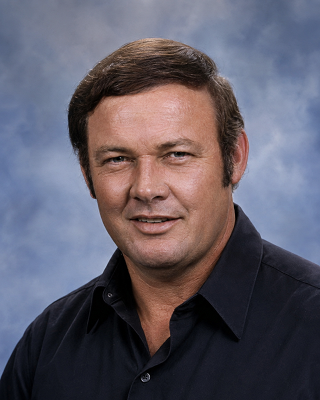
Funny Cars were getting too powerful for their transmissions, and Gene Snow was never the sort of racer who kept an expensive piece of machinery around merely because everybody else thought a race car was supposed to have one.
By the late 1960s, blown Chrysler Hemis were producing enough power that the automatic transmissions common in early Funny Cars had become a weak link. They absorbed power, broke parts and tended to run out of enthusiasm before the engine did. Snow considered the problem and arrived at a pleasantly direct solution: quit using one.
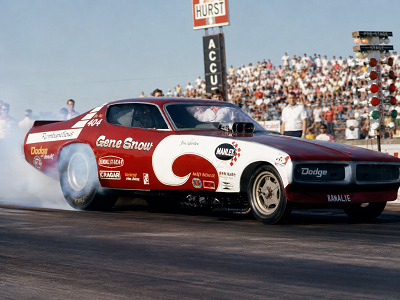
Snow and his crew worked with Crower on a multi-disc centrifugal clutch that allowed his Rambunctious Dodge to run essentially direct drive. The car was not especially impressive leaving the starting line. Farther down the track was another story. Snow’s top-end speeds jumped past the automatic-equipped competition, Rambunctious became the first Funny Car to break 200 mph, and the same basic thinking eventually helped carry Snow to the first NHRA Funny Car world championship in 1970.
Two decades later, after moving to Top Fuel, Snow helped do essentially the same thing again. That car became the first NHRA national-event dragster into the four-second zone.
That was Gene Snow’s recurring habit. When horsepower exposed a weak link, he had very little sentimental attachment to the weak link.
Winning on Sunday Really Did Sell Cars on Monday
Snow came out of Fort Worth, Texas, and originally intended to become an electrical engineer. He spent three years studying engineering at the University of Texas at Arlington before discovering that selling used cars paid better. The decision also supplied racing equipment.
Snow and business partner L.G. Melton operated a used-car lot, and Snow began racing cars from the inventory as a way to promote the business. Win on Sunday and sell that particular car on Monday. Few dealerships have ever taken the slogan quite so literally.
He progressed through a 348 Chevrolet, a 409 and then Chrysler machinery. A 413 Plymouth Sport Fury led to Max Wedge Dodges, then the 426 Hemi. By the middle of the 1960s, Detroit’s factory drag cars had started mutating into machines that no longer fit comfortably into the old rulebook.
Snow went right along with them.
Rambunctious Started Getting Funny Before Funny Car Was a Class
In 1965 Snow raced an altered-wheelbase Dodge Dart built by fellow Texan Don Hardy. Moving the axles forward helped weight transfer and planted the rear tires, but it also made the car look as though somebody had installed the body without consulting the wheel openings. People started calling machines like it funny cars before NHRA had decided Funny Car ought to be a proper class.
That left Snow’s Dart wandering through whatever category the rulebook could be persuaded to accept. For 1966, the chassis was lengthened to improve stability, and Snow won Competition Eliminator at the U.S. Nationals with the Dart running in C/Fuel Dragster. He returned to Indianapolis in 1967 and won again, this time in the new Super Eliminator category.
The rulebook was still trying to decide what the machine was. Snow was mostly interested in whether it won.
More Hemi Created a New Problem
By 1968, Snow had moved to supercharged machinery and quickly adopted the more aerodynamic Dodge Charger body. The engines were making more power. The automatic transmissions were not enjoying the progress.
Snow noticed that even when they survived, the automatic-equipped cars tended to stop accelerating hard near the top end. The Hemi still had more to give, but too much of it was disappearing into the drivetrain. So Snow, crewman Jake Johnston and the people at Crower began experimenting with a different arrangement.
No conventional transmission. Instead, a four-disc Crowerglide centrifugal clutch progressively coupled the engine directly to the rear axle.
The compromise was easy to see. Without transmission multiplication, the car left the starting line softer. Then the clutch locked harder, the Hemi kept pulling and the automatic cars started coming backward.
Snow had traded starting-line drama for finish-line speed. He could live with that arrangement.
The Far End of the Track Became Snow Country
The direct-drive Rambunctious Charger became known for tremendous top-end speed. Snow was regularly running in the mid-190s while competing cars tended to flatten out around 185.
At Don and Carl Gay’s track in Dickinson, Texas, the combination finally crossed the number everybody was watching: 200.88 mph, the first 200-mph Funny Car performance. Snow later ran 205.46 mph at Orange County International Raceway and pushed beyond 210 with a 213.78-mph clocking in 1969.
The direct-drive arrangement had gone from an experiment to an advantage, and Snow had demonstrated an idea that would eventually become fundamental to nitro racing. The clutch could do the work everybody had assumed required a transmission.
NHRA Eventually Made 200 Official
Early Funny Car record keeping could be untidy. Match races were everywhere, timing equipment varied and a spectacular number recorded at an independent track did not automatically become an NHRA national record.
So Snow got another chance to make 200 official. On May 3, 1970, at the NHRA Springnationals at Dallas International Motor Speedway, Rambunctious ran 7.23 seconds at 208.71 mph. That became the first 200-mph Funny Car run at an NHRA national event.
Snow did it in Texas, which suited the whole operation just fine.
1970 Was the Year Rambunctious Became the Standard
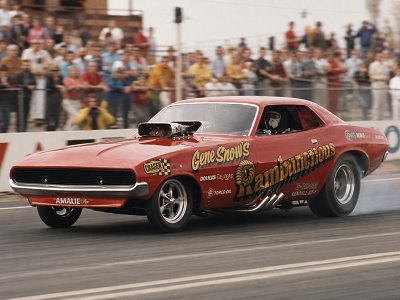
Snow entered 1970 with a new Dodge Challenger and one of the strongest Funny Car combinations in the country. Runner-up finishes at the Winternationals and Springnationals came first. Then the wins started.
Snow took the NHRA Summernationals at York, Pennsylvania, won the World Finals in Dallas and added the inaugural Supernationals at Ontario, California. Winning the World Finals made him NHRA’s first Funny Car world champion. He also won three AHRA Grand American events, captured the AHRA points championship and was named AHRA Driver of the Year.
By the end of the season Rambunctious had run as quick as 6.76 seconds and as fast as 218.44 mph. Snow particularly liked another number: zero.
That was how many times the team needed the spare engine it carried through the season. A fast Funny Car was useful. A fast Funny Car that did not scatter the inventory every weekend was better.
Rambunctious Became an Organization
Snow expanded into a multicar Funny Car operation in the early 1970s, putting longtime crewman Jake Johnston into a second Rambunctious while continuing to race himself. Revell sponsorship followed, along with a large-scale Snowman model kit and an operation that eventually included multiple Funny Cars and a Top Fuel dragster.
Snow kept experimenting too, including a turbocharged Funny Car that supplied the usual reminder that not every clever idea becomes the next Crowerglide. He remained a winner, taking the 1974 NHRA Springnationals at Columbus and the IHRA U.S. Open with a Vega-bodied Funny Car.
But racing costs were climbing, the energy crisis hurt the match-race business and Snow eventually stepped away at the end of 1978. For another racer, that would have completed a very respectable career.
Snow still had another drivetrain problem waiting for him.
He Came Back and Removed the Transmission Again
Snow returned in 1981 and chose Top Fuel. If there was going to be another serious stretch in racing, he wanted the quickest and fastest machinery available.
The results were substantial. From 1983 through 1991, Snow finished in the NHRA Top 10 for nine consecutive seasons. More interesting was what happened underneath the car.
Top Fuel drivetrains were wrestling with the same basic problem Funny Cars had confronted two decades earlier. Enormous horsepower had a habit of making conventional drivetrain parts expensive and temporary. Snow had seen this movie before.
Working with Bob Brooks at AFT, he helped develop a direct-drive clutch arrangement for Top Fuel. The hardware had become more sophisticated, but the thinking had not: let the clutch manage the engine, get unnecessary machinery out of the way and use the horsepower farther down the racetrack.
The architecture became the foundation of the fuel-car drivetrain still recognizable today.
4.997
On October 6, 1988, NHRA opened the new Houston Raceway Park with the Supernationals. Gene Snow made the first qualifying run.
The scoreboard showed 4.997 seconds at 279.06 mph.
It was the first four-second Top Fuel pass at an NHRA national event. Twenty years earlier, Snow had helped put Funny Car beyond 200 mph by changing the way power reached the rear axle. Now another direct-drive fuel car had crossed another barrier.
Same racer. Same kind of problem. A great deal less time to solve it.
The Funny Car Record Was Only Half the Evidence
Gene Snow’s racing résumé would be enough without the engineering story: back-to-back Indianapolis victories before Funny Car was properly organized, the first Funny Car beyond 200 mph, the first official NHRA national-event Funny Car 200 and the first NHRA Funny Car world championship.
Then came national-event success in Top Fuel, nine consecutive Top 10 finishes and the first NHRA national-event four-second Top Fuel run. NHRA eventually ranked Snow No. 26 among its 50 greatest drivers during the organization’s 50th-anniversary celebration.
But the milestones make more sense when viewed together. Snow was not merely standing nearby while drag racing became faster. He kept looking at the machinery sitting between the engine and the elapsed time and asking whether all of it really needed to be there.
The Later Record Is More Complicated
Snow’s racing accomplishments do not erase what happened later in his life. In 2006, he was charged in Texas with aggravated sexual assault of a child following allegations involving a teenager.
The case ultimately ended differently from the original charge. In 2007, Snow pleaded guilty to the reduced charge of injury to a child and received three years of probation.
That later history substantially complicates the public legacy attached to one of drag racing’s most accomplished early Funny Car racers. The racing record remains part of the sport’s history. So does the rest of the biography.
The Bottom Line
Gene Snow belongs among the Funny Car Legends because Rambunctious was there while the class was still figuring out what it was. He raced altered-wheelbase Dodges before NHRA had a proper Funny Car category for them, helped move the class into blown, tube-chassis, flip-top machinery, pushed Funny Car through 200 mph and won its first NHRA world championship.
But the best evidence of what Snow contributed to the machinery came twenty years later, when Top Fuel developed another problem getting enormous horsepower to the tires. Snow went back to the same basic idea that had worked when Funny Cars started eating transmissions.
Use the clutch to control the power. Lose the machinery that is getting in the way. Keep accelerating.
Gene Snow spent a good portion of his racing career proving that when horsepower becomes ridiculous enough, one of the smartest things a racer can do is quit carrying parts that no longer earn their ride.
Gene Snow spent enough time around nitro, Funny Cars and questionable ways of entertaining a crowd to earn a place in Racing Shenanigans.
➤ See Gene Snow help turn the burnout into a wall of fire in Racing Shenanigans
↑ Back to the Top, Before Snow Removes Another Part