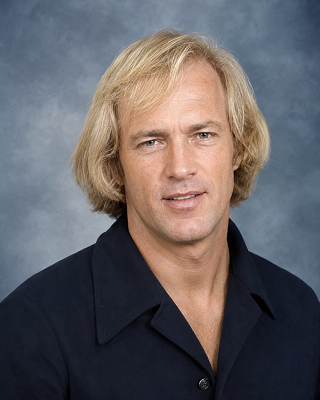
Gordie Bonin
They Called Him 240 Gordie. Then He Kept Making the Nickname Obsolete.
Funny Car drivers generally preferred nicknames involving snakes, mongooses, jungle animals or something else that sounded dangerous on a poster.
Gordie Bonin got a number: 240 Gordie.
That was what happened when a Canadian Funny Car driver spent enough time running in the rarefied 240-mph zone that people stopped needing his last name. Bonin and the Ron Hodgson Pacemaker team became one of the strongest Funny Car combinations of the late 1970s, winning Gainesville three times, taking the 1979 U.S. Nationals, winning twice at the World Finals and pushing the national speed record to 245.90 mph.
Bonin also became the fourth Funny Car driver into the five-second club with a 5.97 at Indianapolis. Then he quit driving, took a desk job with NHRA and stayed away long enough for an entirely different generation of Funny Cars to appear.
So naturally he came back and started winning again.
That was Gordie. The machinery changed, the speeds changed and the people around him changed. The fellow inside the firesuit remained remarkably adaptable.
Canada Had Funny Cars Too
Gordie Bonin was born in Prince Albert, Saskatchewan, in 1948 and grew up in Red Deer, Alberta. He spent enough time around the drag strips at Edmonton and Calgary that eventually watching other people race stopped being sufficient.
His early machinery included a Chevrolet, a Chevelle Super Sport and a factory-backed AMC Hurst/Scrambler. By 1970 he had moved into Junior Fuel, driving a small-block Chevrolet dragster on nitromethane.
Funny Car was about to raise the question considerably.
A Phone Call Put Him in a Funny Car
In 1972, Canadian racer and tuner Gordon Jenner called Bonin with an opportunity. Ron Hodgson’s Pacemaker operation had a new Vega Funny Car and needed somebody to drive it.
Bonin flew to California and went through the licensing process at Lions Drag Strip. On his third run in a Funny Car, he went roughly 205 mph. That was enough to suggest nobody had made a terrible mistake.
The team hauled the Pacemaker Vega to Indianapolis for the 1972 U.S. Nationals with equipment that would look almost recreational beside a modern professional operation. Bonin qualified third and reached the final.
Ed McCulloch beat him for the trophy, but reaching the Indy final on the first serious trip with a Funny Car tends to rearrange a fellow’s plans.
Roland Leong Borrowed Him for a While
Late in 1973, legendary car owner Roland Leong suddenly needed a driver for his Hawaiian Funny Car after rebuilding an operation that had been stolen from a hotel parking lot in Gary, Indiana.
Bonin was available and drove the Hawaiian into 1974 before returning to the Canadian Pacemaker operation.
Leong later remembered Bonin as unusually easy to work with and particularly good at making the right decision when a Funny Car gave its driver a fraction of a second to choose between saving the run and saving the race car.
That ability would become one of Bonin’s calling cards. He was quick, but he was also useful after the run was over.
The Pacemaker Team Found Its Combination
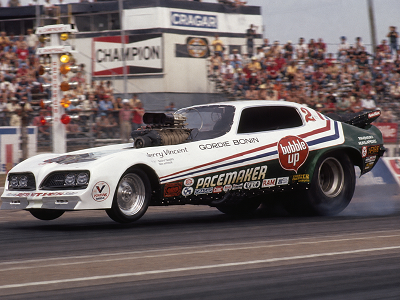
Bonin reunited with Hodgson and Jenner, and veteran tuner Jerry Verheul joined the operation in 1975. The pieces fit.
Hodgson supplied the operation. Jenner and Verheul understood how to make the machinery run. Bonin became the part of the data-acquisition system that wore a firesuit.
Hodgson later described it neatly: they did not have computers in the car, so Gordie was their computer. He could tell the crew what the chassis and engine had done well enough for the tuners to make the next adjustment.
That was worth plenty in an era when a driver who came back saying the car “felt funny” had not exactly delivered a complete engineering report.
The team won the NHRA Division 6 Funny Car championship every year from 1975 through 1980. Then the national-event trophies started arriving.
1977 Was When Everybody Learned the Name
Bonin opened his NHRA national-event win account at the 1977 Gatornationals. The Bubble Up/Pacemaker Trans Am qualified No. 1, set low elapsed time at 6.19 and ran 238.72 mph.
Later that year, Bonin reached the World Finals at Ontario Motor Speedway with Don Prudhomme already on his way to another championship. Bonin beat him in the final.
Prudhomme took the championship. Gordie finished second in the standings and left Ontario with the last trophy of the season.
The Snake still owned Funny Car. The fellow from Alberta had become one of the people making ownership less comfortable.
Gainesville Developed an Odd-Year Problem
The Gatornationals and Gordie Bonin developed one of drag racing’s stranger arrangements. He won in 1977, came back and won again in 1979, then did it one more time in 1981.
The 1981 race was also the 100th NHRA Funny Car national event. Bonin and the Jerry Verheul-tuned Flo-Rite car beat Dale Pulde in the final, 6.18 to 6.21.
If NHRA wanted somebody else to win Gainesville in an odd-numbered year, it eventually had to wait until Gordie stopped arriving with a competitive car.
1979 Was the Year 240 Gordie Became Official
If Bonin had to choose one weekend from his first career, Indianapolis in 1979 made a convincing case.
It was the 25th anniversary U.S. Nationals, and the Funny Car field was viciously quick. Don Prudhomme, Raymond Beadle and Pat Foster were already in the fives when Bonin joined them with a 5.97, making him the fourth member of the Cragar Five-Second Funny Car Club.
Then the Bubble Up Firebird ran 245.90 mph. Bonin backed the speed up during eliminations, giving him the NHRA national Funny Car speed record.
And then he won the U.S. Nationals.
Five-second club, national speed record and an Indy trophy in the same week. There are worse ways to spend six days at a drag strip.
And He Wasn’t Done With 1979
Bonin had already won Gainesville. At the World Finals at Ontario, he won again, defeating Tripp Shumake in the final.
That gave Bonin three NHRA national-event victories for the season, more than any other Funny Car driver that year. Raymond Beadle won the championship; Bonin owned the national speed record and three of the trophies.
Drag racing has never promised to distribute its rewards neatly.
Even the Movie Needed Gordie to Drive
The 1979 Canadian racing film Fast Company used Bonin and his machinery during filming, including a sequence in which the Funny Car blasted through a garage door, stopped for a red traffic light and left when it changed.
There are several things a nitro Funny Car does better than ordinary transportation. Waiting politely at an intersection is not usually one of them.
Six Wins, Then a Desk
The 1981 Gatornationals victory was Bonin’s sixth NHRA national-event win. When the original Pacemaker operation wound down, Bonin moved to California and went to work for NHRA.
From 1983 through 1989 he worked in marketing, eventually serving as director of marketing and marketing services manager. For six years, one of the men who had sold Bubble Up at 240 mph helped sell drag racing itself.
Bonin still wanted to drive. Office work had not cured that particular problem.
The Return Came With the Engine Behind Him
In 1989, old partners Ron Hodgson and Gordon Jenner helped put Bonin back into a race car, this time a Top Fuel dragster. The reunited Canadian combination won the AHRA Top Fuel World Championship.
Two years later, Bonin drove Gary Ormsby’s Top Fuel car at Seattle while Ormsby was ill and reached the semifinals before losing to Joe Amato.
The right foot had survived office work just fine.
Roland Leong Called Again Twenty Years Later
For 1993, Bonin returned to Funny Car with Roland Leong, nearly two decades after their first stint together.
At the Springnationals in Columbus, Bonin reached the final after defeating Wyatt Radke while running the quarter-mile on seven cylinders. Gordon Mineo won the other semifinal but could not return after his Funny Car unexpectedly restarted in the shutdown area and struck Eddie Hill’s tow vehicle.
Bonin took the solo.
Twelve years after his previous NHRA victory, Gordie had another one. Funny Cars had changed enormously in the meantime. Bonin had simply learned the newer version.
Candies & Hughes Gave Him Two More
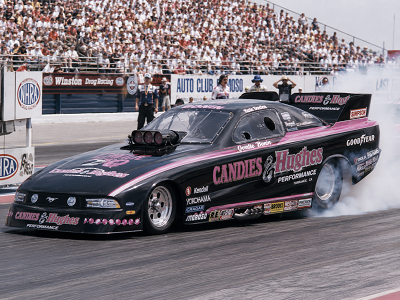
Bonin moved to the famous Candies & Hughes operation for 1994. He won at Memphis and then returned to Columbus, where he won the Springnationals for the second consecutive year by beating Al Hofmann in the final.
The Columbus victory was NHRA Funny Car win number nine.
His first six victories had come between 1977 and 1981. The final three came in 1993 and 1994, after the cars had become dramatically quicker and more sophisticated.
Plenty of racers are fast in the machinery they grew up with. Bonin was still winning after the job description had been rewritten.
Europe Gave Him One More Championship
In 1999, a Prolong sponsorship program put Bonin into a Rune Fjeld Motorsports Top Fuel dragster for the FIA European championship.
He won three of the five events and the 1999 FIA European Top Fuel Championship.
The kid from Red Deer who had gone to Indy in 1972 with two spare pistons had taken a somewhat indirect route to Monaco to collect another championship trophy.
The Numbers Never Quite Explain the Career
Bonin finished with nine NHRA Funny Car national-event victories. He won Gainesville three times, the World Finals twice and the U.S. Nationals once. He finished second to Prudhomme in the 1977 championship, held the NHRA Funny Car speed record at 245.90 mph and became the fourth member of the five-second club.
Bonin, Hodgson and Jenner were inducted into the Canadian Motorsport Hall of Fame in 2000. Gordie Bonin died November 29, 2013, at age 65.
Friends who remembered him after his death kept returning to the same points: easygoing, enthusiastic, good with fans and unusually good at telling a crew what a Funny Car had just done.
And fast. Very fast.
The Bottom Line
Gordie Bonin arrived at his first U.S. Nationals in 1972 with a Canadian Funny Car team that had borrowed a truck and brought two spare pistons. He reached the final.
Seven years later, he returned to Indianapolis with Bubble Up on the body, ran 5.97, set a 245.90-mph national speed record and won the biggest race in drag racing.
Then he spent more than a decade away from NHRA Victory Lane and came back to win three more times in Funny Cars that were considerably less forgiving of anyone who had failed to keep up with the technology.
They called him 240 Gordie because that sounded impossibly fast when he earned it. The problem with the nickname was that Gordie Bonin kept going faster.
↑ Back to the Top, Before Gordie Finds Another Two Miles an Hour