Butch “The California Flash” Leal
Chevy. Ford. Plymouth. Funny Car. Modified. Pro Stock. Just Give Him a Four-Speed.
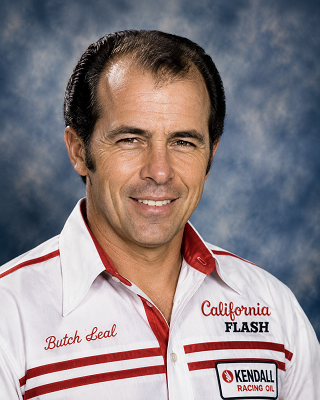
Butch Leal could leave on people. That sounds like a small thing until the other fellow has the quicker race car and still watches your win light come on.
Leal built a career around reaction time, four-speed driving and the inconvenient ability to remain competitive whenever somebody changed the class, engine, manufacturer or rulebook. He started in Chevrolets, became a Ford factory driver at 19, switched to Chrysler, won an NHRA Super Stock championship, helped altered-wheelbase Mopars evolve toward Funny Car, raced Pro Stock, won in Modified and then returned to Pro Stock strongly enough to nearly win the championship.
By then everybody knew the name painted on the doors: the California Flash.
It Started in California Farm Country
Larry “Butch” Leal grew up in California’s San Joaquin Valley around Tulare and Pixley, the son of a trucker and a kid considerably more interested in automobiles than schoolwork.
His first serious street car was a 1960 Chevrolet El Camino with a 348. It did not remain transportation for very long.
Leal began racing while still in high school and quickly established a reputation for being unusually good with a clutch pedal and four-speed. H.L. Shahan became an early friend and influence, and by 1962 Leal was racing a 409 Chevrolet.
Then Chevrolet supplied increasingly serious equipment, culminating in a lightweight 1963 Z11 Impala with a 427. Detroit was paying attention right up until General Motors officially quit racing.
Mickey Thompson Found Him a Ford
GM’s racing withdrawal left plenty of Chevrolet racers wondering what came next. For Leal, the answer arrived through Mickey Thompson.
Ford was preparing its new 427 Fairlane Thunderbolt for 1964 and needed drivers who knew what to do with a high-horsepower four-speed car. Leal was 19 years old and suddenly had a factory Ford.
The Thunderbolt was not a modified street Fairlane in the ordinary sense. Ford and Dearborn Steel Tubing removed weight wherever they could, stuffed the 427 high-riser into the engine compartment and built a car whose principal reason for existing was winning Super Stock races.
At the 1964 Winternationals, Leal reached the final before losing to fellow Thunderbolt driver Gas Ronda. At the U.S. Nationals in Indianapolis, Leal won the Super Stock stick-shift class.
He was barely old enough to buy the tow rig and already racing for Detroit.
The California Flash Needed a Name
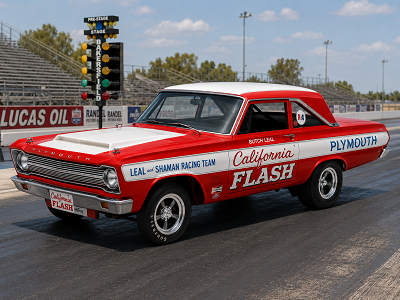
Factory support supplied race cars. Match-race bookings helped pay for everything else, and promoters needed something better to print on the poster than Larry Leal from California.
During a conversation with booking agent Ben Crist and friends, Crist’s wife suggested “The California Flash.” The name stuck.
At Indianapolis in 1964, Leal learned there probably would not be another Ford factory deal for him the following season. Chrysler racing representative Bob Cahill approached him shortly afterward.
Chrysler needed somebody who could drive a four-speed Hemi. That conversation did not take very long.
1965 Put a Hemi in Front of Him
Leal entered Chrysler’s 1965 program with an NHRA-legal A990 Plymouth Belvedere in Super Stock while also participating in the altered-wheelbase Factory Experimental program that was turning into one of drag racing’s biggest attractions.
The legal car carried a cross-ram 426 Race Hemi and four-speed. At Indianapolis, Leal again won the Super Stock stick class, this time wearing Plymouth colors instead of Ford’s.
He went on to become the 1965 NHRA Super Stock world champion.
Ford had hired him because he could drive. Chrysler received confirmation.
The Wheels Started Moving Forward
Detroit’s Factory Experimental teams had discovered that moving the axles forward improved weight transfer. Soon the cars had wheelbases Detroit styling departments had never approved, fuel injection, Hemi power and drivers trying to keep the front tires somewhere near the pavement.
Leal’s altered-wheelbase California Flash became one of the recognizable cars of the transition from Super Stock to Funny Car. NHRA did not yet have a proper home for much of this machinery, so match racing became its natural habitat.
Leal could spend much of the week moving from track to track, racing Sox & Martin, Dick Landy and the other factory-backed combinations promoters could fit onto a poster.
The cars looked funny. The name of the new category eventually took care of itself.
Then He Built a Real Funny Car
By the late 1960s, altered production bodies were giving way to dedicated tube-chassis machines with one-piece bodies.
Leal followed the change with a Barracuda Funny Car built around a Logghe chassis. The car ran into the seven-second range and put the California Flash among the quicker machines of the developing category.
He could have stayed with Funny Car. Instead, another door-car class showed up.
Pro Stock Started in 1970
NHRA introduced Pro Stock for the 1970 season as a professional home for heavily modified production-bodied cars. The class immediately attracted many of the best Super Stock and match-race drivers in the country.
Leal entered the inaugural Winternationals but did not make the 16-car field. Neither did future champions Bob Glidden and Herb McCandless.
There were easier places to earn a living.
Leal initially returned to Chevrolet with a Camaro before going back to Plymouth and a series of orange-and-white California Flash Dusters. By 1972 he was again capable of beating anybody in the class.
At the March Meet that year, Leal defeated Bob Lambeck for the Pro Stock title. He also won the Popular Hot Rodding Championships over Dyno Don Nicholson.
57.2 Percent Was Two Percent Too Much
Pro Stock’s early years produced nearly as much activity in technical inspection as they did on the starting line.
At the 1971 NHRA Supernationals, Leal appeared to have eliminated Ronnie Sox in the semifinals. Officials then checked the California Flash Duster’s weight distribution.
The rules allowed no more than 55 percent over the rear wheels. Leal had 57.2.
He was disqualified, Sox was reinstated and eventually won the race.
Early Pro Stock was like that. You occasionally had to beat the other car twice.
The Hemi Still Had Places to Win
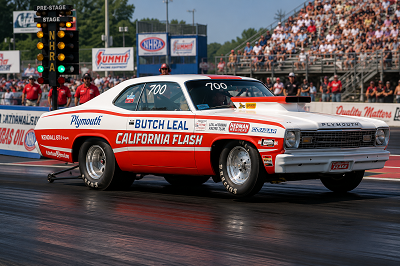
During the middle of the 1970s, NHRA repeatedly adjusted Pro Stock weight breaks while trying to balance big-block Hemis against smaller Chevrolet combinations. The Hemi eventually became difficult enough to campaign competitively that Chrysler reduced its direct Pro Stock effort.
Leal was already proving that moving backward on the class ladder did not mean slowing down.
At the 1974 Summernationals, he returned to his familiar 1965 Hemi Plymouth and won Super Stock. The following year he campaigned a Hemi-powered Duster in B/Modified Production with support from Chrysler’s developing Direct Connection performance-parts program.
That car was runner-up at the 1975 Winternationals, then became a major winner in 1976. Leal won Modified Eliminator at both the Winternationals and Gatornationals and gave Direct Connection exactly the sort of demonstration Chrysler wanted.
When Pro Stock stopped being friendly to his Hemi, Leal found another eliminator and kept winning.
Mr. Direct Connection
Leal’s association with Direct Connection extended beyond driving. Chrysler was trying to sell racers the same sort of pieces its factory teams had learned to use, and Leal could race the equipment, explain it and demonstrate that it worked.
His Dusters and later Plymouth Arrow competed in Modified, Gas and Pro Stock configurations while the California Flash name remained closely tied to Chrysler performance.
By the time the Direct Connection sponsorship ended in 1977, Leal had spent more than a decade jumping between classes without losing his reputation as one of drag racing’s best four-speed drivers.
The first half of the career could have ended there.
It didn’t.
The Flash Came Back to Pro Stock
Leal returned to serious Pro Stock competition in the 1980s, by then racing Pontiac-bodied cars in a category almost unrecognizable from the one he had entered in 1970.
The old four-speeds had given way to sophisticated clutchless transmissions. Engines approached 500 cubic inches, and chassis and aerodynamic development had become increasingly specialized.
One part had not changed. There was still a Christmas tree.
Leal remained exceptionally good at it. Period race reports repeatedly singled out his reaction times, and he could turn a slower elapsed time into a round win by leaving first.
That is particularly irritating when the other fellow is Bob Glidden or Warren Johnson.
1987 Was the Comeback Nobody Needed to Explain
At the 1987 Winternationals, Leal used a holeshot to eliminate defending champion Bob Glidden before finishing runner-up to Warren Johnson.
At Gainesville he went one round better, defeating Glidden and winning the Gatornationals. Victories followed at the Cajun Nationals in Baton Rouge and at Montreal.
By the end of the season, the fellow who had been a factory Super Stock champion more than twenty years earlier finished second to Glidden in the NHRA Pro Stock standings.
Glidden was in the middle of one of the most dominant stretches Pro Stock had seen. Butch Leal was still making him look at the other lane.
Pomona Finally Went His Way
The 1988 Winternationals began with several of the quickest Pro Stock cars falling out early, including Glidden.
Leal qualified eighth and worked through the field to meet Mark Pawuk in the final. This time, Pomona ended with the California Flash in the winner’s circle.
It had been 24 years since his Thunderbolt reached the Winternationals final against Gas Ronda. The cars had changed considerably.
The fellow operating the pedals had not lost much.
Thirty-One Years Was Enough
Leal continued racing Pro Stock through 1991. His final NHRA event came at the World Finals in Pomona, where he beat Bob Glidden in the opening round and Frank Iaconio in the second before Jerry Eckman ended the run.
He retired after a career that had stretched from a 348-powered El Camino to 500-cubic-inch professional Pro Stock cars.
Along the way, Leal collected 12 NHRA national-event victories across Pro Stock, Modified and Super Stock competition and reached 25 national-event final rounds. He became one of the rare drivers to win NHRA national events in all three categories.
He raced Chevrolets, Fords, Plymouths and Pontiacs. The starting line never asked what badge was on the grille.
The Hall Eventually Caught Up
Leal entered the Mopar Hall of Fame in 2014 and the International Drag Racing Hall of Fame in 2015.
The range of his career explains why. Plenty of drivers mastered one class during one set of rules. Leal remained dangerous while drag racing repeatedly reinvented the car underneath him.
The Bottom Line
Butch Leal was a factory Ford driver before he was 20, won Indy in a Thunderbolt, switched to Plymouth, won an NHRA Super Stock championship and drove altered-wheelbase Hemis while Funny Car was still acquiring its name.
He later raced Pro Stock, won major Modified events for Direct Connection and returned to Pro Stock strongly enough to finish second in the 1987 championship more than two decades after his first factory rides.
The cars changed. The classes changed. The manufacturers changed.
The California Flash kept leaving first.
Leal’s factory-racing career put him in the middle of some of Detroit’s more imaginative attempts to turn production cars into race cars without admitting that was exactly what they were doing.