Dick Brannan
He Beat Ford’s Own Test Cars. Ford Hired Him to Fix the Problem.
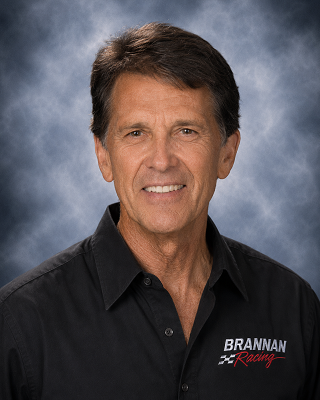
In 1962, Dick Brannan hauled his Ford Galaxie to Detroit Dragway and entered a field packed with serious factory-backed machinery. Ford had test drivers there.
Brannan beat them too.
The 22-year-old from South Bend, Indiana, worked through a field of more than 60 cars and won with a Ford that was not supposed to be capable of doing what he had just done. The people from Dearborn naturally wanted to know what he had done to it.
Brannan approached the entire machine as a system. Remove unnecessary weight. Improve traction. Sort the suspension. Prepare every legal piece instead of waiting for horsepower to rescue a poorly prepared car.
Ford hired him.
Within a few years Brannan was not merely racing factory Fords. He was helping decide what Ford’s factory drag racers would be. The Thunderbolt, lightweight Galaxies and Ford’s brutal A/FX Mustangs all came through a program he helped turn from an embarrassment into a threat.
Romy Hammes Had a Salesman Who Raced on Sunday
Brannan grew up around Fords and machinery, eventually settling with his family in South Bend. He studied mechanical engineering and business, served in the Navy Reserve and became a pilot before returning to civilian life.
Then he went to work selling cars at Romy Hammes Ford. Brannan also raced them.
In 1959, dealership management discovered that one of its sales demonstrators had been appearing at the local drag strip. The important part was that it was winning.
Instead of demanding the young salesman stop abusing the merchandise, the Hammes family backed him. A partnership formed that put the Romy Hammes name on Brannan’s increasingly serious race cars.
Customers tended to notice when the fellow selling Galaxies on Monday had spent Sunday beating everybody else’s Galaxie.
The 1962 Galaxie Changed His Job Description
Brannan’s Romy Hammes-sponsored 1962 Galaxie carried Ford’s 406 and looked much like the full-size machinery Detroit expected to sell by the thousands. It was also very carefully prepared.
At Detroit Dragway, Ford test drivers Bill Humphries and Len Richter saw Brannan beat a field their own cars had failed to handle. Ford people later tracked him down in South Bend.
First they wanted to know why his car was faster. Then they decided it might be easier to put him on the payroll.
Brannan joined Ford’s Stock Vehicles operation in 1962 and became deeply involved in coordinating the company’s drag-racing effort. One weekend he was beating Ford’s engineers. Soon Ford had made him one of the people solving their problems.
Weight Was Horsepower You Didn’t Have to Build
Ford had a problem in Super Stock. Its big Galaxies could make excellent power, but Chrysler and Chevrolet were learning the same lesson Brannan already understood: a race car does not care how impressive the engine is if the engine has to drag too much automobile behind it.
Brannan attacked the Galaxies everywhere the rules allowed. Sound deadener disappeared. Heavy seats were replaced. Carpeting became rubber matting. Fiberglass and aluminum replaced steel where legal. Anything unnecessary had to explain why it was still riding to the starting line.
The result was the factory lightweight Galaxie program.
Brannan also adapted a Studebaker-style Hill Holder mechanism into an early drag-racing line-lock arrangement, allowing the front brakes to hold while the rear tires were spun during a burnout.
In 1963, Brannan personally won more than 65 races and set 22 track records while Ford’s factory racers began giving the other manufacturers much less enjoyable weekends.
But the Galaxie still had one problem that a drill and a thinner bumper could not completely fix.
It was a very large automobile.
The Answer Was a 427 in a Fairlane
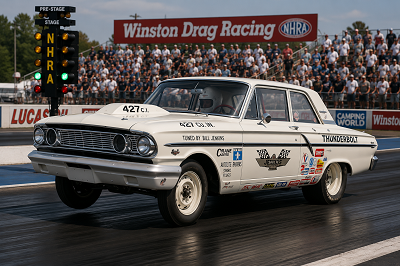
For 1964, NHRA rules made the weight problem impossible to ignore. Ford’s 427 Galaxies could not get close enough to the minimum weight to remain competitive against increasingly specialized factory cars.
Brannan’s solution was wonderfully straightforward.
Use less car.
Bob Tasca had already demonstrated that a 427 could be persuaded into a Fairlane. Brannan and Ford turned the idea into a factory program.
The midsize Fairlane was hundreds of pounds lighter than the Galaxie. Dearborn Steel Tubing handled much of the conversion work while Brannan, Ford engineer Vern Tinsler and others worked through the details required to put a big FE engine into a place originally intended for considerably less machinery.
The first development car became Brannan’s and carried the name Lively One.
The rest of the world soon learned another name.
Thunderbolt.
The Thunderbolt Was a Factory Hot Rod With a Purchase Order
The 1964 Thunderbolt took the old hot-rod formula and gave it corporate resources: big engine, smaller car and very little patience for anything that did not help it reach the other end.
The Fairlanes used Ford’s 427 high-riser with dual four-barrel carburetors, lightweight body pieces, stripped interiors and enough specialized hardware to make the word “production” work considerably harder than usual.
Brannan was involved in selecting, developing and testing the combination before Ford distributed Thunderbolts to its factory racers.
It was exactly the sort of program he understood. Find the weak point, remove it and see what broke next.
The Factory Team Was Full of People Who Could Drive
Brannan also helped coordinate Ford racers who could put all of that engineering to useful work. The factory effort included names such as Gas Ronda, Phil Bonner, Les Ritchey, Bill Lawton, Mickey Thompson, Al Joniec, Ed Martin and others.
This was not a demonstration fleet. Ford expected them to win.
Brannan occupied an unusual position because he could move between development work and the driver’s seat. He could test a new part, understand what it was doing and then race the thing hard enough to find out whether the theory survived contact with a drag strip.
Then the Mustangs Got Strange
Factory drag racing changed quickly after the Thunderbolt. Super Stock machinery gave way to Factory Experimental cars, and by 1965 Ford was stuffing 427 engines into Mustangs that were moving farther away from anything a customer could buy at the dealership.
Brannan was in the middle of that development too.
Holman-Moody prepared a group of Mustang fastbacks for Ford’s A/FX program. Some received the new 427 SOHC — the famous Cammer — while others initially used high-riser wedge engines.
The cars evolved rapidly through altered suspensions, altered wheelbases, fuel injection, lightweight construction and increasingly serious doses of nitromethane.
Yesterday’s stocker was becoming tomorrow’s Funny Car before anybody had completely agreed on what to call the thing.
The Bronco Mustangs Were Test Cars With License Plates Missing
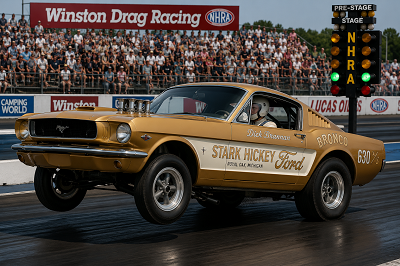
Brannan’s evolving Mustang match racers became known as the Broncos. They were fast, but they were also experimental machinery being pushed into territory where aerodynamics, chassis behavior and tire technology were all learning lessons at exactly the same time as the driver.
Brannan’s cars made enormous numbers of test and match-race passes during 1965 and 1966. Prototype suspension, chassis and safety pieces were tried there before lessons were passed to other Ford teams.
Some of those lessons arrived unpleasantly.
Brannan survived serious crashes in the Mustangs, and another occurred while Paul Rossi was driving one of the cars. Ford eventually restricted Brannan’s driving duties, leaving him more focused on testing and development.
One ill-handling Ford Funny Car also went into the wind tunnel after high-speed instability became impossible to dismiss. The resulting work helped establish the need for spoilers and better aerodynamic control on the increasingly fast factory machines.
At 180 mph, “looks about right” was losing its usefulness.
Ford Kept Giving Him More Things to Develop
Brannan worked inside Ford’s high-performance operation during the Total Performance years, when Dearborn was pouring resources into NASCAR, drag racing, Le Mans, Indianapolis and anything else that offered a stopwatch and somebody from General Motors or Chrysler to beat.
His work extended beyond one generation of drag cars. He was involved with Ford’s 427 racing programs and later with development surrounding the 428 Cobra Jet and Boss 429.
He also worked around NASCAR and other Ford racing efforts as the company tried to turn competition into better engines, better cars and considerably better advertising.
Race on Sunday. Make sure the dealer has something interesting to sell on Monday.
Pro Stock Was the Last Chapter
By the end of the 1960s, drag racing had changed again. Funny Cars had become specialized tube-chassis machines with flip-up bodies, while the new Pro Stock category offered factory brands another place to fight using cars that still resembled something from the showroom.
Brannan raced Ford machinery there too, including Boss-powered Mavericks as the class developed around 1970.
But the factory wars were changing. Ford began withdrawing from much of its direct racing involvement in the early 1970s, and Brannan stopped racing in 1972.
Ford pulled the cars. For a man whose racing career had become inseparable from Ford’s factory program, that pretty well settled it.
The Numbers Miss the Important Part
Brannan won more than 200 sanctioned drag-racing events across NHRA, AHRA and IHRA competition and accumulated dozens of elapsed-time and speed records.
He won championships and major races in machinery ranging from Super Stock Galaxies to Factory Experimental cars and the machines that were becoming Funny Cars. Those accomplishments earned him recognition in multiple drag-racing halls of fame.
But Brannan’s larger contribution happened before the starter dropped the flag.
He helped determine what the car should be.
The Bottom Line
Dick Brannan entered Ford’s factory racing program in one of the better ways imaginable.
He beat it.
The unknown young racer from South Bend showed up at Detroit Dragway in 1962 with a carefully prepared Galaxie and defeated the people Ford was already paying to make Galaxies fast.
Dearborn was smart enough to ask why.
Brannan spent the next decade helping provide the answer through lightweight Galaxies, the Thunderbolt Fairlane, SOHC Mustangs, early Funny Cars, Cobra Jet development and eventually Pro Stock machinery.
He was driver, tester, engineer and factory racing coordinator during one of the wildest periods Detroit ever spent trying to beat itself on Sunday afternoon.
Dick Brannan did not merely drive some of Ford’s fastest drag cars. For a while, if Ford wanted to know what its next drag car ought to be, Dick was one of the fellows it asked.
↑ Back to the Top, Before Dick Finds Another Hundred Pounds to Remove