Don “Dyno Don” Nicholson
Factory Drag Racing Kept Changing. Dyno Don Kept Figuring Out What Came Next.
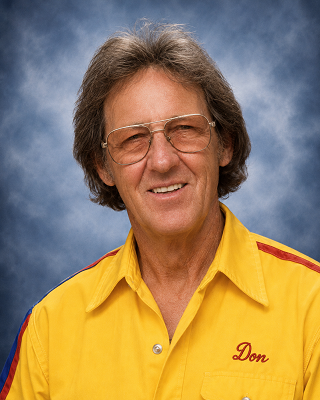
Most racers spend years becoming specialists. Don Nicholson kept becoming a specialist in whatever drag racing was about to turn into.
Stock Eliminator. Factory Experimental. Altered-wheelbase match racers. Flip-top Funny Cars. Heads-up Super Stock. Pro Stock.
Nicholson was there for all of them.
That is what makes “Dyno Don” different from a fellow who simply raced for a very long time. His career crossed several generations of factory drag racing, and every time the cars changed enough to make the old answer obsolete, Nicholson was willing to start figuring out the new one.
He could drive, build engines and tune. He understood the chassis, the transmission and what the stopwatch was trying to tell him.
Don Nicholson did not build his legend by defending one kind of race car. He built it by repeatedly recognizing what the next kind ought to be.
The Dyno Came Before the Nickname Became Famous
Donald Nicholson was born in Missouri in 1927 and eventually became part of the Southern California hot-rodding world. He raced circle-track roadsters, ran at the dry lakes and Bonneville and spent years building engines and working around performance cars before organized drag racing became his main occupation.
During the 1950s Nicholson worked at Chevrolet dealerships in the Pasadena area, where he became particularly good at using a chassis dynamometer to tune cars. That was unusual enough to earn him a nickname.
Dyno Don.
The name fit better than anybody could have known at the time. Nicholson came from a period when plenty of tuning still depended on experience, sound and reading spark plugs. He liked those things too, but the dynamometer added numbers.
Make a change. Measure the result. If the engine liked it, keep going. If it did not, the dyno was considerably less polite than the fellow who had suggested the idea.
The First Winternationals Made Him a National Name
When NHRA held its first Winternationals at Pomona in 1961, Nicholson arrived with Chevrolet’s new 409-powered machinery and won Top Stock. He returned in 1962 and won again.
Those victories changed the size of his racing world. Match-race promoters wanted the famous Chevrolet and the fellow driving it, and Nicholson received enough bookings in the Southeast that he eventually established an operation in the Atlanta area.
The schedule could be brutal. Instead of waiting for a handful of national events, match racers might run several nights a week, travel hundreds of miles and unload against another factory-backed hero who had been doing exactly the same thing.
Nicholson thrived in it.
Then Chevrolet officially got out of racing. The race tracks failed to receive the memo.
Mercury Gave Him a Comet
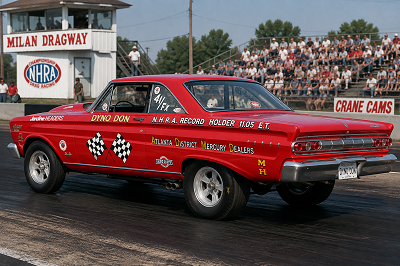
With Chevrolet factory support disappearing after 1963, Nicholson moved to Mercury and became one of Ford Motor Company’s most visible drag racers.
His 1964 A/Factory Experimental Comet was enormously successful on the match-race circuit. Nicholson later estimated that the team won more than 90 percent of its races that year.
Factory Experimental was already showing signs that the word factory was becoming increasingly optimistic. The manufacturers wanted cars that looked familiar enough for spectators to recognize. The racers wanted weight moved rearward, engines moved back, bodies lightened and anything else that made the starting line less likely to win the argument.
By 1965 the Mopar teams were arriving with radically altered wheelbases, so Nicholson modified his Comet to answer them.
The production car was beginning to disappear underneath the racing solution.
Eliminator I Helped Finish the Transformation
In 1966 Nicholson arrived with Eliminator I, a Mercury Comet that made the previous year’s altered-wheelbase machinery look almost conservative.
The car used a purpose-built tube chassis underneath a lightweight one-piece body that tilted upward to expose the machinery. There were still enough Comet shapes on the outside to keep Mercury happy.
Underneath, almost nothing was pretending to be a production automobile anymore.
Eliminator I became one of the foundational cars in the development of the modern flip-top Funny Car. Tube chassis, engine between the front wheels and driver, lightweight one-piece body over the top — the architecture was becoming recognizable.
The thing was not merely historically interesting. It was fast.
Nicholson’s Comet became one of the dominant match racers of 1966 and recorded a 7.96-second run, one of the breakthrough performances of the early Funny Car era.
Stock Eliminator had turned into something that could run in the sevens in about five years.
Then Funny Cars Got Too Funny for Dyno Don
Nicholson continued with Mercury flip-top cars, including later Comets and a Cougar, as Funny Car performance escalated.
But he eventually decided the category had moved too far from the factory-car racing that had built his following. Superchargers, nitromethane and purpose-built chassis were making spectacular race cars, but they were also making it increasingly difficult to explain what any of this had to do with the automobile sitting in a Mercury showroom.
Nicholson went the other direction. He returned to carburetors, gasoline and cars with doors.
That might sound like going backward.
It put him directly in the path of Pro Stock.
Heads-Up Super Stock Was Pro Stock Without the Name
By the end of the 1960s Nicholson was again match racing factory-bodied cars alongside racers such as Bill Jenkins, Ronnie Sox and Dick Landy.
The AHRA offered heads-up Super Stock racing with big engines, relatively light cars and none of the handicap-start arithmetic that could make traditional class racing difficult for a casual spectator to follow.
Two cars staged. The tree came down. First one to the other end won.
That formula worked.
NHRA introduced Pro Stock in 1970, turning the match-race concept into a national professional eliminator. Nicholson had moved from stockers into Factory Experimental, helped establish the flip-top Funny Car and then returned to factory-bodied racing just as the new class arrived.
Ford’s First Pro Stock Win Belonged to Dyno Don
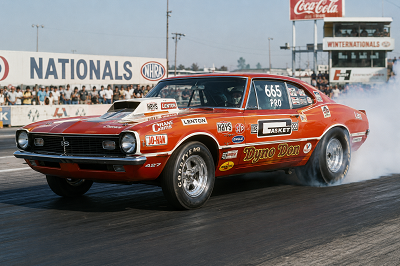
Nicholson’s first Pro Stock effort was a Ford Maverick powered by the exotic 427 SOHC engine.
The car for the 1970 Winternationals was assembled in roughly a week, which is not normally the preferred amount of development time for a new professional racing category.
The Mopars dominated the early class, but Nicholson and his crew kept developing the Ford. During one stretch of match racing in 1970, the Maverick accumulated 45 consecutive round victories.
Then at the 1971 Summernationals, Nicholson won the national event and gave Ford its first NHRA Pro Stock victory.
That alone would have been a respectable addition to a career that already included national Stock victories and one of the landmark early Funny Cars.
Dyno Don was not finished changing combinations.
The Cleveland Pinto Put Him Back at the Front
As Pro Stock’s rules evolved, Nicholson moved away from the big Cammer and toward Ford’s 351 Cleveland architecture in a lighter Pinto. The new combination suited the changing weight rules and became one of the quickest cars in the category.
Early in 1973 Nicholson won the NHRA Winternationals and set a national elapsed-time record in the final. At the Gatornationals he won again while setting both ends of the Pro Stock national record.
More than a decade had passed since his back-to-back Stock victories at Pomona. The cars shared very little beyond the presence of doors and a factory name on the body.
The fellow figuring them out was the same one.
At Fifty, He Finally Chased the Whole Championship
Nicholson spent much of his career where the money was: match racing. National-event statistics therefore tell only part of his story because during the 1960s and early 1970s there simply were not enough NHRA national events to provide the hundreds of opportunities later professional racers would have.
In 1977 Nicholson changed the program and committed to the full NHRA Pro Stock tour with his Ford Mustang II.
He won the Gatornationals, the Springnationals and the U.S. Nationals. By the World Finals, Nicholson had accumulated enough points to secure the 1977 NHRA Pro Stock championship.
He was fifty years old.
The fellow who had won at the first Winternationals sixteen years earlier was now champion of a professional category that had not existed when his national career began.
He Was Never Only the Driver
Nicholson’s versatility made comparison with his rivals difficult. Ronnie Sox became legendary for what he could do with a four-speed. Bill Jenkins became one of the great engine and chassis thinkers of Pro Stock. Bob Glidden later combined driving and engine development into a championship machine.
Nicholson had pieces of all of those skills.
He tuned his own machinery, worked with engine builder Earl Wade and others, understood the chassis and could climb into the car and make the run himself. That was particularly useful during the match-racing years, when there was no enormous technical staff waiting behind the trailer door. If the car slowed down, the driver might also be the fellow expected to determine why before the next round.
Dyno Don had started with a chassis dynamometer. Decades later the machinery had changed completely, but the method had not.
Measure what happened. Find what the car wanted. Make another run.
The Bottom Line
Don Nicholson died on January 24, 2006, at age 78. NHRA had ranked him No. 18 among the greatest drivers of its first fifty years, and his career had earned induction into both the International Drag Racing Hall of Fame and the Motorsports Hall of Fame of America.
His résumé refuses to stay inside one category.
He won Top Stock at the first Winternationals, became a dominant Factory Experimental match racer, helped establish the architecture of the flip-top Funny Car, walked away when that class no longer looked enough like factory machinery, helped create the heads-up racing environment that became Pro Stock, gave Ford its first Pro Stock national-event victory and then, at fifty, won the championship.
Plenty of racers become legends by perfecting one kind of car.
Dyno Don Nicholson became one by repeatedly figuring out the next one.
Dyno Don made a career out of being wherever Detroit’s factory horsepower wars were getting interesting. Chevrolet’s Z11 Impala put him right in the middle of one of the better arguments over what “stock” was supposed to mean.
➤ See the Chevrolet Z11 story in Racing Shenanigans
➤ See Mickey Thompson’s 421 Pontiac story in Racing Shenanigans
↑ Back to the Top, Before Dyno Don Finds Out What the Next Car Wants