Cotton Owens
He Could Beat You With His Race Car or Build Somebody Else One to Do It
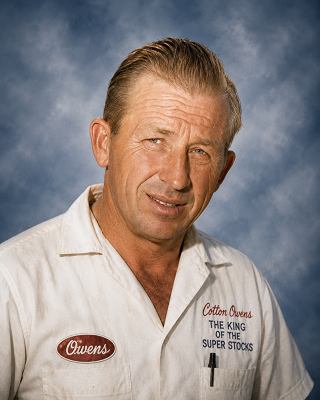
Cotton Owens creates a small classification problem. Call him one of NASCAR’s great drivers and the answer is yes. Call him one of its great car builders and owners and the answer is still yes.
Before NASCAR’s top division became the center of everything, Owens won more than 100 Modified races and earned the name King of the Modifieds. Then he won nine times in NASCAR’s premier series, finished second in the 1959 championship and gave Pontiac its first NASCAR victory.
After that, he moved increasingly to the other side of the windshield and became even more troublesome. Cars prepared by Cotton Owens won 38 premier-series races. David Pearson won 27 of them, including 15 during his 1966 championship season.
Owens also pushed Chrysler toward serious Hemi competition and later prepared the Dodge Daytona that Buddy Baker drove beyond 200 mph at Talladega.
Most racing careers eventually require a fellow to pick a specialty.
Cotton apparently missed that meeting.
First He Became King of the Modifieds
Everett Owens was born May 21, 1924, in Union, South Carolina. After serving in the Navy during World War II, he returned home and worked around automobiles in Spartanburg.
Then he discovered stock-car racing, which was a convenient place for somebody who already understood machinery and did not object to using all of it.
Owens and several friends bought an old Ford to race on the dirt tracks scattered across the South. Before long, the others decided Cotton was the one who ought to drive it.
That judgment held up fairly well.
Owens became one of the dominant Modified racers of the 1950s, collecting more than 100 feature victories and national Modified championships in 1953 and 1954. The nickname followed naturally: King of the Modifieds.
That was not a consolation title. Modified racing could offer large crowds, good purses and enough competition to keep a serious racer busy without chasing NASCAR’s entire Grand National schedule across half the country.
A Crash Changed Which Side of the Windshield Made Sense
In 1951, Owens was badly hurt in a crash that left him with double vision.
He kept racing, because racers have historically required more convincing than most people before admitting a body part is trying to tell them something.
On short tracks, experience and instinct could compensate. As NASCAR moved toward larger and much faster superspeedways, damaged depth perception became a less attractive companion.
Owens did not simply stop. He gradually shifted toward the job he was already proving unusually good at: building the car somebody else would drive.
That was not retirement.
It was reassignment.
Pontiac Got Its First NASCAR Win on the Beach
Owens had made occasional Grand National starts since 1950, but his breakthrough came on February 17, 1957, at the old Daytona Beach and Road Course.
Part of the lap ran on pavement. Part ran on sand. The race therefore required a stock car to tolerate two surfaces that normally would not have been introduced without an argument.
Owens drove a Pontiac and beat Johnny Beauchamp by roughly 55 seconds while averaging 101.541 mph. It was the first time the Daytona beach-course race had been won at an average above 100 mph.
It was also Pontiac’s first NASCAR victory.
General Motors had spent years trying to make Pontiac look like something other than the car a fellow bought when the Buick seemed unnecessarily fancy.
Cotton contributed useful evidence.
He Nearly Won the Championship Himself
From 1957 through 1961, Owens won at least one Grand National race every season. In 1959, he started 37 of the season’s 44 races and finished second in the championship to Lee Petty, with one victory, 13 top-five finishes and 22 top tens.
Two years later, Owens entered only 17 races and won four of them.
Four wins in 17 starts usually gets a car owner’s attention.
In Cotton’s case, the car owner had already noticed.
The Driver Was Also the Mechanic
Owens came from the period before a race team required separate departments for engines, chassis, aerodynamics, simulation and whatever new category was invented after lunch.
If the car was slow, Cotton worked on it. If the engine needed attention, he understood that too. If somebody had to test the repair, he could climb inside and settle the question personally.
That made the transition away from full-time driving easier than it might have been for somebody whose only useful tool was the steering wheel.
Owens began putting serious drivers into his cars, including Junior Johnson, Fireball Roberts, Bobby Isaac and Buddy Baker.
Then another fellow from Spartanburg stopped by.
David Pearson Lived Three Miles Away
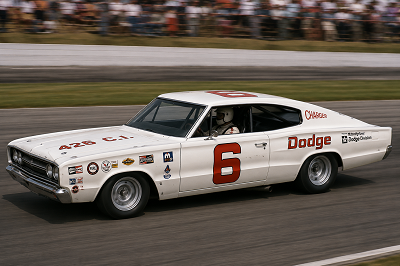
David Pearson lived only a few miles from Owens. Late in 1962, Pearson stopped by the shop while Cotton was considering a larger schedule, and Owens asked whether he would like to drive.
Pearson later remembered that he would have driven for nothing.
Fortunately for both men, Cotton’s business plan was more advanced than that.
The pair went winless in 1963 while figuring out what the operation needed. In 1964, Pearson won eight races in Cotton Owens cars and finished third in the championship.
The driver was fast. The cars were fast.
Then Chrysler supplied an engine capable of making the arrangement even less pleasant for everybody else.
Cotton Wanted the Hemi Back
Owens had already used Chrysler Hemi power in Modified racing and became one of the people urging Chrysler to return hemispherical-cylinder-head horsepower to serious competition.
Detroit listened.
The 426 Race Hemi arrived for 1964 and immediately changed what the Chrysler teams could do. Cotton understood the engine, Pearson understood the resulting race car, and the combination became one of NASCAR’s strongest operations.
The arrangement worked so well that it developed the traditional racing-engineering problem.
The rulemakers noticed.
If NASCAR Didn’t Want the Hemi, Cotton Found Somewhere Else to Put It
For 1965, NASCAR rules made the Race Hemi ineligible, and Chrysler responded by withdrawing much of its factory participation.
Owens and Pearson suddenly owned excellent racing machinery with fewer useful places to race it.
So they went drag racing.
The result was a Dodge Dart station wagon called the Cotton Picker. Putting the Hemi in the normal location apparently seemed unnecessarily ordinary, so the engine went in the back.
The Cotton Picker became part of the increasingly strange Factory Experimental drag-racing scene while NASCAR and Chrysler continued arguing about what properly belonged under a stock-car hood.
Eventually Chrysler and NASCAR reached enough agreement to return to the oval tracks.
Cotton still had the Hemi.
1966 Settled the Argument
David Pearson started 42 races for Cotton Owens in 1966 and won 15 of them.
Fifteen.
That is the sort of number worth checking before assuming somebody added a digit by mistake.
Pearson won the NASCAR Grand National championship, the first at NASCAR’s highest level for Dodge.
Owens had spent years proving he could win races himself. Now he had built a championship operation around another driver and an engine package he had helped push toward competition.
The Owens-Pearson partnership eventually produced 27 NASCAR victories.
That is a substantial contribution to anybody’s 105-win career.
Cotton Could Still Settle an Argument From the Driver’s Seat
By the time Pearson became his star, Owens had mostly stepped away from regular driving.
Mostly.
In 1964, Cotton climbed into one of his own cars for a race at Richmond. Pearson was there too.
Cotton won. Pearson finished second.
It became Owens’ ninth and final NASCAR premier-series victory.
There are several ways for a car owner to explain to the hired driver how he wants the equipment used.
Finishing ahead of him eliminates quite a bit of discussion.
The Garage Kept Winning Without Pearson
Pearson left the Owens operation after the beginning of the 1967 season and later won two more championships with Holman-Moody.
Owens kept building cars for drivers including Buddy Baker, Pete Hamilton, Ralph Earnhardt, Bobby Isaac, Junior Johnson, Fireball Roberts, Mario Andretti and Al Unser.
By the time Cotton retired as a NASCAR owner after 1973, his cars had made 405 premier-series starts and won 38 races.
That would be an excellent ownership career for somebody who had never won nine races from behind the wheel himself.
Then Buddy Baker Went 200
One of Cotton’s most famous cars earned its reputation without winning a race.
It went testing.
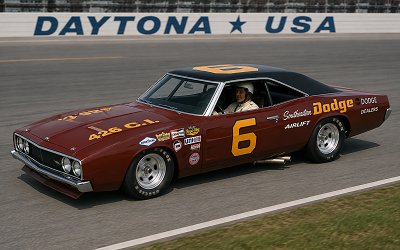
On March 24, 1970, Buddy Baker climbed into a Cotton Owens-prepared Dodge Daytona at Talladega Superspeedway. The winged Dodge had been designed for the sort of speed that makes a normal production automobile look as though it has wandered into the wrong line of work.
Baker turned a lap at 200.096 mph, becoming the first driver officially recorded above 200 mph on a closed course.
Then they sent him out again.
Baker eventually reached 200.447 mph.
Cotton’s first Grand National victory had come on the Daytona beach course at an average of 101.541 mph. Thirteen years later, one of his cars was running almost twice that fast.
Stock-car racing had been improving its equipment rather aggressively.
Spartanburg Was a Racing Town Before Charlotte Took the Job
Cotton Owens Garage belonged to the period before NASCAR’s center of gravity settled around Charlotte.
Spartanburg produced Owens, David Pearson, Bud Moore and enough other racers to make the area one of stock-car racing’s early capitals.
Cotton’s shop became part race team, part engineering department and part gathering place for people who understood how to make heavy American automobiles do things their manufacturers had not necessarily demonstrated in the owner’s manual.
He did not need a giant campus.
He needed a garage, good machinery and somebody who knew how to drive it.
The useful part was that Cotton could usually supply all three.
The Hall of Fame Had to Decide What He Was
Owens was named one of NASCAR’s 50 Greatest Drivers in 1998 and entered the International Motorsports Hall of Fame in 2008.
In 2012, NASCAR announced that Cotton Owens had been elected to its Hall of Fame as a member of the Class of 2013. He died on June 7, 2012, at age 88, only a short time after learning he had been selected.
David Pearson presented his old friend for induction when the ceremony was held the following year.
That was appropriate. Pearson’s championship had supplied one of the clearest demonstrations of what Cotton could do once he handed the steering wheel to somebody else.
The Bottom Line
Cotton Owens won more than 100 Modified races, became the King of the Modifieds, won nine times in NASCAR’s premier division, gave Pontiac its first NASCAR victory and finished second in the 1959 championship.
Then his eyesight made the fastest tracks increasingly difficult, and Cotton shifted toward the garage instead of pretending the problem would solve itself.
His cars won 38 premier-series races. David Pearson won 27 of them and the 1966 championship. Owens helped push Chrysler’s Hemi racing effort, went drag racing when NASCAR would not let him use it and later prepared the Dodge Daytona that carried Buddy Baker through the official 200-mph barrier.
Driver. Mechanic. Engine man. Car owner.
Those became separate occupations later.
Cotton Owens came from the era when a racer was expected to understand the whole automobile.
The inconvenient part for everybody else was that Cotton did.
↑ Back to the Top, Before Cotton Decides the Driver Needs a Better Car