
Joe Amato
He Made Top Fuel Faster. Then He Kept Winning After Everybody Else Caught Up.
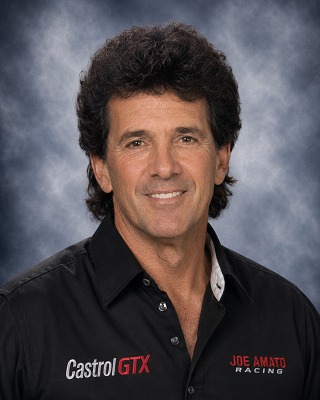
Joe Amato won five NHRA Top Fuel championships, 52 national events and appeared in 99 final rounds. For 19 consecutive seasons, from his first full Top Fuel campaign in 1982 through his final one in 2000, he never finished outside the top ten.
That would have been enough. Then there was the speed.
Amato became the first Top Fuel driver over 260 mph, the first over 280 mph and later the first into the 4.5-second zone. His teams helped change the basic shape of a Top Fuel dragster, then remained competitive long after everybody else copied the ideas.
Joe Amato’s real advantage was not merely being first to another number. It was turning speed, engineering and consistency into a system that stayed competitive for nearly two decades.
The Auto Parts Business Came First
Joe Amato was born in Pennsylvania in 1944 and grew up around the Scranton area. When his father became ill, Amato left school at sixteen to help with the family’s auto-parts business.
He was already fooling with cars, and as the business grew, so did the racing. Eventually Keystone Automotive became a major East Coast automotive-parts operation and supplied something racers have traditionally found useful: money.
Amato did not inherit a factory race team. He built a successful business and used that foundation to go racing seriously. That businessman-racer combination would remain important throughout his career.
Funny Cars Came Before the Dragster
Amato’s national reputation did not begin in Top Fuel. He raced an alcohol-burning Funny Car before moving to Top Alcohol Dragster in 1979.
The change worked. Amato won the 1979 Gatornationals and eventually collected five NHRA national-event victories in an alcohol dragster.
By then the logical question was whether he wanted to remain successful in the Sportsman ranks or spend considerably more money discovering what nitromethane could break.
In 1982, Amato moved into Top Fuel.
The expensive answer had won.
Tim Richards Turned the Operation Into a Contender
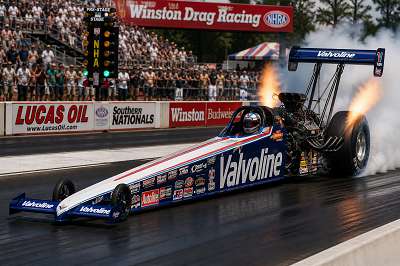
The partnership with crew chief Tim Richards became the center of Amato’s early Top Fuel success. Amato supplied the resources, judgment and driving; Richards supplied one of the sharpest tuning minds in the class.
By 1983, only their second full Top Fuel season, they were already championship contenders. Amato won his first Top Fuel national event at Le Grandnational in Canada, added two more victories and finished second in the championship behind Gary Beck.
The new team had become one everybody else had to watch.
Then they started looking at the rear wing.
The Wing Was in the Wrong Place
Top Fuel dragsters needed rear-wing downforce to keep thousands of horsepower from turning the back tires into decorative smoke generators. Downforce usually came with aerodynamic drag, and drag costs speed.
Working with Indy-car engineer Eldon Rasmussen, Richards and Amato developed a different arrangement: move the wing higher and farther behind the rear axle, then lay it back.
The extra leverage could produce the needed downforce while presenting less drag to the air. The result looked strange compared with the compact wings everybody had been using.
That lasted approximately until the clocks came on.
260.11
The new high-wing dragster debuted at the 1984 Gatornationals. Amato ran 259.36 mph in qualifying.
Then came the semifinals.
260.11 mph.
The first 260-mph Top Fuel pass in drag-racing history.
In the final, Amato faced defending champion Gary Beck, won the race and went 262.39 mph.
The new wing was no longer an experiment. It was an instruction sheet.
Other teams quickly adopted the high, laid-back arrangement, and the basic concept became part of the Top Fuel silhouette. Amato’s team had not merely made its own car faster. It had changed what everybody else’s dragster would eventually look like.
Then They Won the Championship
The Gatornationals was only the beginning of 1984. Amato won three national events, reached four additional final rounds and finished the season as the NHRA Top Fuel world champion.
That championship proved something more useful than the new wing by itself. Technological advantages do not remain private very long in racing. Everybody could see the wing. Everybody could build one.
The team still had to win after the rest of Top Fuel learned the lesson.
Garlits Came Back and Made Life Difficult
The next two championships belonged to Don Garlits, followed by Dick LaHaie’s title in 1987. Amato remained near the front.
In 1987 he won three events and finished only 42 points behind LaHaie for the championship. At Indianapolis, he moved another speed barrier by running 282.13 mph during qualifying for the U.S. Nationals.
First Top Fuel driver over 280.
Then he won the race.
Being second in points had not made the dragster especially slow.
1988 Proved the System Worked
Amato returned in 1988 and won four national events. Darrell Gwynn won six.
Joe Amato won the championship.
There was the system again.
One of Amato’s victories came at the U.S. Nationals, where Gene Snow had just produced a spectacular performance before meeting him in the final. Amato smoked the tires. Snow broke the throttle linkage.
The slower wounded car got to the finish line first. Drag racing occasionally rewards the machine that remains functional a few hundredths of a second longer.
Championship number two belonged to Amato.
Then Top Fuel Entered the Fours
Eddie Hill broke the five-second barrier in 1988. Gene Snow followed, and the four-second club began filling.
Amato joined it in Houston in 1989 with a 4.996.
By then Top Fuel was crowded with racers capable of running at the front. Amato’s advantage was increasingly the thing he had been building since 1982: a team that rarely disappeared.
Gary Ormsby Became the Rival
Gary Ormsby and Lee Beard turned their Castrol GTX team into the class of Top Fuel in 1989. Ormsby won six races and the championship.
In 1990, the argument became considerably more direct. Amato won six races. Ormsby won six races. The championship reached the final event at Pomona, then reached the final round.
Joe Amato versus Gary Ormsby.
Winner takes the championship.
Ormsby left too soon and triggered the red light. Amato ran the race out anyway and secured championship number three.
Nineteen races had been reduced to one bulb on one Christmas Tree.
Then Came the First Western Swing Sweep
Amato kept winning in 1991. During the summer, he became the first NHRA driver to sweep the Western Swing, winning Denver, Sonoma and Seattle on three consecutive weekends.
By the end of the season he had championship number four. Then he won again in 1992.
Three consecutive Top Fuel championships: 1990, 1991 and 1992.
Five championships overall. At the time, nobody in NHRA Top Fuel history had won more.
The System Survived a Crew-Chief Change
The Amato-Richards partnership did not last forever. Richards left the team late in the 1992 championship season, and Amato still finished the job and secured his fifth title.
The next few years were less dominant. Then Jimmy Prock took over the tune-up for 1996.
The results came back quickly, and another performance barrier was about to disappear.
4.595
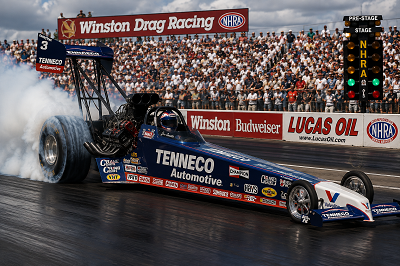
Top Fuel had passed 300 mph in 1992 with Kenny Bernstein. The next great fight moved toward elapsed time.
At Topeka in 1996, with Jimmy Prock tuning the car, Amato ran 4.595 seconds.
The first Top Fuel pass below 4.60.
The fellow who had broken 260 twelve years earlier was still moving the other end of the scoreboard.
Drag-racing technology changes quickly enough that yesterday’s revolutionary idea can become tomorrow’s obsolete spare part. Amato had changed tuners, changed combinations and crossed several generations of Top Fuel development.
He was still winning.
From 1996 through the end of his career, Amato won another 18 national events. The system had survived its original crew chief.
Indianapolis Was Usually Productive
Amato won the U.S. Nationals in 1987, 1988 and 1990, giving him three victories in four years. He also won the season-ending Top Fuel all-star shootout at Pomona six times.
Big races suited the team. So did long championship seasons.
The two talents are not always supplied together. Amato had both.
The Home Track Took Its Time
For a Pennsylvania racer, there was one particularly irritating hole in the résumé. Maple Grove Raceway near Reading was home territory. Amato had raced there for years and kept failing to win the national event.
Five championships did not impress the racetrack.
Finally, in 1999, Amato won at Maple Grove and considered it one of the most meaningful victories of his career. Then he came back in 2000 and won there again.
Career Top Fuel victory number 52.
It would be the last.
The Car Was Still Fast. His Eye Said Stop.
Amato had no carefully planned retirement tour. During the 2000 season, he suffered a detached retina and underwent treatment.
Continuing to drive a Top Fuel car carried the risk of permanent damage to his vision. The choice became fairly simple: race another season or possibly lose your sight.
Amato retired from driving at the end of 2000 after completing his 19th consecutive top-ten Top Fuel season.
There was no long slide into irrelevance. The medical problem ended the driving before the competitive record did.
The Numbers Explain the System
Joe Amato retired with 52 Top Fuel national-event victories, 99 final-round appearances, five world championships, three U.S. Nationals victories and nineteen consecutive top-ten seasons.
He was NHRA’s winningest Top Fuel driver when he retired. Later racers passed some of the totals, but that did not make Amato’s era smaller.
Professional Top Fuel had become a game of engineering, resources, repeatability and season-long execution. Amato remained good at all four while the people and machinery around him changed.
The Bottom Line
Joe Amato is easy to remember as a collection of numbers: 260, 280, 4.595, five championships and 52 wins.
But the important number may be nineteen.
Nineteen straight seasons in the Top Fuel top ten.
The tall rear wing gave his team an advantage, then everybody copied it. The speed records gave him headlines, then somebody went faster. Tim Richards left, the combinations changed and Jimmy Prock arrived.
Amato kept rebuilding the operation around him and showing up near the front.
Joe Amato helped teach Top Fuel how to go faster. His greater achievement was building a team good enough to remain dangerous after the rest of the class learned the lesson.
↑ Back to the Top, Before Joe Moves Another Speed Barrier