Circle Track Racing Basics
Turning Left Is the Easy Part
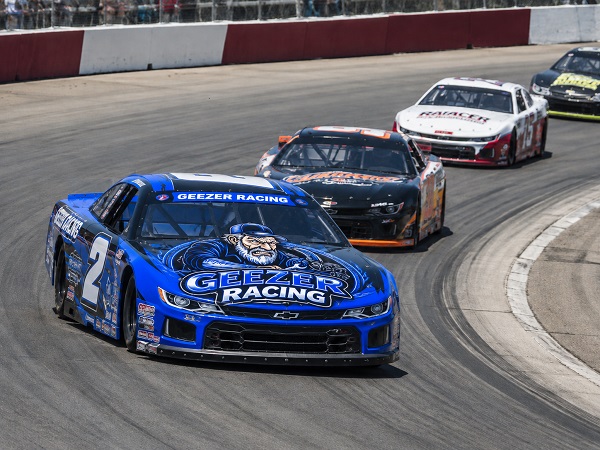
If circle-track racing really were nothing more than turning left, somebody would have perfected it about fifteen minutes after the second automobile was built.
The track keeps going in the same general direction. The driver gets another shot at the same corners every few seconds. Nobody has to remember whether Turn Seven is a left-hander hiding behind a hill. Compared with road racing, this ought to be the easy one.
Then put 20 cars on a half-mile oval, give them enough horsepower to abuse four tires at once, let the track temperature move 30 degrees, wear rubber into one groove, throw a caution with six laps remaining and restart everybody two-wide.
Now the fellow who was half a straightaway ahead has somebody beside his door again, the right-front tire has already spent 80 laps carrying more than its share of the argument, and the quickest line through Turn One is occupied by another car.
That is circle-track racing. The steering wheel spends a lot of time pointed left. Almost nothing else stays that simple.
First, How Big Is This Circle?
Circle tracks come in everything from little quarter-mile bullrings to superspeedways more than two miles around. Calling all of them ovals is accurate in roughly the same way that calling both a go-kart and a tractor transportation is accurate.
On a quarter-mile track, the straightaway may be little more than the piece connecting one corner to the next. The car spends so much of the lap turning, braking or accelerating that mechanical grip and throttle response can matter more than enormous horsepower.
Move to a half-mile and the straights become long enough to use more engine. Go to a mile or mile-and-a-half track and aerodynamic balance starts getting expensive. Put the same general idea on a two-mile superspeedway and the cars may be running close to 190 mph while the atmosphere joins the crew meeting.
A three-eighths-mile dirt Late Model making around 800 or 900 horsepower and a modern stock car on a giant paved oval are both circle-track cars. One may spend the corner sliding sideways through clay while the other depends heavily on aerodynamic downforce and clean air. Same direction. Different problem.
The Lap Is Really Two Corners Joined by Two Chances to Recover
A basic oval gives the driver two straights and two sets of turns every lap. What looks repetitive from the grandstands is actually a continuous cycle of braking, turning, accelerating and transferring weight.
Enter the corner and the driver may lift or brake. Weight moves forward. Turn left and load moves toward the right-side tires. Start feeding power back in and weight moves rearward again.
All of that can happen in a couple of seconds. Then the car reaches the other end and does it again.
That is why oval setup becomes so important. The car is not simply being asked to generate grip. It has to move that grip around the chassis at the right time.
A car that is wonderful in the center of the corner but miserable getting in may never reach the center properly. A car that turns beautifully but cannot accept throttle coming off gives away the whole straightaway.
Every part of the corner sends a bill to the next one.
Entry, Center and Exit — Three Places to Ruin One Corner
Racers usually break a corner into entry, center and exit.
On entry, the car is slowing and beginning to turn. The driver wants enough front grip to get the nose pointed without unloading the rear so badly that it decides to arrive first.
At the center, the car is carrying its greatest sustained cornering load. This is where the chassis either rotates toward the exit or starts demonstrating one of the sport’s two favorite complaints: tight or loose.
On exit, the steering begins opening and the driver gets back to the throttle. Now the rear tires have to accept engine torque while they are still helping the car finish the corner.
The quickest driver is not necessarily the fellow who enters the corner fastest.
One driver can charge into Turn One five mph harder, scrub the front tires, miss the center and wait forever before using full throttle. Another can enter a little slower, rotate the car cleanly and already be accelerating while the first fellow is still trying to convince the nose to come around.
The stopwatch counts the whole corner. It has never awarded a bonus for arriving at the apex with more enthusiasm than grip.
The Racing Line — Sometimes the Long Way Is Quicker
On a typical paved oval, the basic fast line begins toward the outside, arcs down toward the inside near the apex and then lets the car move outward again on exit.
That uses more width of the track and increases the effective radius of the corner.
A larger radius usually lets the car carry more speed because it is not being asked to change direction as sharply.
Suppose one driver hugs the bottom all the way around while another enters wider, turns later and opens the steering wheel sooner. The second car may travel a few extra feet, but if that line lets it carry another five or ten mph and reach full throttle sooner, those extra feet are a bargain.
That is the theoretical part.
The practical part is that somebody else may already be using the line you wanted.
Run underneath him and the corner gets tighter. Run outside and the distance gets longer. Stay side by side and both cars may compromise their preferred line until neither one is especially quick.
The perfect racing line exists mainly when nobody else is racing you.
That is called qualifying.
Banking — The Track Starts Helping
Banking tilts the racing surface toward the inside of the turn. That angle lets the track itself help generate some of the force needed to change the car’s direction.
A nearly flat local oval may have banking in the single digits. Other tracks run in the teens or twenties. Some major speedways climb beyond 30 degrees.
That difference is not decoration. Try running 100 mph around a flat parking-lot corner and the tires have to provide nearly all the sideways force keeping the car from continuing straight. Tilt the pavement and some of the force pressing the car into the track now points toward the center of the turn.
The tires still work hard. They just have help, which is why a heavily banked oval can support corner speeds that would look completely ridiculous on a flat track.
It also means the suspension and tires see enormous loads. The car may weigh 3,000 pounds sitting quietly on four scales, but the right-side tires do not spend a fast banked corner feeling like they are supporting only their polite share of 3,000 pounds.
The car weighs the same. The tires would like to discuss the accounting method.
Tight and Loose — The Two Complaints You Hear All Afternoon
Spend five minutes around a circle-track pit and somebody will describe a car as tight or loose.
A tight car does not turn enough. The front tires reach their grip limit before the rear tires do, so the nose begins sliding toward the outside. The driver adds more steering, which frequently asks even more from the front tires that have already declined the first request. That is understeer, also called push.
A loose car does the opposite. The rear tires run out of useful grip first and the back of the car begins rotating toward the outside. That is oversteer.
The useful part is that a car does not have to be simply tight or loose everywhere. It can be tight entering the corner, neutral in the center and loose coming off. Another car may rotate wonderfully on entry and then push as soon as the driver puts power down.
A slightly free car can be fast because it rotates readily. Too free and the driver spends the exit catching the rear instead of accelerating.
A slightly tight car can be stable and predictable. Too tight and the steering wheel becomes a suggestion box.
Setting Up a Car That Only Turns Left
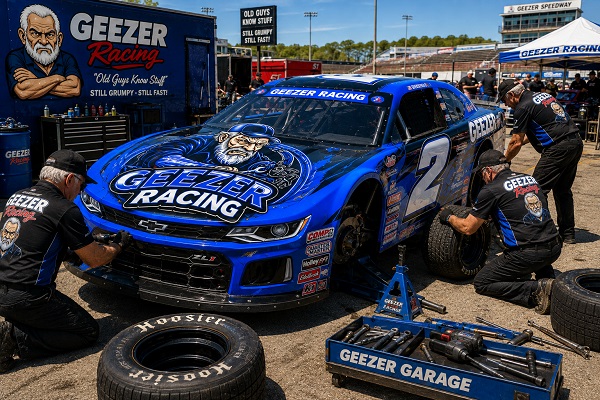
Tight and loose are what the driver reports. The crew gets to translate those two short complaints into several hours of springs, tires, angles and weight.
This is where circle-track cars start looking peculiar to somebody accustomed to street machinery. They are not built around the assumption that right turns deserve equal treatment.
One of the oldest tricks is stagger: using a larger rolling circumference on the right-side tire than the corresponding left-side tire.
Suppose the right-rear tire measures 88 inches around and the left-rear measures 86.5. That gives 1.5 inches of stagger. Every revolution, the right tire wants to travel another inch and a half compared with the left.
That difference encourages the car to arc left.
Another common number is crossweight, or wedge. Put the car on four scales, add the right-front and left-rear weights together, then divide by total vehicle weight.
If a 3,000-pound car carries 1,500 pounds on those two diagonal corners, it has 50 percent crossweight. Adjust the chassis so those corners now total 1,525 pounds and crossweight moves to about 50.8 percent without changing total weight.
Less than one percentage point can change how the car enters, rotates and puts power down.
Then come spring rates, shock valving, sway bars, camber, caster, toe and rear-suspension geometry. All of them change how load moves through the tires and how quickly the chassis reacts.
The important Basics lesson is not memorizing which adjustment fixes every problem. There is no adjustment that fixes every problem. If there were, somebody would have found it seventy years ago and the pit area would contain one crew chief and several hundred unemployed experts.
Tires — Where Every Clever Adjustment Eventually Has to Work
Every spring change, shock adjustment, aerodynamic trick and horsepower number eventually reaches the racetrack through four contact patches.
If the tires are not happy, the rest of the engineering becomes an expensive collection of good intentions.
Tire pressure changes the shape and stiffness of the tire and influences how much tread sits against the track. Depending on the class and surface, race pressures may be dramatically lower than the 30-something psi expected in an ordinary street car. Even one pound can matter.
On pavement, crews may measure tire temperatures across the inside, center and outside of the tread after a run. Those temperatures can show whether the tire is being worked evenly or whether camber and pressure need attention.
The right-front tire often has the worst job on a paved oval. Braking loads the front. Left turns load the right. Combine the two for lap after lap and the right-front gets used hard.
A driver who enters every corner too aggressively may look impressive early while turning that tire into expensive black powder.
Thirty laps later, the steering wheel may have several positions and all of them lead toward the outside wall.
Dirt — The Racetrack Changes While You Are Looking at It
Pavement changes during a race. Dirt can change while the driver is deciding where to enter the next corner.
Early in the program the surface may be moist and tacky with tremendous grip. As cars circulate, moisture disappears. The racing line polishes. Dirt gets thrown outward and can build a cushion near the top.
That cushion is loose material piled along the outside groove. A driver can lean the right-rear tire against it and use the extra bite to help rotate the car.
It works beautifully until he goes six inches too far. Beyond the cushion there is generally not another, even better cushion waiting to reward ambition. There is usually less grip and something solid nearby.
The bottom may stay damp and fast. It may polish slick. The middle can come in later. A track with one obvious groove during the heats may race completely differently by feature time.
That is why dirt racers watch the races before theirs. The racetrack is giving away information.
Driving Dirt — Sideways Can Be the Correct Answer
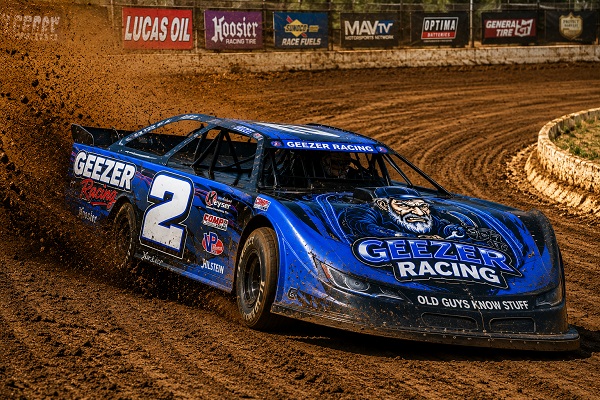
A pavement driver generally wants to keep the tires near their useful grip limit without wasting much of it in a visible slide.
A dirt driver may enter the corner with the rear already rotating. The driver lifts or brakes, transfers load forward, turns the car and then uses throttle to balance the rear-tire slip through the corner. The front wheels may even be pointed somewhat toward the outside while the car continues around a left-hand turn. That is countersteer.
To somebody unfamiliar with dirt racing, it can look as though the driver made a mistake three seconds ago and has not corrected it yet.
Done properly, the car is rotated toward the exit and the driver is balancing steering angle against throttle.
Too little throttle and the car may lose momentum or hook abruptly. Too much and the rear tires convert horsepower into dirt spray without doing enough useful work.
A good dirt racer makes this look natural. Racing has always been good at making the difficult look obvious after somebody else does it correctly.
Pavement — Grip Is Expensive, So Quit Throwing It Away
Pavement generally rewards precision rather than spectacle.
The quickest car works close to the tire’s grip limit while keeping unnecessary sliding to a minimum. A tire that is sliding heavily is generating heat and wear that may not be producing useful forward progress.
This is why a pavement driver can appear calm while being extremely fast. A clean corner may not look dramatic from the grandstands because the car does exactly what it was supposed to do.
The difficulty is repeating that corner while the tires heat, fuel burns off and the track changes.
A car that was neutral at the start may become tight later. Tire pressure rises with temperature. Rubber builds on the track. Clouds move in and cool the surface. The driver changes the line because somebody else is already there.
Pavement may not change as visibly as dirt. It still keeps moving the target.
Short Tracks and Big Tracks — Same Shape, Different Racing
Everything discussed so far changes with the size and speed of the racetrack. A quarter-mile bullring and a two-mile superspeedway are both ovals. So is a rubber band lying on the workbench. That does not make them equivalent.
On a short track, braking, turning and acceleration happen constantly. The car may spend very little time at maximum speed. Mechanical grip, suspension response and getting off the corner cleanly dominate.
On intermediate tracks, the car spends more time at high speed and aerodynamics becomes much more important. Downforce can help push the tires into the pavement, while drag fights straightaway speed.
On a superspeedway, airflow can control the race. The lead car punches a hole through the atmosphere. A following car can sit in that disturbed wake and experience less drag. That is drafting.
Several cars working together may travel faster than one running alone. Pull out to pass and the attacking car can lose that aerodynamic help unless somebody goes with it.
Now the fellow you intend to beat is helping you go faster. Do not worry; the cooperation generally ends before the checkered flag.
Dirty Air — The Draft Sends a Bill
The air behind another race car is not clean, smooth air. It has already been shoved around by the car in front.
That can reduce drag on the straight, but it may also reduce the clean airflow reaching the front aerodynamic surfaces of the trailing car.
Less front downforce means the front tires have to do more work. The car can become tight in the corner even though it handled perfectly when running alone.
Move the nose into clean air and the front may suddenly grip again.
The same wake can therefore be an advantage on the straight and a handling problem in the corner. The air gives the trailing car something, then collects at the other end.
Heat Races, Features and Getting Into the Show
Many local circle-track programs do not simply line everybody up once and run one race.
A typical night may include qualifying, heat races, consolation races and a feature.
Heat races are shorter events used to decide who transfers to the feature and where they start. Some tracks use qualifying times. Others use heat finishes, points, inversions or combinations of all three.
An inversion deliberately starts some faster cars farther back. The theory is that this produces more passing.
The practical result is that racers consider the system perfectly reasonable whenever it hurts somebody else.
Drivers who fail to transfer through the heats may get another chance in a B-main or consolation race. Make it through that and they reach the feature.
The feature is the race everybody came to see, which gives the preliminary races real consequences. Bend the right-front suspension fighting for third in Heat Two and the main event may become something you watch from your own trailer.
Cautions — There Goes the Lead
A yellow flag slows the field for a crash, debris, a stopped car or something else that makes racing at full speed a poor plan.
It also erases gaps. A driver can spend 40 laps stretching a five-second advantage. One car spins, the yellow comes out, the field bunches back together, and five seconds has become several feet.
Everybody knew cautions were part of the rules. That does not make watching a five-second lead disappear feel any more reasonable from inside the leading car.
Restarts — Everybody Gets Ambitious Again
Restarts can be single-file, double-file or governed by various lane-choice procedures depending on the series and track.
Whatever the exact rule, a restart compresses the field and gives everybody another chance to solve problems that had already been moving away from them.
Tires may have cooled. Brakes may have cooled. The preferred groove may have changed. Cars that had no realistic chance of reaching the leader ten seconds earlier are suddenly beside him.
The leader has to accelerate at the proper point without jumping the start. Everybody behind is trying to anticipate that moment without going too soon.
Then 20 cars arrive at Turn One closer together than anybody’s mother would recommend. Racing promoters call this competition. Grandstands generally call it the good part.
Lapped Traffic — The Track Comes With Moving Obstacles
On a short oval, the leaders can begin catching the back of the field surprisingly quickly. Those slower cars are not stationary cones; they are racing too.
A car running nineteenth may be fighting another car for eighteenth while the leader is trying to put both of them a lap down. The leader has to decide whether to pass high, pass low or wait. Second place is making the same decision while hoping the leader chooses badly.
A comfortable lead can disappear in traffic without the leading car slowing down at all.
The fastest way through Turn Three may currently belong to somebody two laps down. Now the leader gets to negotiate.
Pit Strategy — Fresh Tires or Keep What You Already Have?
Longer circle-track races add another problem: stopping the car may make it faster and send it backward at the same time.
Fresh tires usually provide more grip. The trouble is that changing them costs track position.
Suppose a caution comes out with 25 laps left. The leader stays out and keeps first place on worn tires. Another car stops for fresh rubber and restarts tenth.
Now the leader has the racetrack and the tenth-place car has the tires.
If passing is difficult, track position may be worth more. If the new tires are substantially quicker, tenth place may not last long.
Add fuel mileage, another possible caution and whatever everybody else decides to do, and the crew chief has several ways to look brilliant or foolish using exactly the same decision. It usually becomes obvious afterward.
Reading a Circle-Track Race Instead of Watching Cars Go Around
Once the basics make sense, an oval race stops looking like a procession repeatedly passing the same grandstand.
Watch where the quickest drivers enter the corner. One may dive toward the bottom early. Another stays high, makes a larger-radius turn and cuts down later. Watch when they return to the throttle; the fellow who gets back to power sooner often carries that advantage all the way down the next straight.
Watch a tight car. The driver keeps adding steering while the nose drifts toward the wall. Watch a loose car. The rear steps out and the driver has to catch it before getting back to full power.
On dirt, watch the track itself. Darker areas may still contain moisture. The polished groove may be getting slick. The cushion may be moving higher.
On pavement, watch tire management. A car that looked unbeatable early may begin pushing later because the right-front tire has had enough.
On a superspeedway, watch groups rather than individual cars. A lane with several cars tightly connected may build momentum while another stalls.
After a caution, watch the cars with fresh tires against the ones that stayed out for track position.
And when the leader reaches lapped traffic, watch second place. That is frequently where the next race begins.
Bottom Line
Circle-track racing looks simple because the scenery keeps coming back around. The car sees it differently.
Every lap asks four tires to brake, turn and accelerate while the load moves forward, rearward and sideways. Banking changes how much grip the track can support. The racing line changes the corner radius. Stagger and crossweight help a car built to turn one direction. Tire pressure and temperature move during the race. Dirt changes its groove. Pavement uses up the right-front. Aerodynamics matters more as speed climbs.
Then somebody throws a caution and lets everybody try again from several feet apart.
The driver who wins is not simply the one willing to turn left the hardest. He has to enter correctly, rotate the car, preserve enough tire, find the changing groove, work through traffic and get back to the throttle before the fellow beside him does.
That is why circle-track racers can spend all week preparing for an hour of racing and the entire ride home discussing one corner. Turning left really is the easy part.
↑ Back to the Top — Before Somebody Moves the Groove Again