1953 Corvette — Sports Car Looks. Chevrolet Six.
America’s New Sports Car Didn’t Have a V8
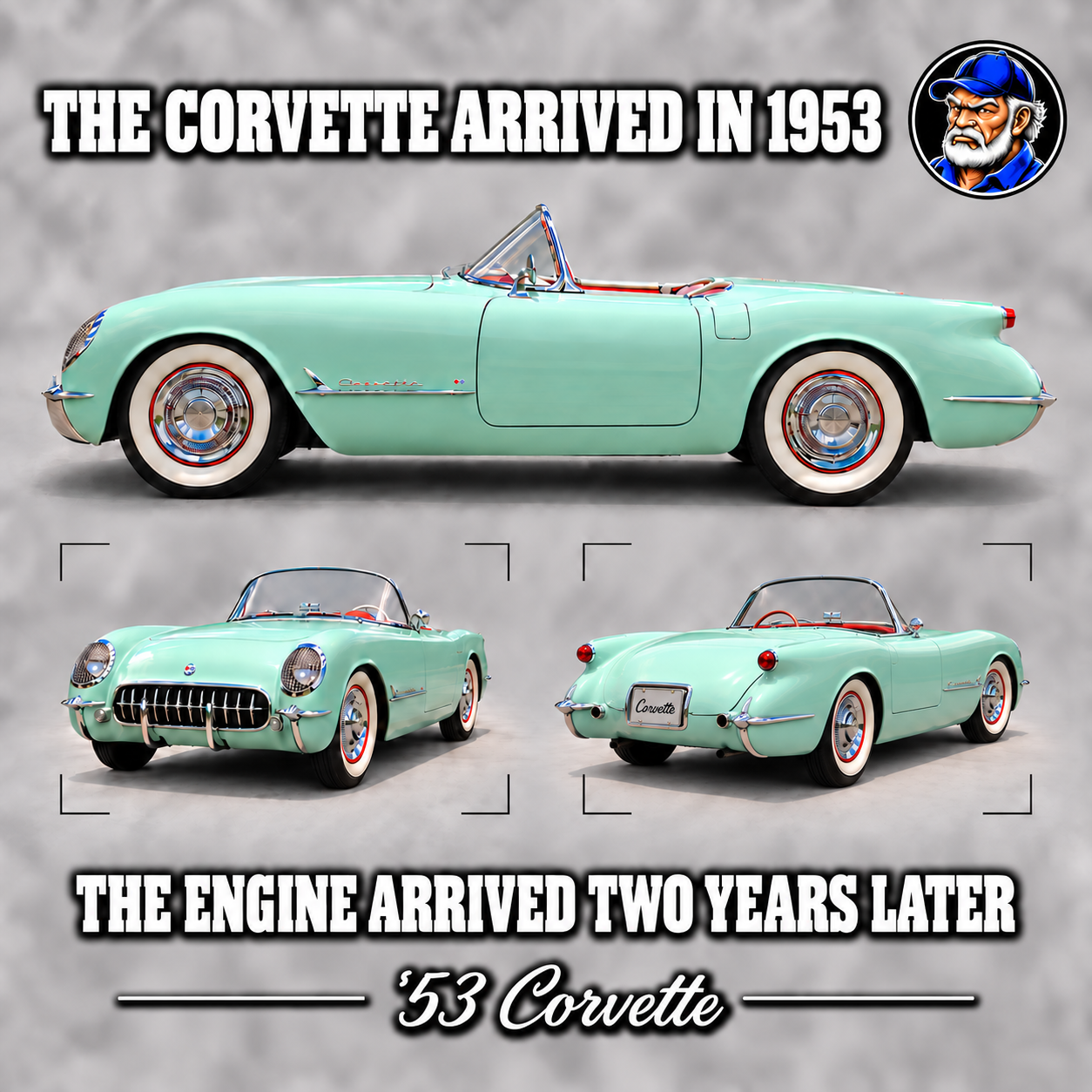
The 1953 Corvette looked like something Chevrolet had no business building. It was low, fiberglass-bodied and strictly a two-seater, with bucket seats, a long hood and a short rear deck. It looked like Detroit had finally decided to answer the Jaguars, MGs and other European sports cars showing Americans there was more to driving than six passengers, a bench seat and a trunk big enough for a family vacation.
Then you opened the hood and found a Chevrolet inline-six.
Not a V8. Not some exotic new racing engine. A 235-cubic-inch six with roots in Chevrolet’s ordinary passenger-car and truck engine family.
That sounds disappointing now because we’ve had seventy years to associate Corvette with V8 power, but Chevrolet had a simple problem in 1953: the small-block V8 didn’t exist yet. The Corvette debuted at GM’s Motorama in January 1953, and the public reaction was strong enough that Chevrolet pushed it toward production before all the mechanical pieces of the Corvette legend were ready.
Only 300 were built that first year, all in Polo White with red interiors, and Chevrolet couldn’t simply reach into the parts bin for the 265 small-block because that engine was still two years away.
So the engineers went to work on what they had.
The regular 235 six wasn’t simply dropped between the Corvette’s fenders and forgotten. Chevrolet raised the compression, changed the camshaft, used solid lifters and fitted three side-draft Carter carburetors on a special aluminum intake. A split exhaust arrangement helped it breathe on the other end.
The result was the Blue Flame Special, rated at 150 horsepower instead of the roughly 115 horsepower available from the ordinary passenger-car version. That was a substantial jump from a familiar old Chevrolet six, and it tells you something important about the first Corvette: the engine itself wasn’t some lazy afterthought. Chevrolet had squeezed real performance out of what was available.
The bigger problem was what sat behind it.
Every 1953 Corvette came with Chevrolet’s two-speed Powerglide automatic, and no manual transmission was offered. That made sense from a production standpoint. Chevrolet already had the hardware, already knew how to build it, and was trying to get an experimental new sports car into customers’ hands without reinventing every mechanical part underneath it.
From behind the wheel, though, a two-speed automatic wasn’t exactly what the bodywork promised.
The Corvette weighed roughly 2,700 pounds, so the Blue Flame had enough power to move it respectably. Period testing put 0–60 performance at around eleven seconds, with a top speed a little over 100 mph. That wasn’t embarrassing for 1953, but the body had written a performance check the drivetrain couldn’t quite cash.
Chevrolet got the idea right before it had all the machinery needed to finish the job. The fiberglass body was genuinely unusual, the proportions were right, and the seating position, floor shifter and two-seat layout made the point before you ever turned the key.
Underneath, though, there was still an awful lot of Chevrolet sedan trying to keep up with the styling department.
The Blue Flame six takes plenty of grief today because we know what came next, but it deserves more credit than it usually gets. Chevrolet took a familiar 235 and gave it more compression, more carburetion, more camshaft and better breathing until it made 150 horsepower.
That wasn’t the mistake. The real limitation was pairing it with a two-speed automatic in a car that looked ready to chase Jaguars through the hills.
Then 1955 arrived, bringing Chevrolet’s new 265-cubic-inch small-block V8. Suddenly the Corvette had the engine its shape had been begging for from the beginning, along with more horsepower, better acceleration and a drivetrain that could grow with the car instead of holding it back.
The difference was bigger than a horsepower number. The V8 changed the Corvette’s character.
The 1953 car had already proven Chevrolet could build the body, the proportions and the idea. The Blue Flame had proven the old six could be pushed harder than anybody expected. Once the small-block showed up, the machinery finally caught up with the styling.
That’s why the first-year Blue Flame cars matter. They weren’t failures; they were the bridge between Chevrolet’s old hardware and its new ambition.
Only 300 people got a 1953 Corvette, and those cars matter because Chevrolet built the sports car before Chevrolet had built the engine the sports car really needed.
The Corvette arrived in 1953. The Corvette engine arrived two years later.