1959 Cadillac — When Tailfins Went Too Far
Cadillac Started the Fin War. Then It Finished It.
Nobody has to ask what year this Cadillac is.
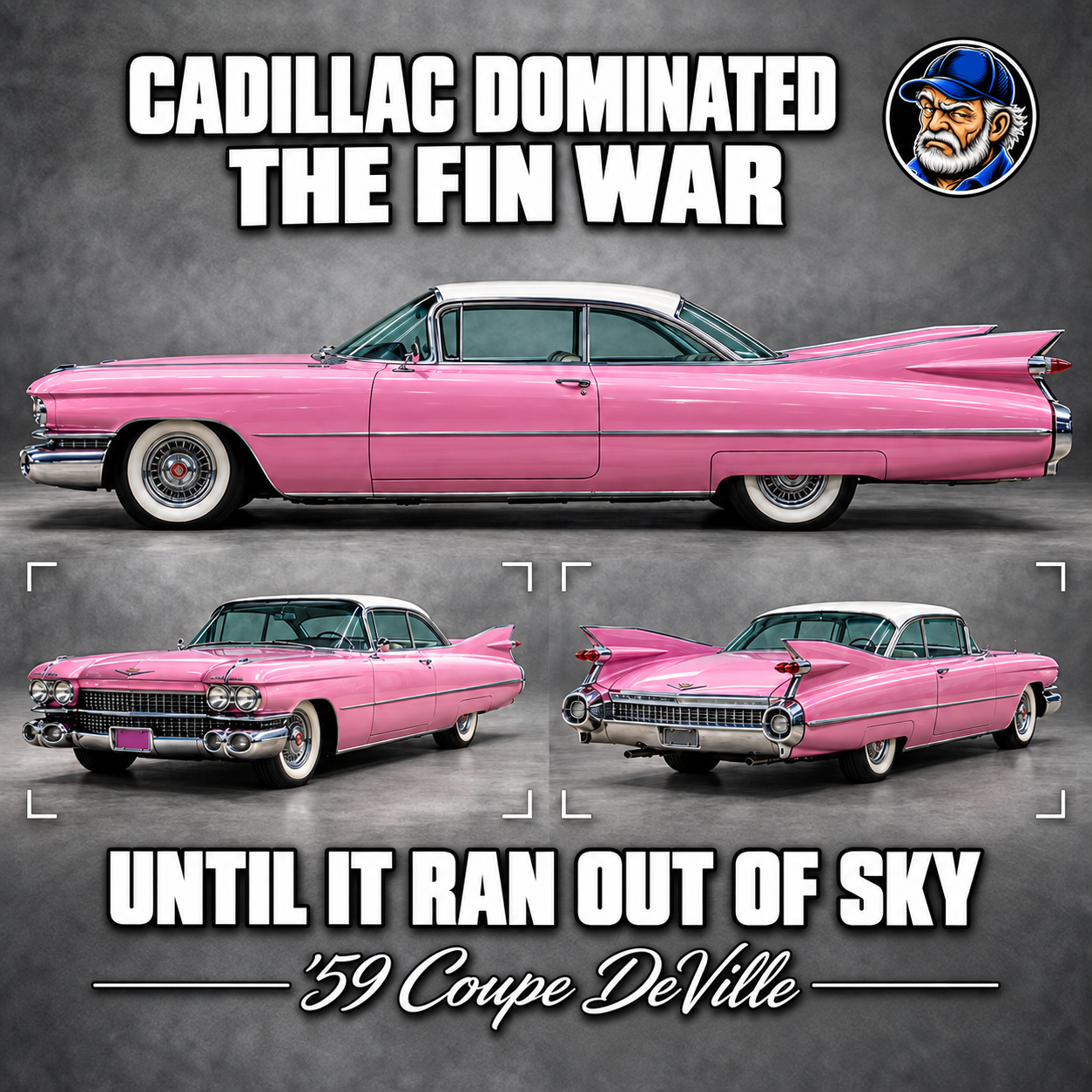
You can identify a 1959 from half a parking lot away without seeing the grille, the badge or anything else Cadillac spent money designing. Just look at the back. Those tailfins rise out of the rear quarters like Cadillac was trying to put vertical stabilizers on a luxury car, and sitting inside each one is a pair of round taillights that look suspiciously like jet exhausts.
Subtle, it wasn’t.
But Cadillac hadn’t suddenly discovered tailfins in 1959. It had been working toward this thing for more than a decade.
The story goes back to the P-38 Lightning, the twin-tail fighter that caught the attention of Harley Earl and GM stylists before World War II was over. When Cadillac introduced its redesigned 1948 models, little fins appeared on the rear fenders. They were modest, almost cautious, and you could still look at the car without wondering whether the thing needed a runway.
Then Detroit started competing.
Through the 1950s, fins spread across the industry and got taller, sharper and harder to ignore. Cadillac had helped start the trend, and once the fin became part of the brand’s identity, backing away wasn’t easy. So Cadillac kept going.
By 1959, the car had become enormous, stretching roughly 225 inches overall on a 130-inch wheelbase, but somehow all that length still wasn’t the first thing anybody noticed. Those fins swept up out of the rear quarters higher than anything Cadillac had used before, leaned outward and carried twin bullet-shaped taillights inside chrome housings.
Chrome wrapped around the rear and through enough sculpted sheet metal that the back of the car looked almost as complicated as the front of a jet. There wasn’t much restraint left, and that was pretty much the point.
The rest of the car followed the same philosophy. The windshield wrapped dramatically around the cabin, the body sat low and wide, and sheet metal seemed to stretch forever between the bumpers. Under the hood, Cadillac had enlarged its V8 to 390 cubic inches, giving the car enough engine to move all that size and chrome without apologizing for it.
The important part, though, wasn’t horsepower. It was timing, because the 1959 Cadillac arrived just as GM styling was changing direction.
Harley Earl retired from General Motors in late 1958, and Bill Mitchell took over GM Styling. Earl had spent years helping turn cars into rolling pieces of jet-age theater. Mitchell wasn’t about to strip the chrome off everything overnight, but the direction was already changing toward cleaner lines and less decoration.
The 1959 Cadillac landed right at the handoff.
That’s what makes the car more interesting than just a set of enormous fins. It was the old styling philosophy pushed about as far as it could go just as GM was starting to move the other way.
And you can see the retreat almost immediately.
The 1960 Cadillac still had fins, but they were already lower and calmer. After that they kept shrinking until what had once looked like aircraft tails became little more than styling ridges along the rear quarters.
Compare the little 1948 fins with the 1959 version and the whole story is sitting right there in sheet metal. What started as a small aircraft-inspired flourish had grown into one of the most exaggerated styling features Detroit ever put on a production car.
That doesn’t make the ’59 Cadillac a styling failure. If Cadillac had shown a little restraint, we probably wouldn’t still be talking about the thing more than sixty years later.
The excess is what made it memorable, and plenty of 1950s cars wore tailfins without ever becoming the picture people carry around in their heads when somebody mentions them. The 1959 Cadillac did.
It represents the whole jet-age idea turned up until the knob came off: longer, lower, wider, more chrome, more decoration and fins that had finally grown about as far as anybody could reasonably push them.
Cadillac started with little bumps on the rear fenders in 1948. Eleven years later, those fins were towering over the trunk with four taillights stuffed into them.
At that point, even Detroit knew the argument was over.
Cadillac spent eleven years growing the fin. In 1959, it finally ran out of sky.