1933 Ford Pickup — Built to Work. Powered by V8.
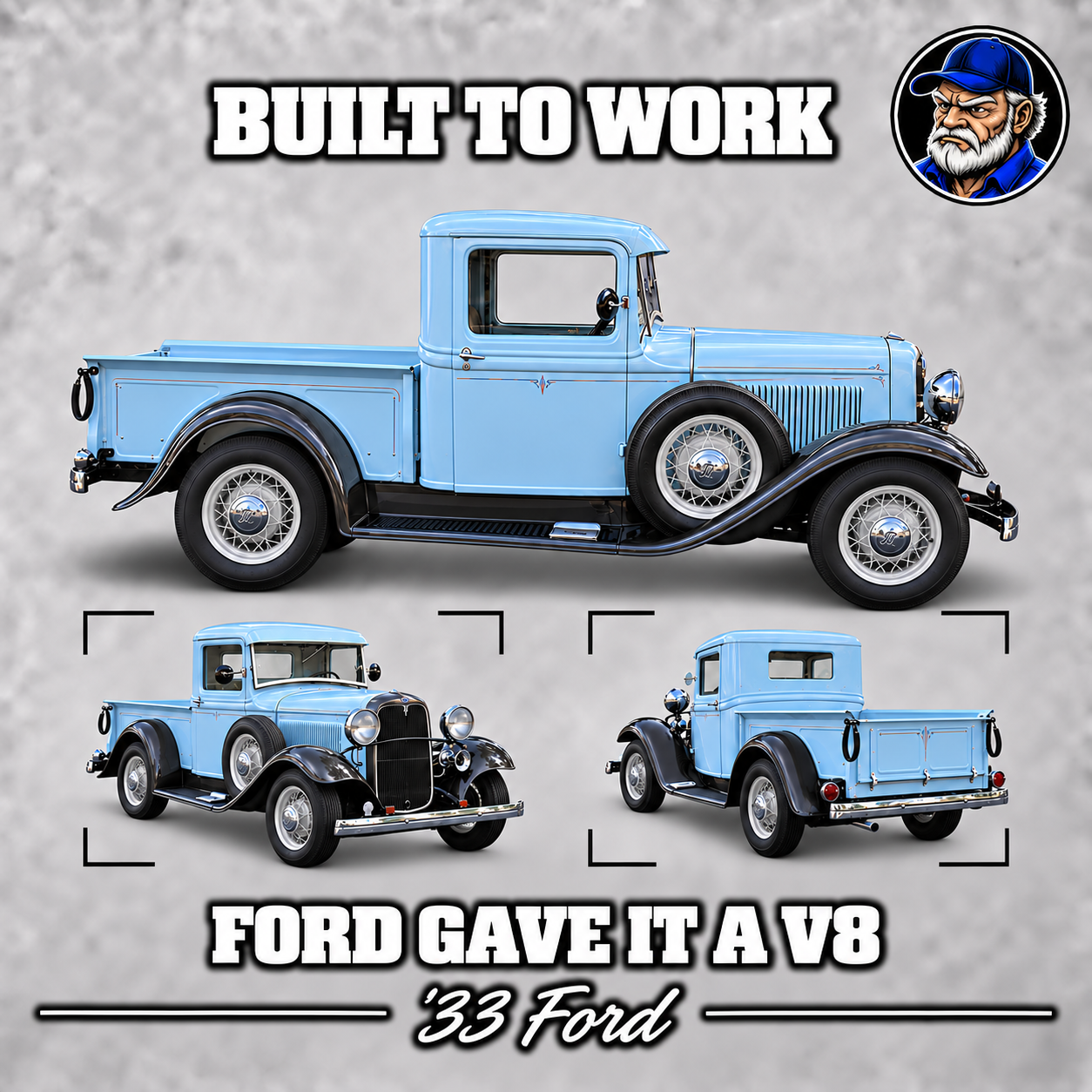
Built to Work. Powered by V8.
In 1933, a pickup truck wasn’t supposed to be exciting.
It was supposed to start in the morning, haul whatever needed hauling, survive another day of abuse, and do it without eating enough money to become part of the problem. This was the middle of the Depression. A truck had to earn its keep.
Ford understood that just fine.
Then it offered one with a V8.
Ford’s flathead V8 had arrived the year before and given ordinary buyers access to eight-cylinder power without sending them into the expensive end of the showroom. For 1933, Ford carried that same basic 221-cubic-inch architecture into its light trucks.
Now the fellow hauling feed, tools, lumber or deliveries had a choice that hadn’t been ordinary for a little working truck.
He could still buy the four-cylinder if simplicity and economy came first.
Or he could order the V8.
The rest of the truck didn’t suddenly become fancy because somebody checked the bigger-engine box. It still rode on a simple ladder frame with solid axles, transverse leaf springs, mechanical brakes and a three-speed manual transmission. The cab was there to keep the driver out of most of the weather, and the bed was there because somebody planned to fill it.
Nobody was trying to turn the thing into a country-club accessory with a little box bolted to the back.
The V8 changed what happened when the truck had work to do.
Its 221 cubic inches produced 75 horsepower for 1933. That number sounds almost comical beside a modern pickup, but that’s the wrong comparison.
This truck wasn’t hauling around power seats, air conditioning, sound insulation, crash structures and enough electronics to run a small office. It was a basic machine built when a fellow expected to hear the gears, feel the road and probably know which rattle belonged there.
Put 75 V8 horsepower into that package and the number starts looking a whole lot healthier.
Horsepower wasn’t the whole story anyway.
A work truck spends most of its useful life nowhere near maximum speed. It starts with weight in the bed, pulls away from intersections, climbs grades, slows down and has to get the load moving again.
That’s where smoother power delivery and useful low-speed shove matter.
The V8 gave the little Ford more authority when the truck was loaded or the road started pointing uphill. It didn’t turn the pickup into some 1933 version of a performance truck. It simply made ordinary work require less persuasion.
That’s what makes the truck interesting.
Today, the early Ford flathead gets remembered through hot rods: stripped fenders, dropped bodies, extra carburetors and somebody trying to make the thing go faster than Henry ever intended.
That reputation came later.
Before hot rodders started treating the flathead as raw material, Ford was already putting the same basic V8 architecture to work in trucks.
That’s an important difference.
The engine didn’t begin life as some exotic piece of speed equipment that eventually found its way into ordinary machinery. Ford had made V8 power practical enough that it could be ordered in a small truck whose first responsibility was earning money.
The hot-rodding legend grew out of an engine that already knew how to work for a living.
And Ford didn’t have to reinvent the pickup around it.
The chassis remained simple. The transmission remained a three-speed manual. The brakes were still mechanical. The suspension still relied on solid axles and transverse springs.
Ford had simply given the buyer another answer to the question under the hood.
That sounds ordinary now because modern pickups can be ordered with different engines, transmissions, drivetrains and enough equipment combinations to make the salesman’s book look like tax law.
In 1933, putting affordable V8 power into a basic light truck was a much bigger statement.
The four-cylinder still made sense for the fellow who wanted the simplest tool possible.
The V8 made sense for the fellow who knew the bed wasn’t going to stay empty.
Neither buyer needed the truck to be glamorous.
He needed it to work.
That’s where the flathead mattered first.
Long before anybody stuffed one into a stripped-down coupe and went looking for speed, Ford had already put one in a little pickup with dirt on the floor and another load waiting in the bed.
Built to work. Powered by V8. Ford gave the flathead a job before the hot rodders gave it a reputation.