1949 Mercury — Detroit Built It. Customizers Finished It.
The Car That Was Begging for a Saw
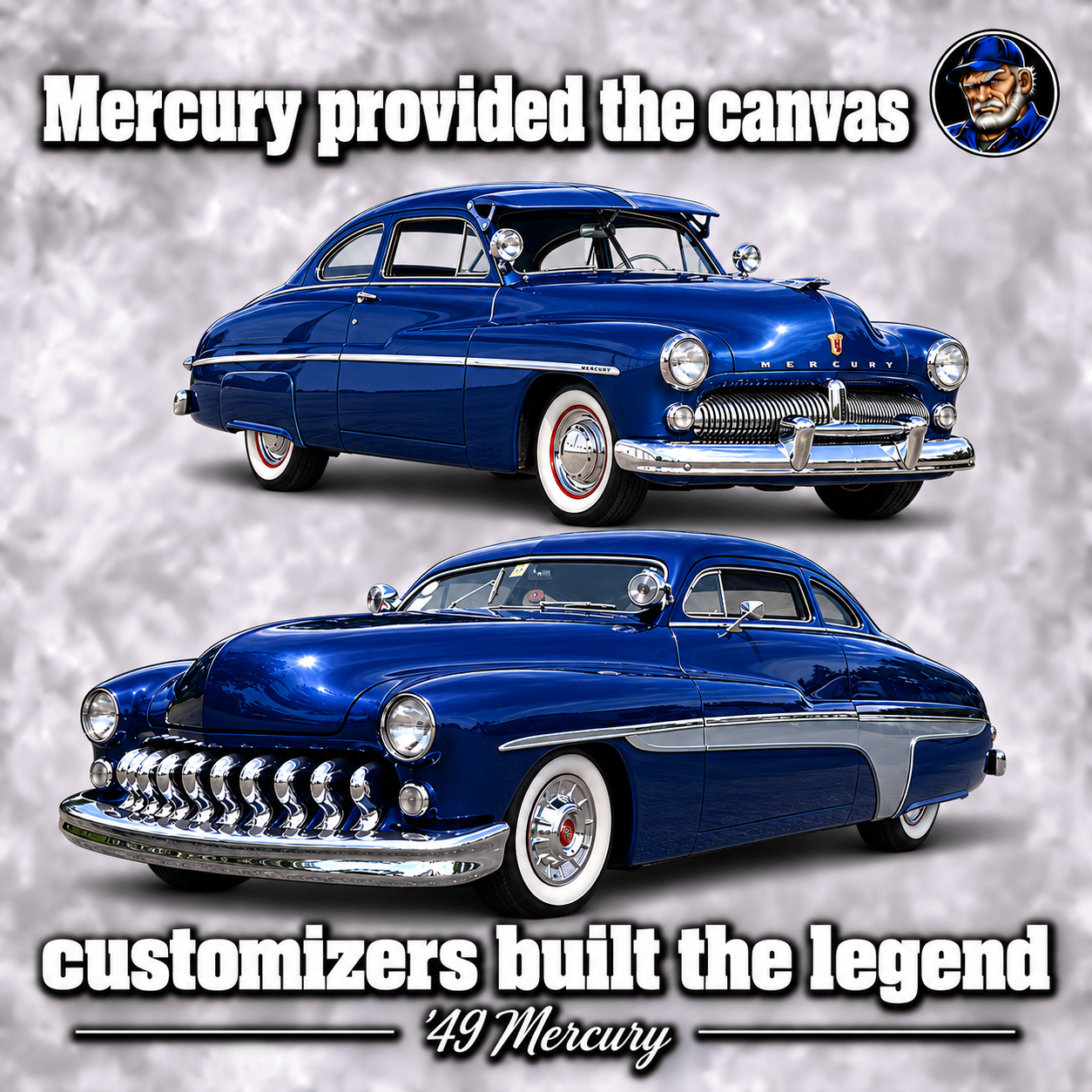
Mercury redesigned the car for 1949 and, without meaning to, handed customizers one of the best raw materials Detroit ever built.
The new Mercury was lower, wider and smoother than the upright cars that came before it. The fenders flowed into the body, the sides were broad and clean, and the coupe carried a big rounded roof over a thick lower body.
Stock, it was a handsome postwar coupe, but chopped and lowered it became something else entirely.
Take a few inches out of that tall greenhouse and the whole car stretches visually. Drop the suspension, smooth the trim, mold in the headlights and cover the rear wheels with skirts, and the Mercury stops looking like a family coupe and starts looking like it was poured instead of assembled.
That’s why the 1949–51 Mercurys became so closely tied to the lead-sled look. Plenty of cars were chopped in the early custom era, but the Mercury simply took the treatment better than most.
Its proportions were doing half the work before anybody picked up a torch. The body had enough mass below the beltline to support a low roof without looking awkward, while the long hood and rear quarters let the new roofline flow into the rest of the car. Bring the stance down and the whole thing looks longer, lower and heavier without needing much help.
Then the customizers went after everything else.
Early builders including Sam Barris helped establish the chopped-Mercury formula, and the idea spread quickly through the California custom scene. Door handles disappeared. Hood and deck trim came off. Headlights were frenched into the fenders. Grilles were changed. Seams were filled. Rear skirts hid the wheels. The object wasn’t to decorate the car. It was to make the body look less like separate stamped pieces and more like one continuous shape.
That also explains the “lead” in lead sled. Before plastic body filler became standard, customizers commonly used body lead to fill seams and smooth reshaped metal. Once enough cutting, welding and filling had been done and the car was sitting down close to the pavement, the nickname fit pretty well.
The stock Mercury’s 255-cubic-inch flathead V8 made 110 horsepower, but nobody was building one of these things to settle a quarter-mile argument. Hot rods chased speed. Customs chased line, proportion and presence, and the Mercury had all three waiting under a roof that was just a little too tall.
By the early 1950s, builders were pushing the idea even farther. The famous Hirohata Mercury, built from a 1951 model for Bob Hirohata, showed just how much could be changed without losing the car underneath it. The roof was chopped, the pillars and body lines were reworked, the lights were integrated and nearly every major surface was altered, yet the finished car was still unmistakably a Mercury.
Most cars become less recognizable the more factory pieces you remove. The Mercury somehow became more recognizable.
Detroit supplied the proportions, the sheet metal and a roof begging to lose a few inches. The customizers took it from there.
Mercury built the canvas. The customizers built the legend.