1951 Hudson Hornet — The Family Sedan That Went Racing
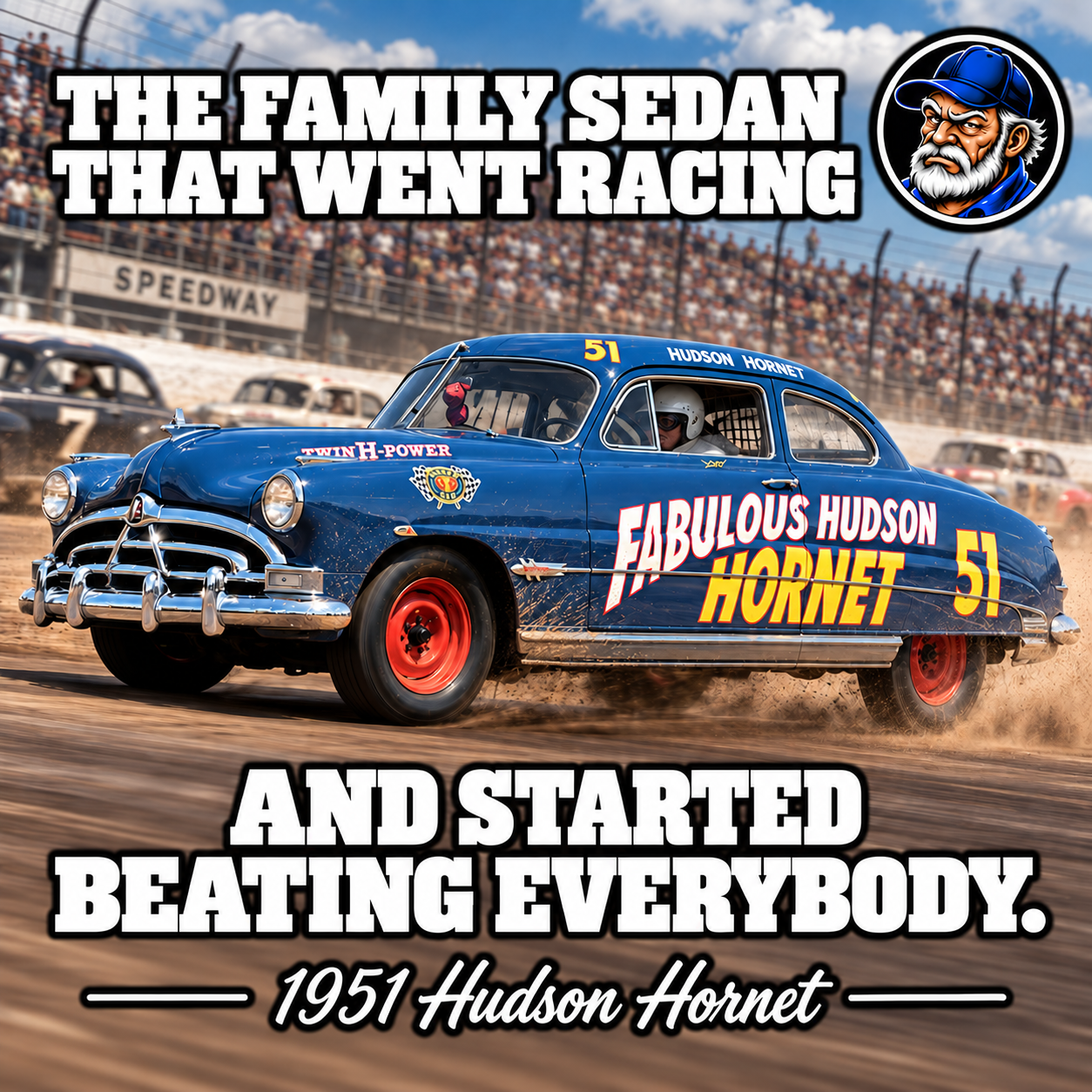
The Family Sedan That Went Racing
The 1951 Hudson Hornet didn’t look like somebody’s idea of a race car.
It was a big American sedan with plenty of chrome, room for the family and the kind of body shape that looked more interested in a long highway trip than banging doors on a dirt track.
Then Hudson started embarrassing people with it.
The trick wasn’t one magic part.
It was the whole package.
Hudson had already been building its Step-Down cars since 1948, using a body structure that let passengers sit down inside the frame rails instead of perched on top of them. That lowered the floor, lowered the roofline and, more important once somebody started leaning on the car, lowered the center of gravity.
The Hornet sat low because it actually was low.
Not lowered with cut springs.
Not crouched down for a magazine photograph.
Built that way.
By 1951, Hudson wrapped that basic architecture around a 308-cubic-inch straight-six and created the Hornet.
On paper, that didn’t sound like the recipe for terrorizing stock-car racing. It was a big sedan with a straight-six and no exotic overhead-valve V8 hiding under the hood, while plenty of Detroit cars already had engines that looked more impressive in a brochure.
The Hudson didn’t care much about brochures.
That long 308 had plenty of torque, and Hudson offered its Twin H-Power setup with two carburetors feeding the big six. Add the low center of gravity and a chassis that stayed composed when the road bent, and the Hornet started making a whole lot more sense at speed than it did sitting under showroom lights.
The thing could corner.
That was where the trouble started for everybody else.
Stock-car racing in the early 1950s still depended heavily on the production car underneath. Drivers weren’t sitting inside purpose-built tube-frame machines wearing vaguely familiar sheet metal. If the showroom car had lousy balance, weak brakes or a chassis that fought the driver, the race car inherited the argument.
Hudson happened to start with a very good argument.
Marshall Teague saw it early. So did Herb Thomas, and Hudson did something unusual for a manufacturer at the time.
It paid attention.
The company supported racers with parts and technical help instead of pretending the cars just happened to be winning on Sunday. Teague helped make the “Fabulous Hudson Hornet” famous, and the results soon made the name hard to dismiss.
In 1951, Teague won five NASCAR races in only 15 starts, while Herb Thomas won seven races overall and took the championship after switching to a factory-supported Hudson during the season. Thomas would win another NASCAR championship in 1953, again with Hudson power underneath him.
Teague also won the Daytona Beach & Road Course in both 1951 and 1952.
By then, the Hornet wasn’t sneaking up on anybody.
If one showed up in the pits, everybody knew exactly what had arrived.
That’s the part that makes the Hornet story so good.
Hudson didn’t build some flashy homologation special with wings hanging off the back or a giant engine barely fitting between the fenders. It built a family car unusually well, and racers discovered that the same things making it stable and comfortable on the highway also made it mighty useful when somebody started throwing it into corners.
The Hornet’s success arrived at exactly the right time for Hudson, too.
The company didn’t have Ford or General Motors money. It couldn’t simply buy more advertising than Detroit’s giants and expect everybody to surrender.
Winning races was cheaper.
And considerably harder to ignore.
Every time another Hornet crossed the finish line first, Hudson got to remind buyers that the same basic shape was sitting in its showrooms.
There was a wonderful bit of insolence in that.
The little independent manufacturer wasn’t supposed to be beating the big companies at their own game.
The old-fashioned straight-six wasn’t supposed to be frightening newer machinery.
The big sedan wasn’t supposed to behave that well in corners.
Yet there it was.
The Hornet’s domination wouldn’t last forever. Racing moved quickly, overhead-valve V8s kept getting stronger, and Hudson itself wouldn’t remain independent much longer.
But for a few years in the early 1950s, one of the nastiest cars to meet on a stock-car track looked suspiciously like something your neighbor might’ve used to haul the kids to church.
Hudson built the family sedan.
The racers found the attitude.
Hudson built the sensible sedan. The racetrack brought out its bad habits.