1960 Thunderbird — Four Seats. Bigger Sales.
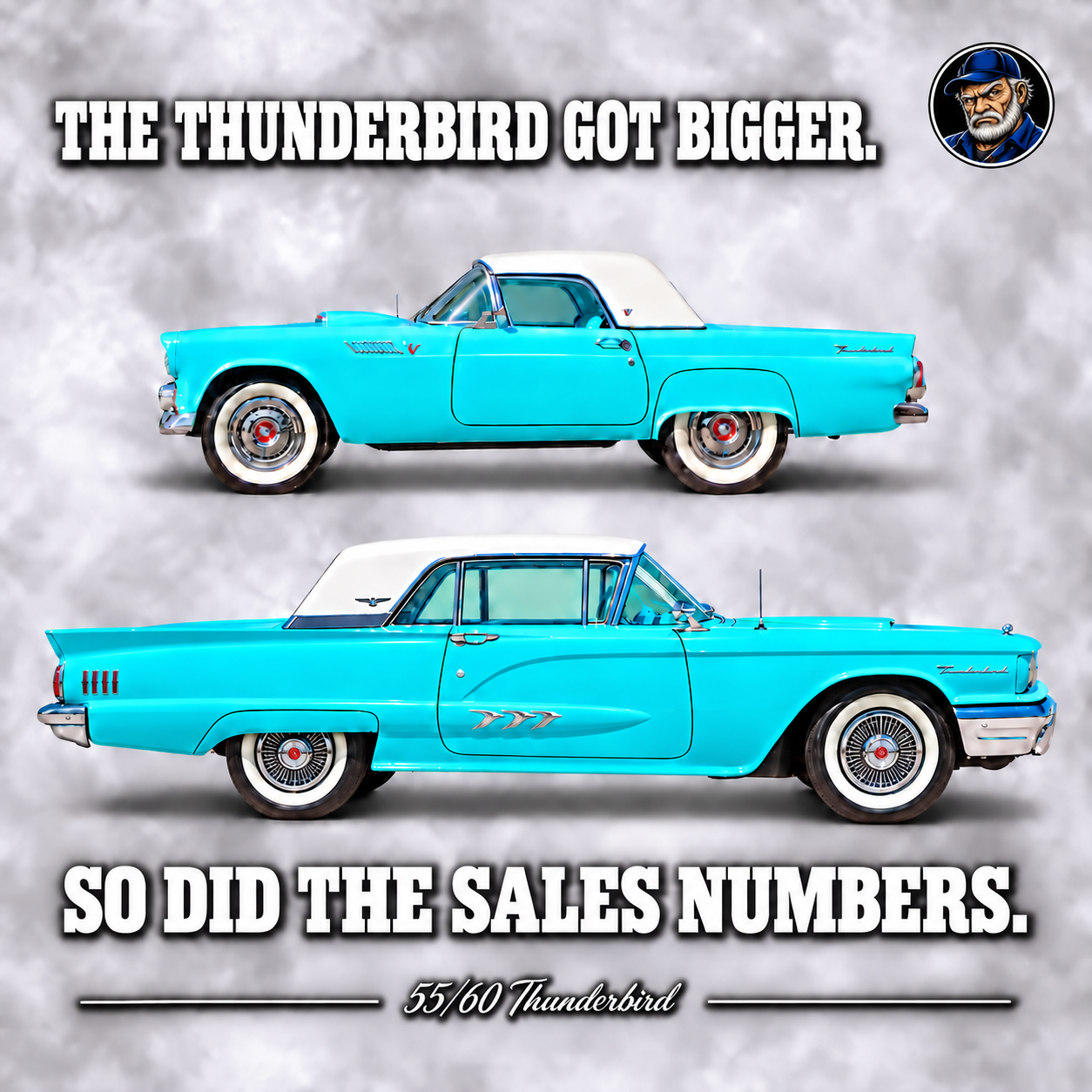
Four Seats. Bigger Sales.
The original Thunderbird looked like exactly the kind of car Ford ought to keep building forever.
Two seats. V8 power. Removable hardtop. Just enough sporting attitude to make the fellow behind the wheel feel like he’d bought something a little more interesting than the family sedan.
There was only one problem.
Ford wanted to sell more of them.
The 1955–57 Thunderbird had plenty of image, but two seats put a hard limit on who could actually use one. Fine for a Sunday drive. Fine for the country club. Fine until somebody wanted to take more than one passenger somewhere.
So Ford did something that probably made the sports-car purists choke on their coffee.
For 1958, it added a back seat and made the whole car bigger. The little two-seat Thunderbird was gone, replaced by a longer, heavier and more luxurious four-passenger car that quickly picked up the Square Bird nickname.
That wasn’t just Ford stretching the old car until another seat fit. It was changing the mission.
The new Thunderbird wasn’t trying to chase Corvette anymore. Ford had figured out there was a much larger crowd looking for something stylish and distinctive without giving up comfort, luggage room or the ability to bring a couple more people along.
On paper, that sounds like Ford ruined it.
The customers disagreed.
The Square Bird still had to look special, and it did. The low roof, wide stance, quad headlights and slab-sided shape made sure nobody mistook it for an ordinary Ford. Inside, bucket seats, bright trim and a more upscale cabin kept the personal-luxury idea alive even though the car had grown considerably.
The extra size wasn’t there just to make the brochure numbers bigger. It gave Ford room to turn the Thunderbird into something a buyer could actually use more often without making it feel like another family sedan with a fancy badge stuck on the fender.
That balance mattered.
Too practical and the Thunderbird lost the magic.
Too pure and Ford was right back where it started with a two-seat car plenty of people admired but fewer could justify buying.
Ford also made sure the larger car had enough engine to carry the extra weight without turning the whole thing into a slow-moving piece of furniture.
By 1960, the standard engine was the 352-cubic-inch V8, while buyers wanting more could order the big 430-cubic-inch Lincoln-based V8.
That suited the Square Bird just fine. This wasn’t supposed to feel light and nervous. It was supposed to feel substantial, smooth and expensive, with enough power to move all that extra sheet metal without making the driver regret buying the bigger car.
The important part, though, was still sitting behind the front seats.
Now a fellow could buy something distinctive enough to stand apart from an ordinary Ford without leaving half the family home every time he wanted to use it.
Ford had traded some purity for practicality.
And the sales numbers showed just how many buyers thought that was a pretty good deal.
The two-seat Thunderbird had never been a volume car by Ford standards. Once Ford added the rear seat and changed the whole formula, sales climbed to levels the original never approached.
By 1960, the lesson was pretty hard to miss.
The market for a stylish personal-luxury coupe was a whole lot bigger than the market for a two-seat sporty car.
Ford hadn’t merely made the Thunderbird bigger.
It had changed what the Thunderbird was for.
The original car had been Ford’s answer to the Corvette. The Square Bird became something more useful: a car for the buyer who wanted more style than a family sedan, more comfort than a sports car, enough V8 to keep things interesting, and a back seat so he didn’t have to explain to two friends why they were walking home.
The purists still had a point.
The four-seat Thunderbird was heavier, softer and less sporting than the original little roadster.
Ford knew that.
It just learned that a whole lot of customers cared more about what the car could do for them than whether it stayed faithful to the original formula.
By 1960, the Thunderbird wasn’t America’s answer to the Corvette anymore.
It was becoming the car everybody else had to answer.
Ford added two seats, lost some purity, and found a much bigger market. Four seats. Bigger sales.