1962–1963 Mustang Concepts — Before Ford Lit the Fuse
April 17, 1964 Was Two Years in the Making
On April 17, 1964, Ford turned the Mustang loose on America. It looked like an overnight sensation.
It wasn’t.
Two years earlier, the first car to wear the Mustang name had two seats, a little V4 behind the driver, and about as much in common with the production pony car as a go-kart had with a Galaxie. Ford hadn’t found the Mustang yet. It had found the idea, and that was enough to get started.
The market was changing fast. Younger buyers were showing up with money in their pockets, more families were buying second cars, and the same old big Detroit sedan wasn’t going to answer every question forever. Ford needed something smaller, sportier, and a whole lot less stodgy.
So it built the Mustang I.
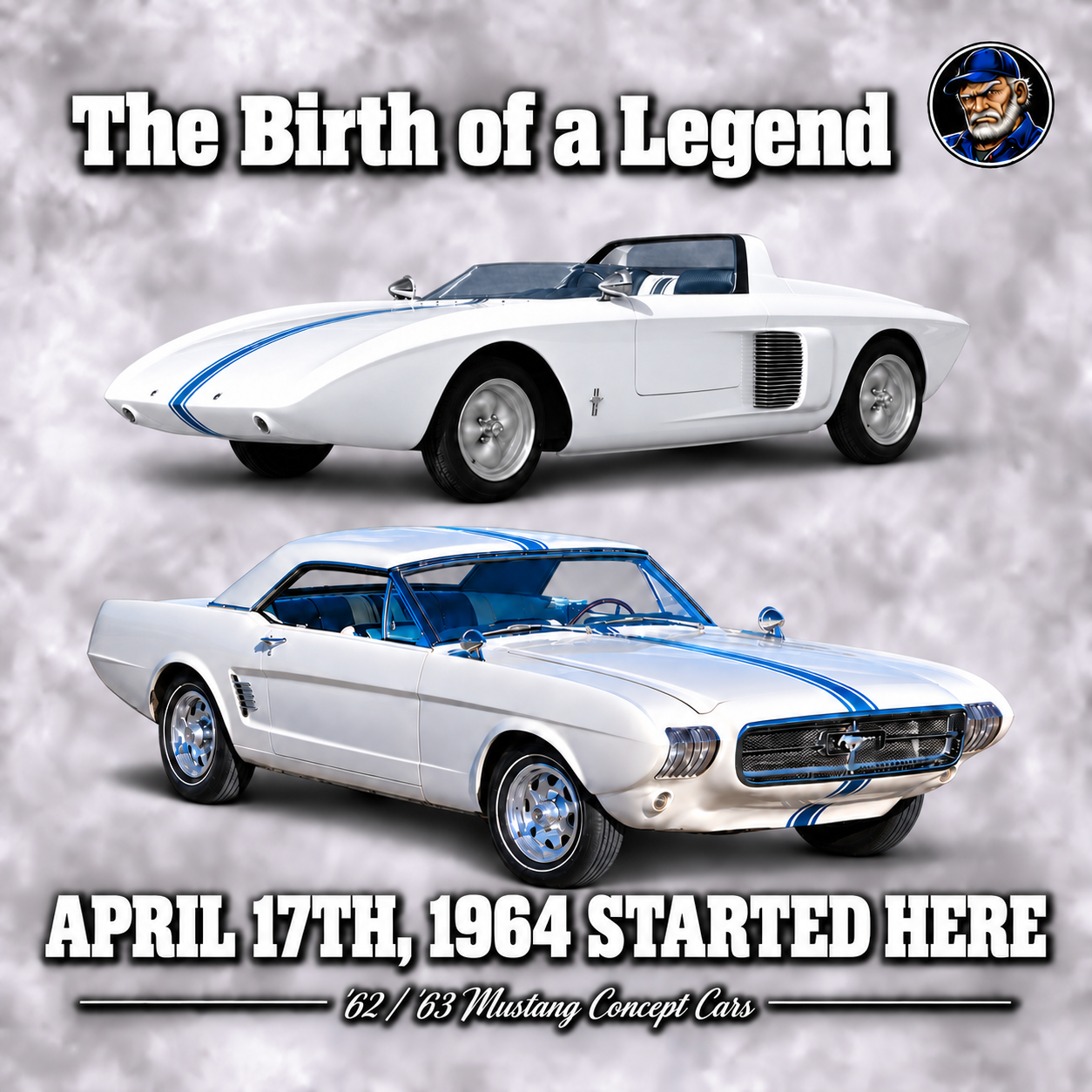
The little roadster stood only about 39½ inches tall, rode on a 90-inch wheelbase, weighed roughly 1,544 pounds, and wore an aluminum body. A 91-cubic-inch German Ford V4 sat behind the seats and drove through a four-speed transaxle. In its higher-output form, it made 109 horsepower.
That number doesn’t sound like much until you remember there wasn’t much car to move.
Ford took the running Mustang I to Watkins Glen in October 1962, where Dan Gurney drove it around the circuit before the United States Grand Prix. That got attention in a hurry. Ford kept hauling the thing to auto shows and college campuses, watching younger buyers crawl all over it and taking notes.
The answer was pretty clear. They liked small, they liked sporty, and they liked something that didn’t look like what Dad had been driving for the last ten years.
That gave Ford exactly what it wanted from the Mustang I, because the company wasn’t actually planning to sell anybody a hand-built aluminum mid-engine two-seater. The little roadster was terrific bait, but it was never going to be the car Ford could build cheaply enough, sell by the hundreds of thousands, and service at every dealership from New York to Kansas.
Behind the scenes, the real Mustang program was already heading somewhere much more sensible: four seats, engine up front, familiar Ford mechanical pieces, and a price an ordinary young buyer might actually be able to swing. Ford had created the excitement with one car while preparing to sell another. Now it needed something that could connect the two.
That’s where the 1963 Mustang II came in.
This one wasn’t another clean-sheet dream car. Ford built it from a prototype production Mustang body, then dressed it up enough to keep the show-car crowd interested. The headlights and grille were altered, the bumpers disappeared, a removable roof went on, and the whole thing got enough special treatment to make sure nobody mistook it for something already sitting behind the dealership.
But squint past the show-car tricks and there it was: four seats, engine up front, long hood, short rear deck, sculpted sides. Now the Mustang was starting to look like a Mustang.
Ford even painted the Mustang II white with blue striping, tying it back to the little 1962 roadster. That wasn’t an accident. The first concept had sold the public on the idea. The second one started showing them what Ford was actually going to do with it.
Then Ford took the Mustang II right back to Watkins Glen, where Lee Iacocca unveiled it on October 5, 1963, almost exactly a year after the Mustang I had stirred everybody up. By then Ford wasn’t really asking whether people wanted a sporty new car anymore. It already had that answer.
Now it was showing them, without quite admitting it yet, what was coming.
Six months later, the guessing stopped.
On April 17, 1964, Ford unveiled the production Mustang to the public at the New York World’s Fair and put it on sale across the country the same day. The cars were officially 1965 models, though those early ones would eventually pick up the unofficial “1964½” nickname.
The exotic little mid-engine roadster was gone, along with most of the concept-car foolishness. Good thing, too. What Ford put in the showroom was far smarter for the American market: four seats, proven mechanical pieces, a reasonable price, and enough engines, transmissions, colors, interiors, and options to let a buyer make one mild, fancy, fast, or anything in between.
Ford figured it might sell around 100,000 a year.
It took about 22,000 orders on the first day and sold roughly 417,000 Mustangs in the first twelve months.
That wasn’t luck. The Mustang I had made America look. The Mustang II had shown them what was coming.
Then April 17 arrived and Ford finally gave them the keys.
Ford spent two years preparing the fuse. On April 17, 1964, America struck the match.