1963 Corvette — Split Window
One Year. One Window. One Argument.
The 1963 Corvette Sting Ray didn’t need help becoming memorable.
It had an all-new shape, independent rear suspension, a lower roofline, sharper proportions and the kind of styling that made the old solid-axle Corvette look like it belonged to another decade.
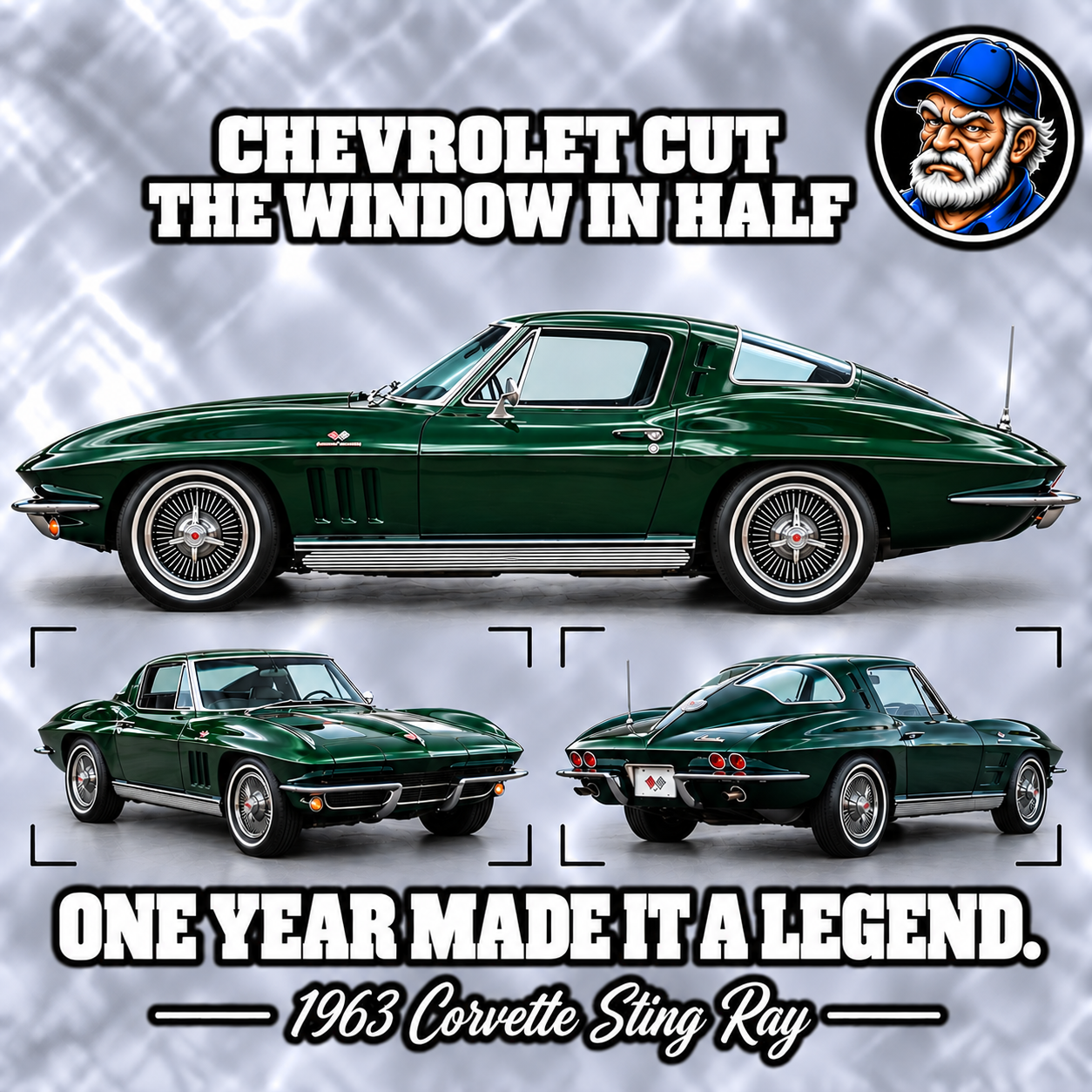
Then Chevrolet split the rear window in half.
That one decision turned the 1963 coupe into one of the most recognizable Corvettes ever built and started an argument almost immediately. Bill Mitchell loved the look. Zora Arkus-Duntov hated what it did to rearward visibility, and both men had a point.
The split rear glass wasn’t some last-minute styling trick. It was tied directly to the shape of the new Sting Ray coupe and Mitchell’s determination to carry a center spine down the roof and through the rear deck. The divider finished the idea and gave the car a visual backbone from the windshield all the way to the tail.
From the outside, it worked beautifully.
From the driver’s seat, not so much.
That same divider sat right in the middle of the rearward view. Instead of one broad piece of glass, you got two smaller windows with a strip of bodywork between them. Mitchell saw a design feature while Duntov saw something blocking the driver’s view, and that was really the whole argument: one man was defending the shape, the other was defending the car.
Duntov had another reason to care.
By 1963, the Corvette was becoming a much more serious machine dynamically. This was the first Corvette coupe, the first production Corvette with independent rear suspension, and the first year of the second-generation body. Chevrolet had finally given the car a modern chassis and a suspension that could do more than just survive a straight road.
Under the hood, the 327 small-block lineup ranged from 250 horsepower up to 360 in the fuel-injected version.
So here was a Corvette that was lower, sharper, faster and more sophisticated than what came before it, and somebody had planted a styling divider exactly where the driver wanted to see.
You can understand why Duntov wasn’t impressed.
You can also understand why Mitchell fought to keep it. The split window was part of what made the new coupe look so different from everything else on the road. Take the divider away and the rear became cleaner, easier to see through and more practical.
It also became less distinctive.
Chevrolet settled the argument for 1964 by replacing the split glass with a single rear window. Visibility improved immediately, but the coupe also lost one of the details that had made the 1963 impossible to mistake for anything else.
That made the split window a one-year-only feature, and that’s where the legend really started.
Plenty of one-year details disappear without anybody caring. This one didn’t, because the split window sat right at the intersection of styling and function. It looked terrific, and it got in the way just enough to become unforgettable.
Chevrolet fixed the problem.
Collectors spent the next sixty years wishing it hadn’t.
Today, the split window defines the car before anybody checks the engine, trim tag or option list. You can spot one across a parking lot and know exactly what you’re looking at.
Chevrolet made the Corvette better for 1964.
It made the 1963 more desirable by accident.
The split window lasted one year. The argument never ended.