1968 Hurst/Olds — GM Said 400. Olds: 455.
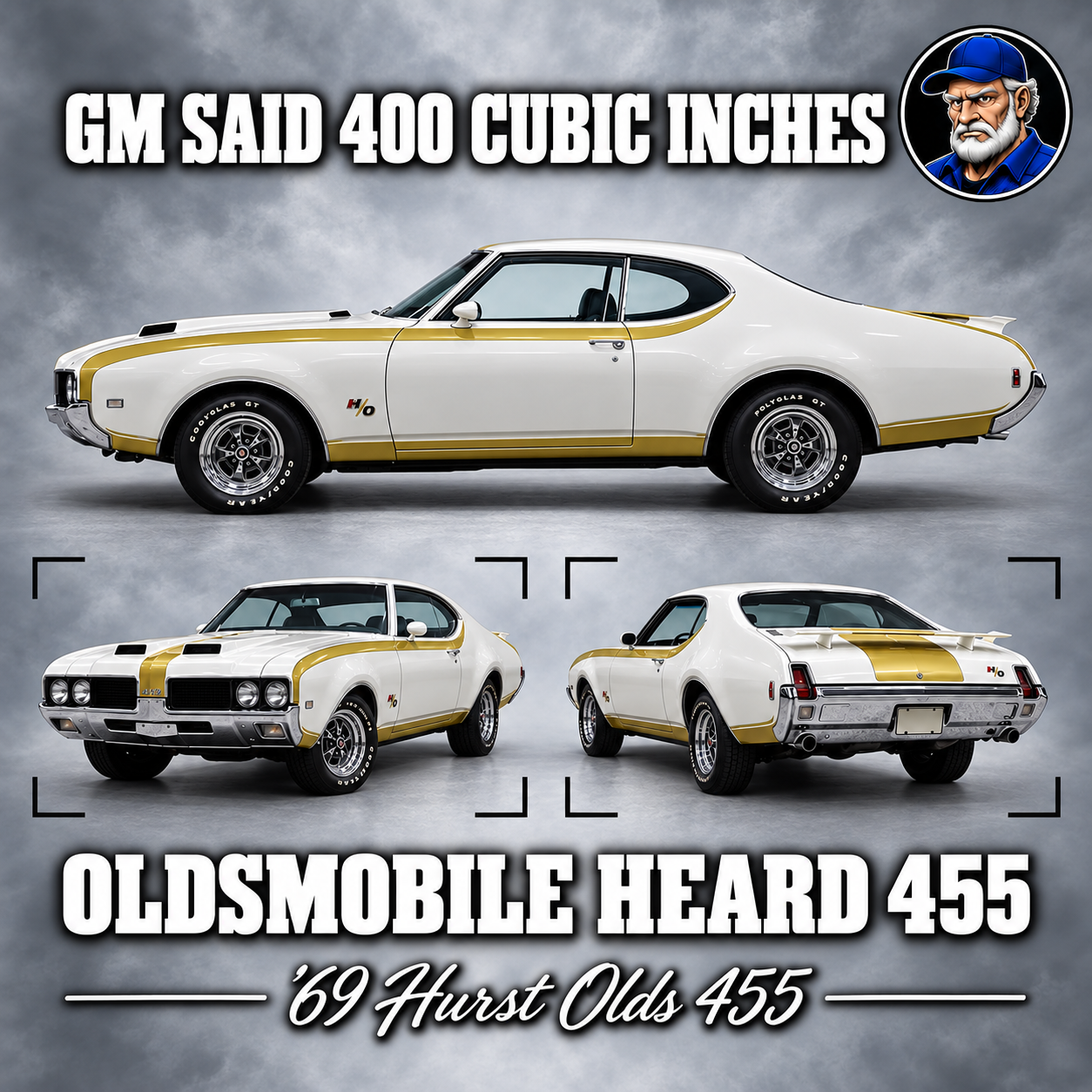
GM Said 400 Cubic Inches. Oldsmobile Heard 455.
General Motors had a rule.
Intermediate cars weren’t supposed to get engines larger than 400 cubic inches.
That sounded simple enough until Oldsmobile looked at the 455 sitting in the parts bin.
The 4-4-2 already had a 400. It was quick, respectable and perfectly capable of keeping Oldsmobile in the muscle-car fight. The problem was that Oldsmobile had something bigger, and GM said it couldn’t put it in the car.
So Oldsmobile found another route, and Hurst was the answer.
Instead of building the cars on the regular line with a 455 installed, Oldsmobile sent specially prepared 4-4-2s outside the normal production process for conversion. Hurst Performance handled the job, and that little detour around the rulebook gave Oldsmobile exactly what it wanted: a 455 in an intermediate.
There are times when corporate policy meets engineering ambition and engineering politely says, “We’ll see about that.” This was one of them.
The 455 was rated at 390 horsepower, but the number that really changed the character of the car was torque: 500 lb-ft.
Five hundred pound-feet in a midsize Oldsmobile in 1968 was enough to settle most arguments before they got started.
The regular 4-4-2’s 400 already gave the car plenty of performance, but the 455 brought more low- and midrange shove. This wasn’t an engine that needed to be wound tight before anything happened. Put your foot down and the car didn’t hold a committee meeting first. It went.
Oldsmobile and Hurst made sure the rest of the package could live with that kind of torque.
The 455 was backed by a Turbo Hydra-Matic 400 automatic, and Hurst supplied its Dual-Gate shifter. Leave it in the normal gate and it behaved like an automatic. Move it into the performance side and the driver could hold and select gears manually.
No four-speed was offered, which probably bothered a few fellows who thought every serious muscle car needed a clutch pedal. The Hurst/Olds wasn’t interested in passing a purity test. It had 500 lb-ft of torque and a transmission stout enough to survive behind it.
The Force Air setup fed outside air toward the engine through scoops mounted below the front bumper, and the appearance package made sure nobody mistook the thing for an ordinary Cutlass.
Every 1968 Hurst/Olds wore Peruvian Silver with black accents, while red inner fender wells added another little warning under the hood. The loophole might’ve been administrative, but the car sure wasn’t.
That’s what makes the first Hurst/Olds more interesting than just another rare muscle car.
Detroit manufacturers were always looking for ways to squeeze more power out of whatever the rulebook allowed: bigger carburetors, hotter camshafts, better heads, steeper gears.
Oldsmobile’s problem was different. It already had the engine; the corporate rule said the car couldn’t have it.
So Oldsmobile changed the path the car took before it reached the customer.
That outside conversion wasn’t some footnote to the story. It was the reason the Hurst/Olds could exist at all.
Only 515 were built for 1968.
That made the car rare, but rarity isn’t what makes the story work. Plenty of cars were rare because nobody wanted them.
The Hurst/Olds was rare because it was a specialty answer to a very specific corporate problem.
GM had drawn the line at 400 cubic inches. Oldsmobile wanted 455, and Hurst gave it a way around the line.
GM drew the line at 400. Oldsmobile drove around it.