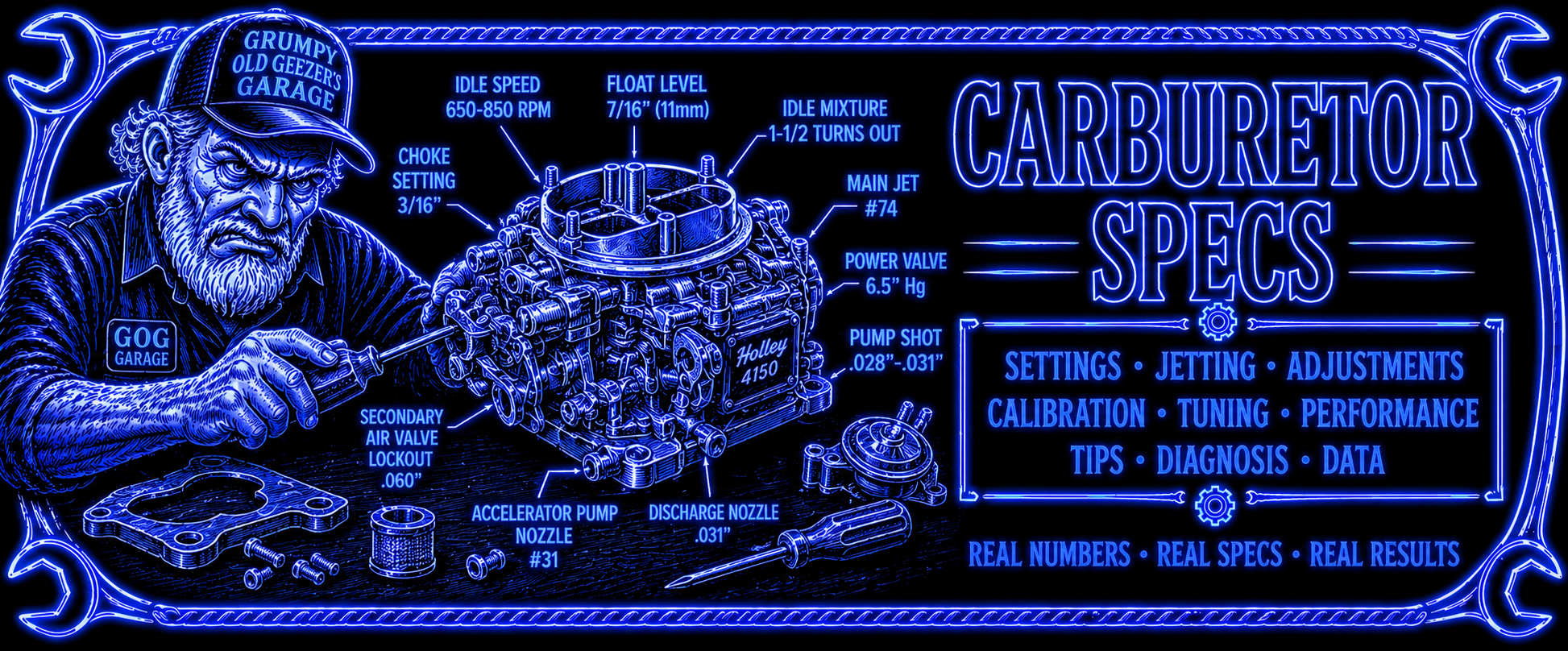
Holley Carburetor Specs
Holley is one of those names people throw around like it explains the whole carburetor. It doesn’t.
A Holley might be a one-barrel economy carburetor, a two-barrel truck carburetor, a factory muscle-car four-barrel, an emissions-era compromise, a marine carburetor, a race Dominator, or an aftermarket street carb that has been rebuilt by six different owners with seven different opinions.
That is why Holley identification matters. Saying “it has a Holley on it” is about as useful as saying “it has tires.” The model, list number, secondary type, bore configuration, choke setup, metering arrangement, and intended application all matter.
This page organizes the major Holley carburetor models so you can get to the right family before you start tuning, rebuilding, buying parts, or repeating garage folklore.

Holley Carburetor Models

Single-barrel Holley carburetors commonly used on early inline engines, economy vehicles, industrial applications, and utility equipment where simplicity and durability mattered more than outright performance.
Single-barrel carburetor family used heavily on inline-six and light-duty applications during the emissions era. Common on trucks and economy vehicles where drivability and fuel economy mattered more than excitement.
Single-barrel Holley carburetors used in economy, emissions, and light-duty passenger-car applications during the years when manufacturers were trying to satisfy emissions regulations without completely strangling drivability.
Two-barrel modular Holley family used in factory applications, trucks, circle-track racing, and street-performance builds. The 2300 became extremely popular because it combined simplicity, decent airflow, and easy tuning without the size and complexity of a large four-barrel.
Early four-barrel Holley design from the period when factory V8s started demanding more airflow and better throttle response. Important historically, but not something to confuse with the later modular Holleys everyone argues about at swap meets.
Square-bore Holley performance carburetor family designed as a cleaner, more integrated alternative to traditional modular Holleys, aimed at street-performance users who wanted Holley airflow with fewer external bowl-gasket leak points.
Spread-bore Holley performance carburetor family aimed at Quadrajet-style intake applications, giving users a Holley-style alternative without automatically changing the manifold. Useful when the intake stays; confusing when people expect it to behave exactly like a Q-Jet.
Modular square-bore four-barrel Holley performance family used across OEM performance, street-strip, racing, marine, and aftermarket builds. Highly tunable, widely supported, and perfectly capable of making a bad combination worse when somebody thinks adjustment equals understanding.
Simpler square-bore Holley four-barrel family commonly using a secondary metering plate instead of a full secondary metering block. Often smoother, cleaner, and better suited to street engines than people admit when they are busy bragging about bigger hardware.
Spread-bore Holley carburetors built during the emissions era to compete with Quadrajets and survive tightening fuel-economy and drivability requirements. Often misunderstood, heavily vacuum-controlled, and far less popular with racers than the classic square-bore Holleys.
Square-bore emissions-era Holley four-barrel family strongly associated with late carbureted Ford performance applications. Close enough to traditional Holley architecture to look familiar, but loaded with emissions-era details that punish people who start unplugging things for sport.
Spread-bore emissions-era Holley four-barrel family built around tighter fuel control, vacuum systems, feedback-era hardware, and late-carburetor compromise. It belongs to the awkward years when carburetors were being asked to act like computers without actually becoming fuel injection.
Large race-oriented Holley carburetors designed for serious airflow and competition use. Fantastic on engines that actually need them. Completely ridiculous on most street cars pretending to be race cars.
↑ Back to the Top, Before the Parts Start Arguing

Identification Notes
Holley’s importance comes from range and adaptability. The company built carburetors for basic transportation, work trucks, industrial engines, factory performance programs, marine use, racing, hot rods, restomods, and aftermarket performance builds.
Early Holley carburetors appeared on economy vehicles, industrial engines, tractors, utility equipment, and inline engines long before the company became synonymous with high-performance V8 applications.
Two Holleys may look nearly identical while functioning very differently. One may belong on a factory performance engine. Another may belong on a boat. Another may belong in a box under the bench until somebody figures out what parts have been swapped into it.
Correct identification matters because parts, calibrations, tuning components, and airflow characteristics vary heavily between models.
Holley list numbers matter more than appearance alone. On many Holley carburetors, the list number is stamped on the choke horn or air horn area. Some later, modified, or choke-horn-removed carburetors may require checking other identifying marks, casting features, metering blocks, throttle body details, and physical configuration.
Before identifying a Holley, confirm the model family, list number, vacuum or mechanical secondary design, choke type, spread-bore or square-bore layout, metering block configuration, and whether it was built for OEM, marine, race, emissions, or aftermarket use.
A “Holley 750” is not a complete identification. That is a starting point. The details are where the truth is hiding.

Shared Family Notes
During the 1960s and 1970s, Holley gained major visibility through factory muscle car programs at Ford, Chevrolet, Mopar, AMC, and other manufacturers. High-performance Mustangs, Camaros, Chevelles, Mopars, and specialty performance packages frequently used Holley carburetors because they offered strong airflow capability and aggressive fuel delivery characteristics.
By the emissions era, Holley also produced spread-bore and feedback-style carburetors designed to compete in a market increasingly dominated by fuel economy requirements, emissions controls, and computer-assisted tuning systems.
Today, Holley remains heavily represented in street performance builds, drag racing, circle track racing, marine applications, hot rods, restomods, aftermarket crate-engine packages, and traditional muscle car builds.
Some Holley families are simple and rugged. Others are highly tunable and extremely sensitive to improper setup.
Holley carburetors also became popular because racers could modify them easily. Jets, power valves, accelerator pumps, secondary springs, and linkage systems could all be changed without redesigning the entire carburetor. That flexibility made Holley legendary — and also helped create an endless supply of badly tuned street cars.
Holley carburetors became popular largely because the designs are modular and serviceable. Metering blocks, jets, power valves, accelerator-pump systems, secondary springs, shooters, floats, linkage systems, and other components can often be changed individually without redesigning the entire carburetor.
That modularity made Holley extremely attractive to racers and performance enthusiasts because tuning changes could be made quickly and repeatedly at the track, in the shop, or in the driveway.
Holley also built carburetors for dramatically different applications. Some models were intended for basic transportation and fuel economy. Others were intended for heavy towing, marine service, circle-track durability, drag racing, or high-RPM street performance.
The important thing to understand is that Holley flexibility is not magic. The carburetor still has to match the engine’s airflow demand, camshaft behavior, vacuum signal, gearing, vehicle weight, and intended use.
A street engine usually wants clean signal, good throttle response, and predictable fuel delivery. A race engine may tolerate or require a completely different setup. Confusing those two worlds is how a good carburetor gets blamed for a bad combination.

Common Problems
Incorrect Tuning
People throw jets, power valves, accelerator pumps, and secondary springs at Holleys like painkillers instead of diagnosing the actual problem first.
Vacuum Leaks
Warped metering blocks, damaged gaskets, worn throttle shafts, loose screws, and improper assembly commonly create tuning problems blamed on the carburetor itself.
Mixed Components
Many older Holleys contain parts from multiple carburetors, rebuild kits, aftermarket modifications, and homemade “performance upgrades” that no longer match the original calibration.
Improper Float Adjustment
Incorrect float levels create flooding, lean conditions, poor transition behavior, hard starting, and inconsistent fuel delivery.
Oversized Carburetors
One of the most common mistakes in American garages is bolting an enormous carburetor onto an engine that cannot use the airflow. Bigger numbers impress people at car shows a lot more than they impress the engine.
Wrong Application
Marine, race, emissions, OEM, and universal aftermarket Holleys may look close enough to fool people, but they are not automatically interchangeable. A carburetor built for one job can be miserable when forced to do another.
Owner-Created Problems
Half the Holleys called “junk” are really just thirty years of bad tuning decisions stacked on top of each other.
Parting Shot
Holley built everything from economy carburetors to full race hardware, but the company earned its reputation because the designs could be tuned, modified, repaired, and adapted almost endlessly.
That flexibility made Holley legendary — and also made badly modified Holleys one of the most common sights in American garages.
Identify the exact model first. Then identify the configuration and application before buying parts, changing tuning components, or assuming anything interchanges.