Drag Racing Basics
Two Cars, One Strip, and Several Ways to Lose Before the Finish Line
Drag racing looks like the easiest form of motorsports ever invented. Two cars line up, the lights come down, everybody makes noise, and the first one to the other end wins.
That explanation lasts until the quicker car loses. Then somebody runs 11.92 on an 11.95 dial and loses for going too fast. Another fellow leaves first even though his car is two seconds slower. Somebody with the higher finish-line speed gets beaten, and another driver is finished before he travels six inches because a red light came on. So there is a little more going on than standing on the loud pedal.
The good news is that drag racing is not especially complicated. It is precise. The starting line is measured in inches, the race in thousandths of a second, and the timing slip keeps enough evidence that most excuses have a fairly short life expectancy.
How Much Racetrack Are We Talking About?
The old standard is the quarter-mile: 1,320 feet. That number is wired into generations of hot rodders. Ask an old fellow what his car ran and there is a good chance he has already put the finish line 1,320 feet away before the question is finished.
Eighth-mile racing cuts that distance to 660 feet and is common all over the country. Modern NHRA Top Fuel and Funny Car stop the clocks at 1,000 feet. Other classes still run the quarter, and plenty of local tracks run the eighth.
The important part is that the track is not simply waiting for the car to reach the other end. Electronic beams measure what happens at several points along the way. A quarter-mile timing system commonly records 60, 330, 660, 1,000 and 1,320-foot elapsed times, with speed measured near the finish.
That means the timing system does not merely tell you whether the pass was good. It can often tell you where it stopped being good.
Before the Race — The Burnout Is Not Just Showing Off
The first thing a newcomer notices is the burnout. The rear tires spin, smoke rolls out, the engine makes enough noise to interrupt conversations three counties away, and somebody unfamiliar with drag racing may reasonably assume the driver is celebrating before the race has started.
The burnout has a job. Drag slicks work best within a useful temperature range, and spinning them heats the rubber. More important, the burnout cleans debris from the tread surface and leaves fresh rubber against the prepared racing groove.
On a properly prepared drag strip, that groove already contains rubber from earlier runs along with traction compound applied by the track crew. The result can be extraordinarily sticky. Walk across a heavily prepared starting line in ordinary shoes and the pavement may reveal strong opinions about whether anybody is allowed to leave.
More burnout is not automatically better. Too little may leave the tire cold. Too much can overheat it, abuse the driveline and waste time. Different tires and classes want different procedures.
The objective is not to create the largest cloud. It is to make the tire useful when the green light arrives.
Staging — Seven Inches Suddenly Become Important
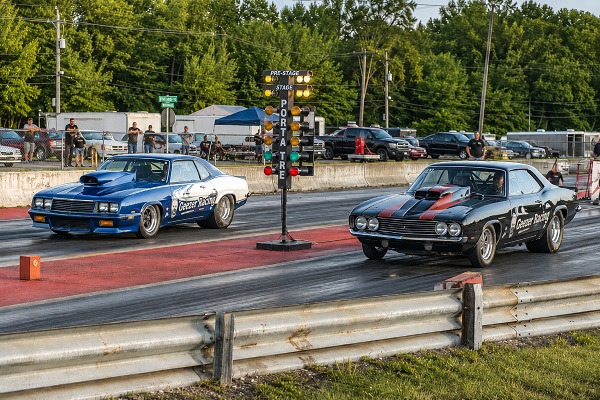
The starting line is not simply a stripe painted across the pavement. Two light beams cross each lane and tell the timing system where the front tires are.
Roll into the first beam and the pre-stage light comes on. At that point the front tire is roughly seven inches short of the stage beam. Ease forward and the stage light comes on. Now the front tire is sitting in the beam that controls the start of the elapsed-time clock.
Seven inches does not sound important until a driver is creeping through it in a loud race car loaded against a converter or clutch while the fellow in the other lane is doing exactly the same thing. Suddenly seven inches has all the breathing room of a crowded elevator.
A driver can stage shallow, just barely entering the beam, or move farther forward. Roll deep enough and the pre-stage light may go back out. Deeper staging shortens the amount of tire movement required to clear the stage beam, which can improve reaction time, but it also reduces rollout and puts the driver closer to a red light.
There are racers who will discuss those few inches longer than ordinary people discuss buying houses. Here they have a reason.
The Christmas Tree — It Is Not Waiting for You
The starting-light assembly between the lanes is the Christmas Tree. Pre-stage and stage indicators sit at the top, followed by three amber lights, green and the red light nobody wants to see on his own side.
Two common sequences are the Pro Tree and the Sportsman, or full, Tree.
On a Pro Tree, all three ambers flash together and green follows four-tenths of a second later. On a Sportsman Tree, the ambers come down one at a time, half a second apart, with green following the final amber by another half-second.
A good driver does not wait for green, see it, think about it and then decide to leave. Do that and the other fellow may already be looking for second gear.
The driver reacts to the amber sequence because the body, clutch or converter, suspension and front tires all require some time to turn a thought into movement. The trick is to begin that chain early enough that the front tire clears the stage beam just after the legal start.
Modern reaction times use .000 as perfect. A positive number means the driver left that amount late. A negative number means the tire cleared too soon and the red light has already settled the argument.
A .050 light is five hundredths of a second. That sounds tiny until the other driver cuts a .015 and owns .035 second before either car has traveled far enough to impress anybody.
Racers spend serious money trying to find .035 second in the car. A sleepy right foot can donate it for free.
Reaction Time — The Clock Before the Clock
Reaction time belongs to the start. Elapsed time belongs to the run. They are related to who wins, but they are not the same measurement.
The elapsed-time clock does not begin when the green light appears. It starts when the front tire leaves the stage beam.
That means a driver can sit at the line admiring the green light, finally leave, run the quickest elapsed time of his life and still lose badly. The car may have performed perfectly once it started moving. The timing system is under no obligation to forgive the sightseeing beforehand.
Reaction time also depends partly on rollout — how far the front tire must travel before clearing the beam. Tire diameter and staging depth therefore affect the number.
This is one of drag racing’s recurring lessons: the driver and the machine are being timed separately before they are judged together.
The Launch — Where a Good Run Usually Starts
For all the attention given to horsepower, the first sixty feet often tells you more about whether the pass is going to be good.
A car that hooks hard and accelerates cleanly builds speed early, and every foot after that benefits. A car that spins, bogs or wanders away from the starting line may recover later, but it has already spent time it cannot get back.
Suppose a car normally runs 1.50 seconds to sixty feet and suddenly turns in a 1.68. Nearly two-tenths disappeared before the car traveled the length of a modest house lot. The engine can make excellent horsepower for the remaining 1,260 feet and still spend the whole pass trying to earn back what the starting line already took.
That is why racers stare so hard at sixty-foot times. The launch does not merely begin the run; it sets the terms.
Traction — Horsepower Has to Go Somewhere
An engine can make all the power anybody is willing to pay for. The rear tires still get the final vote on how much reaches the ground.
At launch, weight transfers rearward. The rear suspension, tire construction, tire pressure, gearing, converter or clutch and track surface all decide whether that weight becomes useful traction or merely accompanies a cloud of smoke.
A soft drag slick can wrinkle its sidewall under load, allowing the tire to absorb some of the initial shock instead of instantly breaking loose. Suspension geometry can help plant the tire. The converter or clutch determines how hard power arrives. Gear ratio multiplies torque but can also make the tire’s job harder.
Everything is connected. Put more power into a car that already cannot hook and it has not necessarily become a quicker race car. It may simply have become a more expensive tire-smoking machine.
Elapsed Time — Now We Measure the Car
Elapsed time, or E.T., is how long the car takes to travel from the starting line to the finish after leaving the stage beam.
A 10.20-second pass is quicker than a 10.40. A 6.50 is quicker than a 6.60. Drag racers generally use quick when talking about elapsed time and fast when talking about speed because the two numbers tell different stories.
The interval clocks help break the pass apart. Sixty feet shows the launch. Three hundred thirty feet tells you what happened after the car settled into the run. The 660-foot number gives the eighth-mile result. Then come 1,000 feet and, where applicable, the quarter-mile finish at 1,320.
If the sixty-foot number is bad but the later intervals recover, start near the launch. If the early numbers are normal and the car falls off later, start looking farther down the run.
That little strip of paper can save a lot of people from standing around an open hood inventing theories.
Trap Speed — Your Speedometer Is Not Involved
Finish-line speed is not simply a radar gun taking a snapshot as the nose crosses the stripe. In NHRA-style quarter-mile timing, speed is calculated over the final 66 feet of the course.
So if the board says 118 mph, that number represents the car’s performance through that final speed trap. E.T. tells how long the whole trip took. Trap speed tells how hard the car was moving at the far end.
This is why a car can produce disappointing elapsed time and still show healthy speed.
Spin leaving, stumble, make a lazy shift and then pull hard on the top end. The E.T. will complain about the mistakes. The speed may tell you the engine itself is perfectly willing.
High speed with a weak E.T. often means there is more performance available. Good. Now somebody gets to find where it was left.
The Quicker Car Can Still Lose
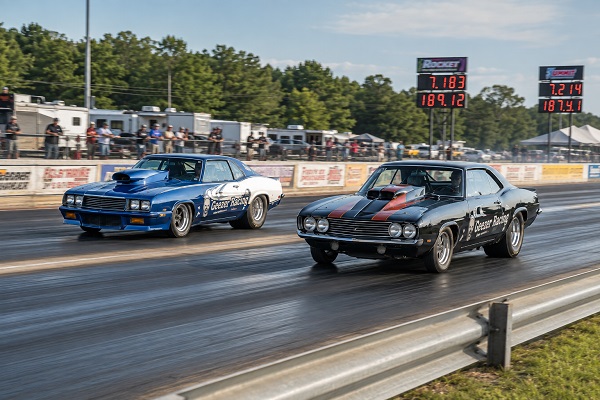
This is where somebody watching only the E.T. board occasionally decides the wrong car won.
Suppose Car A runs 7.00 seconds and Car B runs 6.95. Car B is quicker by .05 second.
Now give Car A a .020 reaction time and Car B a .080. Car A leaves .060 second sooner. It gives back .050 during the run and can still reach the finish about .010 ahead.
Car A wins with the slower elapsed time. That is a holeshot win.
The slower car did not magically become quicker. The driver simply did enough better at the starting line to overcome the other car’s advantage afterward.
Spend all winter finding another five hundredths in the engine and that is an accomplishment. Give away six hundredths on the Tree and the driver just handed it back with interest.
Heads-Up Racing — Build It, Tune It, Beat Him
Heads-up racing is the form everybody understands instinctively. Both cars receive the same starting signal and the first legal car across the finish line wins.
Top Fuel, Funny Car and Pro Stock are familiar examples. There is no dial-in giving the slower car a head start. Build the car, tune it, cut the light and get there first.
That sounds wonderfully simple. Unfortunately, “make the car quicker than everybody else’s and do not make a mistake” is one of those plans that becomes more difficult when other people adopt it too.
Heads-up racing rewards outright performance, but even here the driver remains part of the elapsed-distance problem. A poor light can throw away a quicker car. Tire spin can throw away horsepower. A missed shift can turn an excellent engine into spectator entertainment.
The fastest machine still has to complete the race properly.
Bracket Racing — Bring the Car You Actually Own
Bracket racing solves a different problem: how do you let a 10-second car race a 13-second car without simply giving the slower driver a three-second view of the other fellow’s taillights?
Each driver predicts what the car will run and places that number on the window. That is the dial-in.
Suppose one car is dialed at 12.00 and the other at 10.00. The 12-second car leaves two seconds earlier. If both drivers have equal reaction times and both cars run exactly their dial-ins, they should reach the finish together.
Now consistency becomes as important as raw horsepower.
A plain 13-second car that runs 13.02, 13.01 and 13.03 all afternoon can become miserable company for a 10-second car that runs whatever number it feels like producing next.
Bracket racing rewards knowing the machine that is actually in the lane, not the one somebody has been describing in the pits.
Breaking Out — Yes, You Can Lose for Going Too Fast
Dial 12.00 and run 12.01 and you stayed above your number. Dial 12.00 and run 11.95 and you went quicker than you said you would.
That is a breakout, and in ordinary bracket racing it can cost you the round.
This is the point where newcomers occasionally decide the rulebook has become confused. It has not. The head start was calculated from the performance numbers each driver claimed. Run quicker than your dial and you exceeded the number used to handicap the race.
That is also why bracket racers sometimes lift or even brake near the finish line. If one driver is comfortably ahead, arriving too early may be a bigger danger than arriving second.
Two drivers can therefore spend most of the pass trying to go as quickly as possible and the last few feet trying not to go too quickly.
Once the idea clicks, it makes perfect sense. Mostly.
Lane Choice and Track Conditions — Both Lanes Are Supposed to Be Equal
A drag strip has two lanes. On paper they cover the same distance. In reality, they can behave differently.
One lane may have more rubber. One may receive more sun. A small oil cleanup can change traction. Shade can cool one side while the other stays hot. Wind direction can affect one lane differently depending on surrounding walls, grandstands or terrain.
In some elimination formats, the quicker qualifier earns lane choice. That is not merely ceremonial.
A driver or crew chief may prefer the lane that has been producing better sixty-foot numbers, appears cleaner, has a better groove or simply feels more predictable.
At a good track the difference may be tiny. Racers specialize in caring about tiny differences.
Weather — The Air Is Part of the Tune-Up
Engines do not race in a laboratory. Temperature, humidity and barometric pressure change how much oxygen the air contains.
Cool, dense air generally lets an engine make more power. Hot, humid air usually gives it less to work with. That matters in nearly every form of racing, but drag racing makes the difference especially obvious because the clocks measure the entire result to thousandths.
Track temperature matters too. A cool surface may not offer the same traction as a warmer one. Get the surface too hot and it may become greasy. Add direct sun, clouds, wind and changing rubber and the crew is not merely tuning the car; it is tuning the car to the afternoon.
A combination that was perfect at 10:00 in the morning may be less impressed with itself at 3:30.
What the Driver Actually Does
A good drag-racing pass looks almost uneventful from the driver’s seat because everything happens correctly.
The driver performs the burnout, backs into the groove if required, approaches the beams, stages precisely and watches the Tree. At the start he releases the brake, clutch or transbrake according to the car, keeps the machine pointed straight and makes the required shifts.
That sounds manageable until you shorten the whole job to a few seconds.
A 10-second car gives the driver ten seconds from launch to finish. A 7-second car gives seven. A Top Fuel driver has less than four seconds of racing after the throttle opens.
If the car moves toward the wall, spins badly, shakes the tires, drops power or does something else unpleasant, the driver has to decide whether to stay in it or shut it off.
There is no prize for completing a bad run after the car has clearly withdrawn its cooperation.
How a Drag-Racing Event Actually Unfolds
A race weekend normally includes practice or qualifying runs before eliminations begin. The exact format depends on the class and sanctioning body, but qualifying establishes who gets into the field and often where they are placed on the elimination ladder.
Once eliminations start, the basic arrangement is brutally efficient: two cars race, one advances, and the other starts loading the trailer unless there is another class to run.
Win the next round and do it again. Continue until only one car has avoided red lights, mechanical failures, traction problems, breakout mistakes and somebody else simply getting there first.
That simplicity is part of drag racing’s appeal. There is not much room to hide a bad afternoon inside a season-average lap time. The other lane is right there and the result appears on the scoreboard a few seconds later.
The Timing Slip — Bring Your Excuse, We Brought Numbers

After the run comes the timing slip, and this is where many excellent stories experience mechanical failure.
A typical slip gives reaction time, sixty-foot time, additional interval times, final E.T. and finish-line speed for both lanes. Read from top to bottom, it is almost a little biography of the run.
Weak reaction time but good E.T.? The car did its part after the driver finally released it. Bad sixty-foot with strong numbers later? Start near the launch and traction. Good early numbers followed by weak top-end performance? The problem moved farther down the track.
Compare slips from several passes and patterns appear. Maybe the sixty-foot slows as the track gets hotter. Maybe the car consistently picks up speed at the far end but cannot leave cleanly. Maybe one lane repeatedly produces a better early number.
And if somebody in the pits insists the car “felt like its best pass ever,” the timing slip is under no obligation to protect the friendship.
Reading a Drag Race Instead of Just Watching the Noise
Once the basics make sense, there is considerably more to watch than two cars disappearing toward the finish line.
Start with the burnout. Did the driver put the car back into the established groove? Watch staging. Does one driver go in quickly while the other takes his time? Look at how shallow or deep the cars appear in the beams.
Then watch the Tree. If one car visibly moves first in a heads-up race, that may be reaction time rather than superior horsepower. If the other car begins closing the gap farther down the track, driver advantage and vehicle performance are fighting over the same finish line.
Watch the first sixty feet. A car that leaves cleanly and plants the rear tires is already building a good pass. A car that hazes the tires may still recover, but the timing slip is likely to remember what happened.
Listen to the shifts. Watch whether the car stays straight. Notice whether the driver lifts early or drives all the way through the stripe.
In bracket racing, pay attention near the finish. A driver with a lead may lift or brake to avoid breaking out. The car that looks as though it gave up may actually be trying to win more carefully.
Then look at both E.T. and reaction time before deciding who “should” have won. The scoreboard usually makes more sense once the only question is no longer which car was faster.
Bottom Line
Drag racing is two cars and one finish line, but the race begins long before either one reaches it.
Seven inches separate pre-stage from stage. Four-tenths or half-second amber sequences determine when the driver begins reacting. Thousandths separate a good light from a poor one. The first sixty feet tell whether the launch worked, and the interval clocks show where the car gained or lost the rest.
The burnout prepares the tire. The track crew prepares the groove. The suspension, converter or clutch and tire pressure decide whether horsepower becomes acceleration or smoke. Weather changes the air and the track. Lane conditions change what the car can tolerate.
Then the timing slip records the entire argument. Horsepower gets the crowd’s attention. The Tree catches the driver, the clocks catch the car, and the finish line does not care which one had the better excuse. That is drag racing.
↑ Back to the Top — Before Somebody Blames the Other Lane