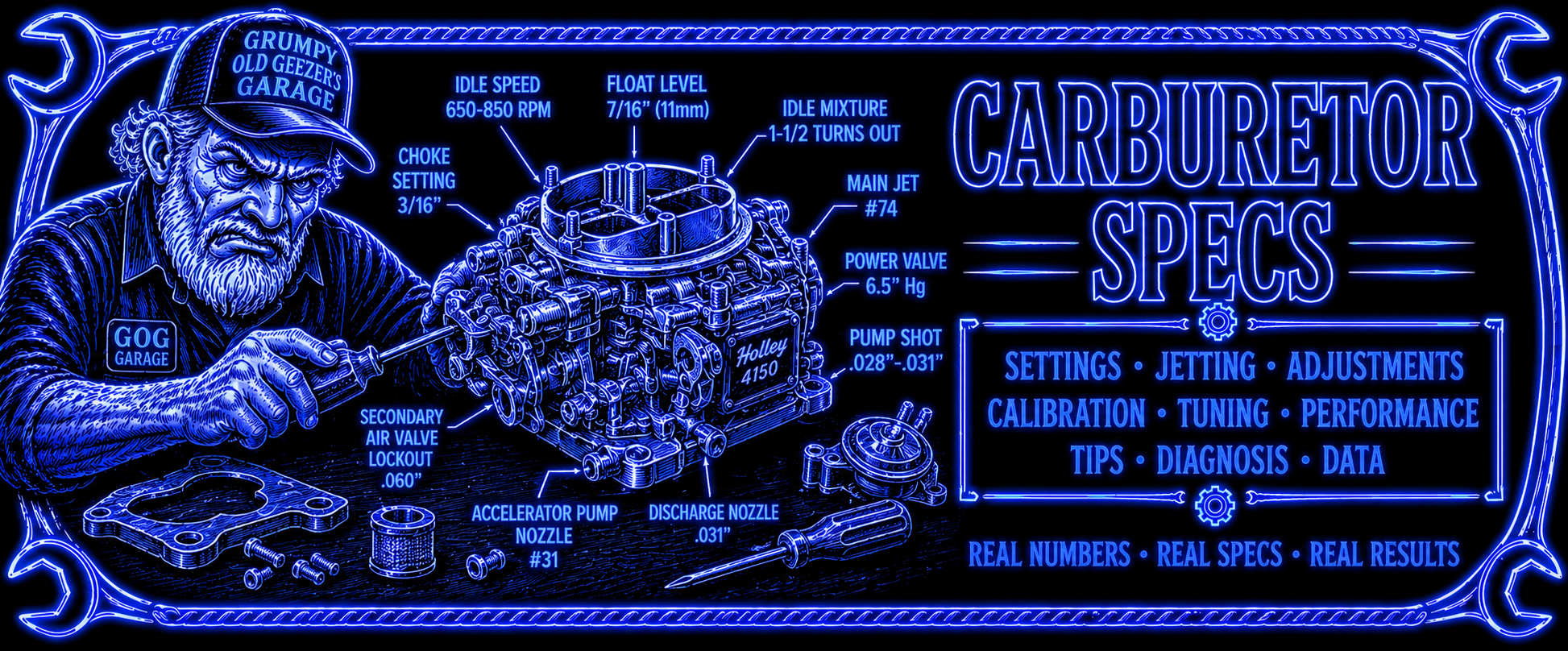
Rochester Carburetor Specs
Rochester carburetors powered millions of American vehicles for decades, especially across General Motors platforms. If Holley became the loud performance name, Rochester became the carburetor most people actually drove every day.
That does not make Rochester simple. Rochester built everything from basic one-barrel economy carburetors to two-barrel workhorses, early four-barrels, spread-bore Quadrajets, feedback carburetors, emissions-era units, and enough vacuum-controlled hardware to make a careless owner start cutting hoses like he was pruning shrubs.
Saying “it has a Rochester on it” tells you almost nothing by itself. The model family, production era, bore configuration, choke system, vacuum controls, emissions equipment, calibration, linkage, and original application all matter.
Rochester Carburetor Models

Two-barrel Rochester carburetor family widely used on GM V8 engines, trucks, and performance applications. Durable, common, and simple enough that mechanics learned on them before the internet convinced everyone tuning was a mystical ceremony.
Early Rochester four-barrel carburetor family used during the rise of American V8 performance before Quadrajets became dominant across many GM applications. Important early four-barrel hardware, not a Quadrajet with different clothes.
Two-barrel Rochester carburetor family related to Quadrajet architecture and used during the emissions era where manufacturers wanted decent drivability without a full four-barrel setup. Looks simple enough until the calibration and vacuum controls remind you otherwise.
Computer-controlled Rochester Quadrajet family used during the transition into electronic engine management systems. Loaded with sensors, solenoids, mixture-control hardware, vacuum controls, and emissions equipment that terrified people who still thought a timing light solved everything.
Single-barrel Rochester carburetor family used heavily on early Chevrolet inline engines and basic passenger-car applications where simplicity, cost, and dependable street operation mattered more than glamour. Not exciting, but plenty of engines ran because it did its job.
Single-barrel Rochester carburetor family used on smaller-displacement engines and emissions-era applications where fuel economy, drivability, and packaging mattered more than pretending every engine needed four barrels.
The best-known Rochester carburetor family, using a spread-bore layout with small primaries and very large vacuum-operated secondaries. Excellent when properly matched and tuned. Miserable when butchered by somebody with a screwdriver, side cutters, and confidence.
Progressive two-barrel Rochester carburetor family used during the fuel-economy and emissions era, often on smaller GM engines. Built for street efficiency and drivability, not for people who think every secondary opening should sound like a barn door in a tornado.
↑ Back to the Top, Before the Parts Start Arguing
Identification Notes
Rochester Products Division served as General Motors’ primary carburetor supplier for decades and became one of the most common carburetor names in American automotive history.
Early Rochester carburetors focused on drivability, simplicity, manufacturing efficiency, and broad OEM compatibility across Chevrolet, Pontiac, Oldsmobile, Buick, Cadillac, GMC, and other GM-related applications.
Two Rochester carburetors may look similar externally while behaving very differently on the engine. One may be a simple one-barrel on an inline engine. Another may be a Quadrajet calibrated for a specific engine, transmission, axle ratio, emissions package, and vehicle weight. Close enough is not close enough when the passages and calibrations are different.
Proper identification matters because calibration, linkage, emissions equipment, and internal configuration vary heavily across applications.
Unlike many aftermarket-oriented carburetors, Rochester units were often calibrated very specifically for individual engines, transmissions, vehicle weights, axle ratios, emissions systems, and drivability requirements.
That means two Rochester carburetors that appear almost identical externally may behave very differently because of calibration changes hidden inside the carburetor.
Exact identification belongs on the model-specific pages and future identification-reference pages. For this parent page, the lesson is simple: model family first, application and calibration second, surviving hardware third.
A “Quadrajet” is not a complete identification. Neither is “Rochester two-barrel.” GM built countless variations across decades of production, and those details matter.
Shared Family Notes
As performance demands increased during the 1950s, 1960s, and early 1970s, Rochester produced larger and more capable two-barrel and four-barrel carburetors designed for factory V8 applications while still keeping street manners in the picture.
The 2G family became one of Rochester’s great workhorse two-barrel lines. It was common, durable, widely used, and simple enough that generations of mechanics learned on it before everybody decided every problem needed a four-barrel and a bigger story.
The 4GC helped carry Rochester into the early four-barrel era, but the Quadrajet became the name everyone remembers. Small primaries made the Quadrajet efficient and responsive in normal driving, while the huge secondaries gave it serious airflow when the engine actually needed it.
By the emissions era, Rochester carburetors became increasingly complex as manufacturers fought tightening fuel-economy standards, emissions regulations, catalytic converter requirements, and computer-control systems. Some of those carburetors were clever. Some were miserable after the vacuum hoses were “simplified” by someone with side cutters and confidence.
Today, Rochester carburetors remain common in restorations, factory-correct builds, muscle cars, trucks, street-performance vehicles, and emissions-era vehicles that still retain original-style fuel systems.
Some Rochester families are rugged and simple. Others are heavily vacuum-controlled and extremely sensitive to wear, leaks, adjustment errors, incorrect rebuild work, missing emissions hardware, and owner creativity.
Rochester carburetors earned their reputation through drivability, factory integration, and broad OEM use. Many Rochester families were calibrated to behave well on specific street-driven vehicles under varying temperatures, altitudes, loads, and operating conditions.
Quadrajets are especially misunderstood. People stare at the huge secondary bores while ignoring the small primaries that made the design surprisingly efficient and responsive during normal driving. Big holes get attention. Small primaries do the daily work.
A properly tuned Quadrajet can deliver excellent street manners, throttle response, drivability, and respectable fuel economy while still supporting strong high-load airflow capability.
A badly rebuilt Quadrajet can make a vehicle behave like it was assembled during an electrical storm.
Many Rochester carburetors are highly sensitive to vacuum leaks, throttle shaft wear, warped castings, incorrect float adjustment, missing emissions controls, improperly routed vacuum hoses, incorrect choke setup, and mismatched calibration parts.
Common Problems
Vacuum Leaks
Worn throttle shafts, dried gaskets, cracked hoses, warped castings, leaking plugs, and poor sealing create many of the drivability problems blamed on Rochester carburetors.
Incorrect Rebuilds
Many Rochester carburetors have been rebuilt multiple times using incorrect parts, mismatched calibrations, missing components, or generic kits that ignored the original application. A kit that fits is not the same thing as a kit that restores the calibration.
Warped Castings
Overtightening screws and repeated heat cycles commonly warp air horns and main bodies, especially on older Quadrajets. Tightening it harder is not precision work. It is how the next leak gets born.
Improper Float Adjustment
Incorrect float levels create flooding, hesitation, lean conditions, hard starting, and inconsistent fuel delivery.
Vacuum Hose Chaos
Emissions-era Rochester systems often depended on vacuum hoses, switches, thermal valves, delay valves, choke pull-offs, and controls. Missing or incorrectly routed hoses can turn a good-running engine into a disaster with diagrams.
Quadrajet Well-Plug Leaks
Some Quadrajets can suffer from fuel leakage at bottom well plugs, creating hard starts, fuel smell, rich conditions, or empty-bowl complaints after sitting. Do not diagnose the whole carburetor before checking the places Rochester owners have been complaining about for decades.
Mixed Components
Air horns, throttle bodies, primary rods, secondary rods, hangers, jets, linkages, choke parts, and emissions hardware can be swapped or mismatched after decades of rebuilds. A Rochester made from three Rochesters is not automatically better because it has more donors.
Owner-Created Problems
A shocking number of “bad Rochester carburetors” are really just decades of hacks, shortcuts, deleted emissions equipment, broken vacuum systems, incorrect rebuilds, and mystery adjustments piled on top of each other.
Parting Shot
Rochester carburetors became some of the most widely used carburetors in American automotive history because they delivered strong drivability, broad OEM compatibility, and adaptable performance across an enormous range of vehicles.
When properly identified, matched, rebuilt, and adjusted, many Rochester carburetors perform far better than their reputation suggests.
When improperly rebuilt, badly modified, mismatched, or connected to a vacuum system designed by three generations of confused owners, they can become absolute nightmares.
Find the exact model, verify the application, respect the calibration, and fix the vacuum system before blaming the carburetor.