Bobby Allison
Bobby Allison Spent a Career Refusing to Let Somebody Else Decide When He Was Finished.

Bobby Allison could be difficult. Team owners knew it, NASCAR knew it, and anybody trying to convince him that a race car was fine when Bobby knew it was not usually learned something about the limits of persuasion.
He wanted to understand what the car was doing. He wanted it prepared his way. If the arrangement stopped making sense, Allison had remarkably little attachment to the arrangement.
That made his career less tidy than Richard Petty’s. It also produced 85 Cup victories, three Daytona 500 wins, four Southern 500s, three Coca-Cola 600s and the 1983 championship.
Allison won in his own equipment and somebody else’s. He won as part of the Alabama Gang, won deep into his forties and took the Daytona 500 at fifty.
Then, fifty-three years after one disputed finish, NASCAR finally admitted that Bobby had been right about that one too.
Stubbornness can make life inconvenient. Occasionally it also keeps a fellow from surrendering something that belongs to him.
The Alabama Gang Came From Florida
Robert Arthur Allison was born in Miami in 1937, which is an inconvenient starting point for one of Alabama’s most famous racers.
The explanation was money. Allison raced in South Florida but discovered that the short tracks around Birmingham offered more opportunities and better purses. In 1959, he moved to the Hueytown area.
His younger brother Donnie followed, along with their friend Red Farmer. They traveled together, worked on cars together and raced often enough that competitors eventually started calling them the Alabama Gang.
The name stuck because the winning did.
Modifieds Taught Him Not to Wait for Somebody Else
Allison came through Modified racing, and that mattered. Modified racers did not generally arrive at the track, climb into somebody else’s perfect automobile and spend the afternoon discussing steering feel.
They built things. They changed things. They repaired whatever had failed the night before and tried not to repeat the experiment.
Allison won Modified Special Division championships in 1962 and 1963, then NASCAR Modified championships in 1964 and 1965.
By the time he became a regular in NASCAR’s top division, Bobby already considered understanding the race car part of the driver’s job.
That habit never left. Neither did the arguments it occasionally produced.
Then the Cup Wins Started
Allison’s first premier-series victory came at Oxford Plains Speedway in 1966. He started from the pole, led 238 of 300 laps and won.
Two more victories followed that year, and from 1966 onward Allison won multiple Cup races for ten consecutive seasons.
He did it in Chevrolets, Dodges, Fords, Mercurys, Matadors and eventually Buicks. He changed owners, fielded his own cars and moved between manufacturers often enough that the paint department had trouble becoming sentimental.
The common component kept climbing through the window.
1971 and 1972 Were Almost Ridiculous
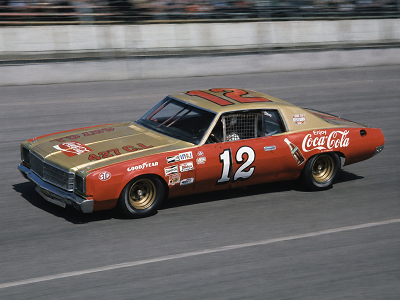
Allison won 11 Cup races in 1971 and another 10 in 1972. The second season also included 12 runner-up finishes and 11 poles.
Twenty-two races ended with Bobby Allison either first or second.
Richard Petty still won the championship.
That says something about NASCAR in the early 1970s. It also helps explain why Allison could finish an objectively excellent season and still look as though somebody had misplaced part of it.
Second was not what all that work had been for.
One of Those Wins Disappeared for 53 Years
The Myers Brothers Memorial at Bowman Gray Stadium was run as a combination event between NASCAR’s Grand National cars and smaller Grand American pony cars. Allison entered a Ford Mustang from the Grand American division.
Richard Petty led the first 112 laps in his larger Plymouth, then stopped for fuel. Allison did not. Bobby led the remaining 138 laps, crossed the finish line first and beat Petty by about three seconds.
He received the trophy. He received the winner’s money.
Then NASCAR managed to misplace the winner.
Grand National competitors argued that a Grand American car should not earn a Grand National victory. NASCAR settled the dispute by declaring that the race had no official winner.
Allison considered the arithmetic considerably simpler. He had crossed the line first.
He spent the next 53 years saying so.
On October 23, 2024, NASCAR finally restored the victory and officially gave Allison career win number 85.
Apparently the scoring department merely needed half a century to finish checking its work.
The Championship Kept Getting Away
For all the winning, the Cup championship remained missing. Allison finished second repeatedly. Petty beat him. Later Cale Yarborough and Darrell Waltrip became part of the problem.
By the early 1980s, Allison was into his forties and the obvious conclusion was that the championship window had closed.
Bobby had never shown much respect for obvious conclusions.
He won five races in 1981 and finished second to Waltrip. In 1982, he won eight races.
Waltrip won twelve.
Allison finished second again.
By then the bridesmaid jokes had become less original than Bobby’s complaints about them.
The Bumper Fell Off. The Buick Improved.
One of Allison’s 1982 victories came in the Daytona 500. Early in the race, the rear bumper came off his No. 88 Buick after contact.
The Buick promptly became very fast.
This produced the predictable theory that perhaps the bumper had not been especially committed to remaining attached in the first place.
No proof supported the accusation, NASCAR allowed the result to stand, and Allison led 147 laps before beating Cale Yarborough by nearly 23 seconds.
The bumper declined to explain its contribution.
It was Allison’s second Daytona 500 victory and another useful reminder that the supposedly aging driver was still capable of ruining everybody else’s Sunday.
At Forty-Five, He Finally Got the Championship
Allison entered 1983 driving the No. 22 Buick for DiGard Racing. He had spent years changing teams, arguing with teams and occasionally making his own life harder because compromise had never been his strongest mechanical component.
This time the pieces stayed together long enough.
Allison won six races, including his fourth and final Southern 500 at Darlington. Late in the year he won three consecutive races and took control of the championship fight.
At Riverside, the title finally became his. He beat Darrell Waltrip by 47 points.
Bobby Allison was a NASCAR Cup champion.
He was forty-five when the season began. Nobody could accuse him of getting the answer early.
Talladega Settled the 200-MPH Argument
Allison also changed NASCAR through a race he did not win. At Talladega in May 1987, Cup cars were running at extraordinary speeds. Bill Elliott had qualified at 212.809 mph.
During the race, Allison’s engine failed and debris beneath the car cut a rear tire. At more than 200 mph, the Buick turned sideways and lifted into the air.
It struck the catch fence separating the track from the grandstands, tearing down part of it before falling back onto the racing surface. The fence kept the car out of the crowd and prevented a much larger disaster.
NASCAR had seen enough. Horsepower restrictions followed for the remaining superspeedway races of 1987, and restrictor plates arrived at Daytona and Talladega in 1988.
The unrestricted 210-mph era was finished.
Bobby had not volunteered to conduct the test. The results were still difficult to argue with.
See the 1987 Talladega crash in Walked Away
The Last Win Put Davey in the Mirror
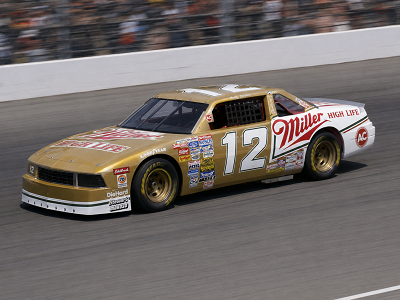
Allison returned to Daytona in February 1988 at fifty years old. His son Davey had become one of NASCAR’s brightest young drivers.
Late in the 500, the two Allisons separated themselves from the field. Bobby led. Davey followed. The son had younger reflexes and a very good race car.
The father had no intention of becoming sentimental at 190 mph.
Bobby won the Daytona 500. Davey finished second.
It remains the only father-son 1-2 finish in Daytona 500 history. For Bobby, it was Daytona victory number three and, although nobody knew it yet, the final win of his career.
After decades of racing everybody else’s sons, Bobby Allison’s last victory came with his own filling the mirror.
Pocono Ended the Driving
Four months later, Allison was racing at Pocono. On June 19, 1988, his Buick spun and was struck hard in the driver’s side by another car.
Allison suffered massive head injuries. For a while, survival mattered considerably more than racing.
He spent 108 days in the hospital and eventually recovered enough to resume public life and return to the racetrack as an owner and father. He never raced a Cup car again.
The crash also took pieces of his memory. Allison later said that among the events he could no longer remember was the 1988 Daytona 500.
The photographs remained. The trophy remained. Davey remembered.
Racing occasionally keeps a particularly strange set of souvenirs.
See the 1988 Pocono crash in Walked Away
Then Racing Took More Than a Career
Allison’s years after Pocono became intertwined with the racing careers of his sons.
In 1992, his younger son Clifford Allison was killed in a practice crash at Michigan International Speedway. He was twenty-seven.
Less than a year later, Davey crashed a helicopter while attempting to land at Talladega Superspeedway. He died the next morning at thirty-two.
There is no useful racing cliché for losing two sons in eleven months.
Bobby continued appearing at races, meeting fans and representing the Alabama Gang, but the family story had changed permanently.
That also changed what the 1988 Daytona photographs meant. For one afternoon, father and son had finished first and second and stood together in Victory Lane.
The Alabama Gang Outlasted the Racing Careers
Allison remained one of NASCAR’s most visible retired stars. The Alabama Gang grew beyond Bobby, Donnie and Red Farmer; Neil Bonnett became part of the Hueytown racing family, and Davey carried the name into another generation.
Bobby stayed near the center of it. He signed autographs, told stories and kept insisting that his career total was 85 wins while NASCAR’s official record stubbornly said 84.
Eventually even that argument ended his way.
The Record Book Finally Caught Up
Allison entered the NASCAR Hall of Fame with the Class of 2011. During his induction speech, he still insisted he had won 85 Cup races.
NASCAR still said 84.
Thirteen years later, chairman Jim France and Mike Helton visited Allison and told him the Bowman Gray victory was finally being restored.
His official record became 718 Cup starts, 85 victories and 59 poles, along with three Daytona 500 victories, four Southern 500 victories, three Coca-Cola 600 victories and one Cup championship.
The restored win moved him alone into fourth place on NASCAR’s all-time Cup victory list.
Bobby Allison died on November 9, 2024, a little more than two weeks after NASCAR finally gave him the number he had claimed for 53 years.
For once, the argument was settled before Bobby ran out of time to win it.
The Bottom Line
Bobby Allison was stubborn. There is no reason to polish that into something more polite.
The stubbornness strained relationships, produced arguments and probably made several seasons harder than necessary.
It also helped make him great.
He changed teams because he believed there was another way to win. He kept chasing a championship after younger drivers were supposed to have inherited the sport. He won Daytona at fifty with his son directly behind him.
And when NASCAR told him one of his victories did not count, Bobby spent 53 years refusing to agree.
Eventually NASCAR changed the record book.
Bobby Allison spent his career refusing to let somebody else decide when the race was over.
More often than was convenient for everybody involved, he turned out to be right.
Bobby Allison spent decades in NASCAR’s hardest racing and fiercest rivalries, which gave Racing Shenanigans more than one reason to keep his name handy.
➤ See the 1979 Daytona 500 fight in Racing Shenanigans
↑ Back to the Top, Before Bobby Finds Another Argument Worth Winning