Cale Yarborough
He Didn’t Know How to Back Off. Three Straight Championships Proved It.
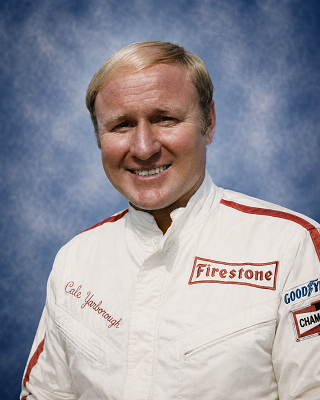
Cale Yarborough raced stock cars the way a linebacker might approach an unlocked screen door. There was probably a more graceful way through. Cale was mostly interested in whether the opening was large enough.
He won 83 NASCAR Cup races, four Daytona 500s and five Southern 500s. From 1976 through 1978, he became the first driver in NASCAR’s top division to win three championships in a row.
During those three seasons he won 28 races. The championship streak stood unmatched for thirty years.
The interesting part is that none of this required Yarborough to stop being Cale Yarborough.
He attacked races when he was young, attacked them while winning championships and was still making last-lap Daytona passes after cutting back to a part-time schedule.
Plenty of drivers can be fierce for an afternoon.
Cale figured out how to make fierce last for decades.
The Farm Needed Him Before NASCAR Did
William Caleb Yarborough was born in South Carolina in 1939 and grew up on a farm near Timmonsville. His father died in an airplane crash when Cale was eleven, leaving the oldest of three boys with responsibilities that normally arrive considerably later.
He worked the farm, drove tractors, boxed and became a hard-running high-school football player. Clemson coach Frank Howard offered him a football scholarship.
There was one complication.
Cale was already racing cars.
Howard eventually told him to choose between football and racing. Yarborough packed his clothes, and Howard reportedly warned him that he might starve trying to become a race driver.
That was a sensible warning.
It simply turned out to be aimed at the wrong fellow.
He Lied His Way Into Darlington
Yarborough had been fascinated by nearby Darlington Raceway since childhood and once sneaked under the fence just to get inside.
By 1957, sneaking into the grandstands no longer seemed ambitious enough. He wanted to race the Southern 500.
NASCAR required him to be twenty.
Cale was eighteen.
So he said he was twenty-one.
The plan worked until officials discovered who was actually driving the No. 30 Pontiac and flagged him out of the race. He finished 42nd.
Not much of a NASCAR debut, but the operating procedure was already visible.
Get onto the racetrack first.
Deal with the obstacle after it notices.
The Overnight Success Took Eight Years
NASCAR did not immediately reward Yarborough’s determination with money or good race cars. He worked in logging and raised turkeys while trying to keep the racing career alive.
Builder Banjo Matthews helped move him into better machinery during the middle 1960s. In 1965, eight years after the underage Darlington attempt, Yarborough finally won his first Cup race at Valdosta 75 Speedway in Georgia.
Cale had spent years trying to get into good race cars.
The Wood Brothers were about to give him one worth waiting for.
The Wood Brothers Gave Him Something Worth Wrestling
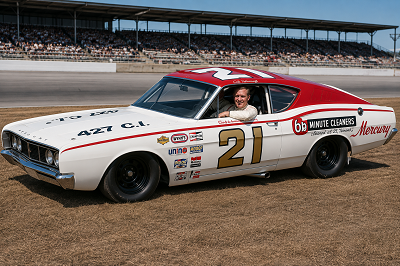
The Wood Brothers built some of NASCAR’s finest superspeedway cars. Yarborough supplied a driver willing to use all of them.
In 1968, he won the Daytona 500, then added victories at Atlanta, Martinsville and the July race at Daytona.
Then came Darlington.
The track where Cale had once lied about his age just to enter now watched him lead 169 laps and win the Southern 500.
He eventually won that race five times: 1968, 1973, 1974, 1978 and 1982.
Yarborough freely admitted he hated how difficult Darlington was while also wanting to win there more than anywhere else.
That was Cale in one sentence. If a place fought him, he became more interested.
He Even Tried Indianapolis
Yarborough’s career was not confined to stock cars. He made four Indianapolis 500 starts and competed extensively in USAC Championship cars when factory changes temporarily disrupted his NASCAR opportunities.
His best Indianapolis finish was tenth in 1972.
Open-wheel racing never became his main identity, but it established something useful about him. Cale was not merely good at wrestling one kind of heavy stock car around familiar Southern tracks.
Give him unfamiliar machinery and he still wanted to know how hard it could be driven.
Junior Johnson Found the Right Driver
The defining partnership came with Junior Johnson.
Junior liked drivers who did not require motivational speeches.
Cale qualified.
From 1974 through 1980, the partnership won 45 Cup races. The cars were fast, Junior understood how to prepare them, and Yarborough considered anything less than all-out competition a questionable use of gasoline.
In 1976, the pieces finally stayed together for an entire season.
Cale won nine races and the championship.
Then he did it again.
Three in a Row
Yarborough won another nine races in 1977, including his second Daytona 500, and took championship number two.
In 1978, he won ten races and championship number three.
Three seasons. Twenty-eight victories. Three consecutive championships.
No driver had ever done it. Not Richard Petty. Not anybody.
The streak stood unmatched until Jimmie Johnson equaled it in 2008.
The most revealing part was not that Yarborough could dominate one race. Everybody already knew he could do that.
Championships require a driver to survive bad cars, bad tracks, bad luck and his own enthusiasm long enough to keep collecting points.
Cale had taken enormous aggression and made it repeatable.
That was the dangerous part.
Then America Watched Him Get Into a Fight
The 1979 Daytona 500 arrived with CBS televising the entire race live from flag to flag while a major snowstorm kept millions of potential viewers indoors.
NASCAR suddenly had a national television audience.
Cale Yarborough and Donnie Allison gave them something to discuss.
They were fighting for the lead on the final lap when their cars made contact on the backstretch and both went into the infield. Richard Petty went on to win.
Yarborough and Allison began arguing. Bobby Allison arrived. The argument became a fight, and the television cameras remained operational.
The blame for the crash stayed disputed for decades.
The effect on NASCAR did not.
Millions of viewers had just watched a dramatic finish followed by three racers settling the disagreement before anybody could locate a public-relations representative.
Yarborough later joked that one Yarborough against two Allisons was not particularly fair. They were friends again afterward.
America remembered the fight.
He Almost Won a Fourth Championship Anyway
The championship streak ended in 1979, but Yarborough was hardly finished.
In 1980, his final full-time season with Junior Johnson, he won six races and finished second in the championship to Dale Earnhardt.
Then Cale made a strange decision for somebody still capable of winning titles.
He chose to race less.
Years of full schedules had kept him away from his family, so beginning in 1981 he concentrated on selected events instead.
The theory was simple enough: fewer races, more family, and concentrate the racing effort where it counted.
The irritating part for everybody else was that Cale kept winning anyway.
The Part-Time Driver Kept Winning
Yarborough won multiple Cup races in each of his first five seasons after abandoning the full schedule.
Without a championship calendar to chase, he could concentrate on the races he and the team wanted most.
Daytona remained near the top of the list.
In 1983, Yarborough arrived with Harry Ranier’s No. 28 Chevrolet and produced a Speedweeks that would have been excessive even by Cale’s standards.
His first qualifying lap was 200.503 mph, the first 200-mph-plus qualifying lap by a Cup car at Daytona.
Then he tried another lap.
The Chevrolet became airborne and rolled violently. The primary car was destroyed, and the qualifying speed disappeared when the team had to switch machinery.
So Cale climbed into the backup Pontiac.
And won the Daytona 500.
Apparently destroying the fastest car on the property merely complicated the schedule.
He Came Back the Next Year and Did It Again

In 1984, Yarborough returned to Daytona.
This time the qualifying car stayed on its wheels, and Cale won the Daytona 500 pole at 201.848 mph.
During the race, he worked toward the front. Darrell Waltrip led on the final lap, but Yarborough used the draft, made the slingshot pass and won.
Back-to-back Daytona 500 victories gave him four for his career.
One year he destroyed the primary car and won with the spare.
The next year he qualified above 201 mph and passed for the win on the last lap.
Reducing the schedule had apparently not reduced the driver.
Win Number 83 Required Coming Back Five Times
Yarborough’s final Cup victory came at Charlotte in October 1985.
The afternoon did not proceed neatly.
He went a lap down, recovered it, lost it again and eventually fought back from being lapped five different times.
Then he took the lead late and held off Bill Elliott.
Career victory number 83.
Twenty years had passed since number one.
For a final victory, it was unusually appropriate. The race spent most of the afternoon telling Cale Yarborough that winning was no longer a reasonable expectation.
Cale kept requesting another opinion.
Eventually He Owned the Problem
Yarborough continued making selected starts through 1988 and eventually moved into team ownership. His final Cup start came at Atlanta in November 1988, where he finished tenth.
Then he handed the steering wheel to somebody else and concentrated on running the organization.
Ownership never matched his driving success, but Cale Yarborough Motorsports did reach Victory Lane. In 1997, John Andretti won the summer Daytona race for the team.
The fellow who had won four Daytona 500s from behind the wheel now had another Daytona trophy while standing outside the car.
There are worse places for a racing career to keep circling back to.
The Numbers Stayed Large
Yarborough finished with 562 Cup starts, 83 victories and 69 poles, along with four Daytona 500 victories, five Southern 500 victories and three consecutive championships.
NASCAR named him one of its 50 Greatest Drivers in 1998, and he entered the NASCAR Hall of Fame in 2012.
Darlington eventually named its Cup garage for the teenager who once had to sneak into the place.
That is a fairly complete improvement in access privileges.
Yarborough died in 2023 at age eighty-four. By then enough stories about his toughness had accumulated that fact and folklore occasionally became difficult to separate.
The race record does not need the folklore.
The Bottom Line
Cale Yarborough was tough. Everybody says it because everybody saw it.
But toughness alone does not produce 83 Cup victories, four Daytona 500s, five Southern 500s and three consecutive championships.
The real trick was control.
Cale could attack a race without turning an entire season into a collection of damaged Sundays. He could run hard enough to intimidate people and still remain disciplined enough to win championships three years in a row.
Then, after abandoning the full schedule, he could show up at Daytona, destroy the primary car and win with the spare.
Cale Yarborough raced as though backing off meant surrender.
The remarkable part was that for decades he made that attitude look less like recklessness and more like a winning system.
Cale Yarborough raced hard enough, long enough and close enough to other determined people that Racing Shenanigans occasionally found him in the middle of an argument that did not end at the checkered flag.
➤ See the 1979 Daytona 500 fight in Racing Shenanigans
➤ See the 1969 Talladega driver boycott in Racing Shenanigans
↑ Back to the Top, Before Cale Decides Second Place Is Unacceptable