
Eddie Hill
He Came Back After Twenty Years and Drove Top Fuel Into the Fours.
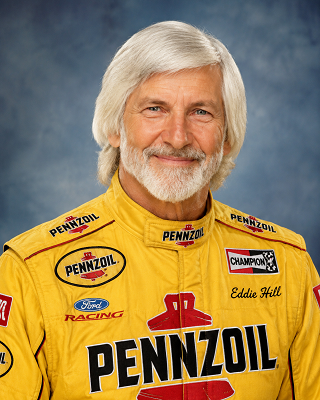
Eddie Hill was fifty-two years old when he made the quickest drag-racing pass anybody had ever made. That is not the usual age for introducing everybody else to the future.
On April 9, 1988, at Texas Motorplex, Hill covered the quarter-mile in 4.990 seconds.
Four point nine nine zero.
The first four-second Top Fuel run in drag-racing history.
Hill had already raced dragsters in the 1950s and 1960s, built bizarre machinery with multiple engines and four rear tires, quit drag racing, raced motorcycles, dominated drag boats, set a 229-mph water-speed record, survived a brutal boat crash and returned to Top Fuel after nearly twenty years away.
At first, the comeback did not go particularly well. Then Eddie Hill began figuring it out.
Three years after returning he broke the five-second barrier. Five years after that he won the 1993 NHRA Top Fuel championship at age fifty-seven.
Eddie Hill’s career was one long refusal to accept that the machinery — or the calendar — had already decided how fast he was allowed to go.
He Started Building Before He Started Buying
Eddie Hill was born in 1936 and grew up in Texas. Competition arrived early, first with motor scooters, then motorcycles and cars.
Hill studied industrial technology at Texas A&M, which suited a fellow who preferred understanding machinery to merely owning it. For his first drag-racing effort in 1955, he put an Oldsmobile V8 into a Model T-style chassis, drove the car to the track, raced it and drove it home.
Modern Top Fuel teams have made a few logistical adjustments since then.
Hill kept building. By the end of the 1950s he had become fast enough to leave his engineering job and try racing full time. That required machinery capable of earning money, and Hill’s solution was not always conventional.
The Double Dragon Had More of Everything

The best-known creation from Hill’s first drag-racing career was the Double Dragon.
One engine would have been simpler. Hill installed two. Two rear tires would have been normal. For some appearances, Hill ran four slicks across the back.
Each engine had its own driveline arrangement, and the whole contraption generated enough starting-line violence that at the 1961 NHRA Nationals it actually dug into the fresh racing surface.
Officials were not delighted. Spectators probably got their money’s worth.
The important part was not that Hill enjoyed building strange dragsters. He was already approaching racing as a mechanical problem. If more traction was required, build more traction. If more power was required, add another engine.
Elegance could be discussed after the time slip came back.
By 1966, the Money and the Fire Had Won
Hill moved into Top Fuel and experimented with increasingly serious nitro machinery. He was fast, but he was also funding much of it himself. That combination eventually became difficult.
A major engine fire at Green Valley Raceway in 1966 damaged more than the dragster. It damaged the racing budget.
Hill quit professional drag racing.
Not racing. Just that particular form of it.
He opened Eddie Hill’s Fun Cycles in Wichita Falls and returned to motorcycles, racing short track, motocross, cross-country, road racing and drag bikes. In 1972 he became a Texas motorcycle road-racing champion.
Going slowly had never made the list of alternatives.
Then He Found a Way to Drag Race on Water
In 1974, Hill attended a drag-boat race. Less than a month later, he was racing one.
This was not a gradual hobby.
Hill won his first time out in a gas hydroplane, and by his third race he had set a class speed record. Then he moved into nitro.
From 1978 through 1984, Hill’s blown-fuel hydroplanes won 55 of 103 races. He won four American Drag Boat Association world championships and became the Southern Drag Boat Association’s top points racer five consecutive years.
In 1982, Hill ran 229 mph through the quarter-mile on water. The mark stood as the world’s fastest propeller-driven quarter-mile boat record for years. His hydroplane eventually ran a 5.16-second elapsed time, quicker at the time than the Top Fuel dragster record on pavement.
Some fellows change sports to slow down. Eddie Hill changed surfaces and made the problem worse.
Water Eventually Made Its Argument
Drag boats were spectacular when everything worked. When they didn’t, pavement began looking almost friendly.
In October 1984 at Firebird Lake near Phoenix, Hill’s boat lost power at roughly 200 mph and turned sideways. The hydroplane flipped, and Hill was thrown across the water.
He suffered seven broken bones, a concussion, eye injuries and enough additional damage to require a long recovery. He had also watched too many other Top Fuel boat racers die.
That ended the drag-boat career.
The sensible response might have involved retirement.
Hill bought a Top Fuel dragster.
The Comeback Was Terrible
Hill returned to asphalt Top Fuel racing in 1985, nearly two decades after his first career ended. The cars, rear-engine layout, clutches, tires and tuning knowledge were different.
Hill was not immediately good at any of it.
He failed to qualify repeatedly. At one point the operation was so broke that after failing to qualify at Indianapolis, Hill and his wife Ercie did not have enough money to fuel the transporter for the trip home.
An unexpected $375 earned from an elapsed-time pool supplied the gasoline money.
This was not yet the Nuclear Banana. It was barely a functioning fruit stand.
Gene Snow Helped Point Him in the Right Direction
Hill knew engines. What he did not yet know was the combination required by modern Top Fuel.
Fellow Texan Gene Snow helped him with baseline tuning information. Hill absorbed it and went back to work.
In 1986, the team finally began qualifying consistently enough to race, and at Denver Hill reached his first NHRA national-event final round.
In 1987, the improvement became impossible to miss. At Texas Motorplex he ran 285.98 mph, setting the NHRA Top Fuel speed record.
For a time, Eddie Hill held the quarter-mile speed record on both land and water.
The fellow who had returned to Top Fuel looking hopelessly behind was now one of the fastest men in it.
The Yellow Car Changed Everything
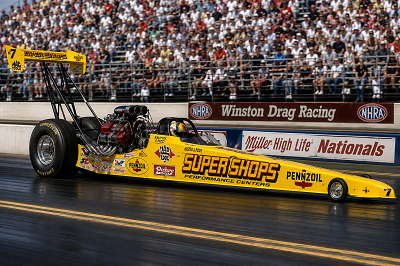
For 1988, Super Shops and Pennzoil backing transformed Hill’s operation. The bright-yellow dragster became difficult to miss, and fans eventually knew it as the Nuclear Banana.
The team was just as distinctive. Ercie Hill was not decorative pit furniture. She was co-owner, business manager, record keeper, backup person, sponsor representative and another set of hands wherever one was required.
Terry “Fuzzy” Carter handled much of the mechanical work and became another familiar face around the team. Hill remained the tuner, studying the data, selecting the components and making the calls.
In March, Hill won the 1988 Gatornationals, his first NHRA national-event victory.
Three weeks later, everybody stopped talking about whether somebody would run a four.
4.990
Texas Motorplex had changed what racers expected from a drag strip. Its all-concrete racing surface offered enormous traction, and by April 1988 Top Fuel teams knew the four-second barrier was close.
The question was who would get there first.
On April 9, Hill staged against Gene Snow during an IHRA event at the Motorplex. Hill’s dragster left hard, and near the far end he used a fuel-system lean-out arrangement intended to keep the engine from dropping cylinders.
The scoreboard came up:
4.990.
The first four-second quarter-mile pass in Top Fuel history.
It happened on 4/9 with a 4.99. Even the calendar had decided to cooperate.
Hill was fifty-two years old. The performance barrier that defined the next era of Top Fuel had fallen to a man who had first raced a homebuilt dragster thirty-three years earlier.
NHRA Got Its Four in Houston
Because Hill’s historic run occurred at an IHRA event, NHRA still had not seen an official four-second pass at one of its own national events. Gene Snow took that distinction at the 1988 SuperNationals in Houston with a 4.997 during qualifying.
Hill was not finished.
He entered eliminations after a miserable qualifying effort that included repeated supercharger failures. Another racer loaned the team a blower, and Hill reached the semifinals against Snow.
Snow ran into trouble. Hill ran 4.990, establishing an NHRA national record.
Then Hill met Joe Amato in the final. Amato smoked the tires, while Hill ran 4.936 at 283.10 mph.
Too quick to be backed up as the official record. Quick enough to make the point.
The first man into the fours had just gone considerably farther into them.
The Old Fellow Was Just Getting Started
Hill won four NHRA national events in 1988, but the championship went to Joe Amato.
The next several seasons kept Hill near the front while Top Fuel performance accelerated brutally. The field that had spent 1988 celebrating four-second runs soon regarded them as necessary equipment.
Hill kept adapting.
In 1992, at age fifty-six, he won the Gatornationals and became the oldest driver at the time to win an NHRA professional event. During eliminations he produced four consecutive runs in the 4.8-second range.
Age had become a statistic for the announcer to mention. It was not doing much to slow the race car.
At Fifty-Seven, He Finally Won the Championship
By 1993, Eddie Hill had been competing in one form of motorsport or another for most of his life. He had won championships on motorcycles and water and broken records on both water and pavement.
But he had never won the NHRA Top Fuel championship.
That changed emphatically. Hill won six of the season’s 18 national events: Phoenix, Gainesville, Atlanta, Topeka, Sonoma and Brainerd.
He clinched the championship before the final event. At 57 years and eight months, Hill became the oldest Top Fuel world champion in NHRA history.
The man who had looked hopelessly outdated during his comeback now owned the biggest trophy available.
It had taken nearly forty years from his first drag race.
That is a long apprenticeship.
Even the Rules Eventually Got His Name
Hill continued racing well into his sixties and won his final NHRA national event at Denver in 1996 at age sixty.
In 1997, severe vibration during qualifying at Sonoma tore his dragster apart near the finish line. Hill survived. The car did not.
Under NHRA rules at the time, a team could not simply substitute a backup car and continue in eliminations. The rule was later changed, and racers came to know the revision as the Eddie Hill Rule.
By then Hill had been racing long enough to break records, break race cars and occasionally help break the rulebook.
Two Explosions Were Enough
The end finally came in 1999. At Texas Motorplex, a massive engine explosion damaged Hill’s dragster and injured him. The team repaired the operation and went to Houston.
Another engine exploded during qualifying.
The force compressed Hill’s spine, and he left the drag strip in an ambulance.
Hill was sixty-three. This time he did not buy another Top Fuel car.
He retired with 13 NHRA national-event victories and the 1993 championship. NHRA later ranked him No. 14 among the greatest drivers of its first fifty years.
That would have been a respectable place to stop racing altogether.
Eddie Hill eventually went road racing instead.
Some habits are resistant to treatment.
The Bottom Line
Eddie Hill’s career does not fit neatly into one era. He raced homebuilt dragsters when sixty years of Top Fuel history had not happened yet, built the Double Dragon, quit drag racing, raced motorcycles and dominated drag boats.
He went 229 mph on water, survived a crash that should have made asphalt seem like a spectator sport, returned to Top Fuel after nearly twenty years and failed.
Then he learned. He got faster.
At age fifty-two, he became the first human being to cover a Top Fuel quarter-mile in less than five seconds. Five years later, he became world champion.
Eddie Hill spent most of his racing life discovering another place where everybody thought the limit was. His specialty was arriving there old enough to know better — and going through it anyway.
↑ Back to the Top, Before Eddie Finds Something Else That Needs to Go Faster