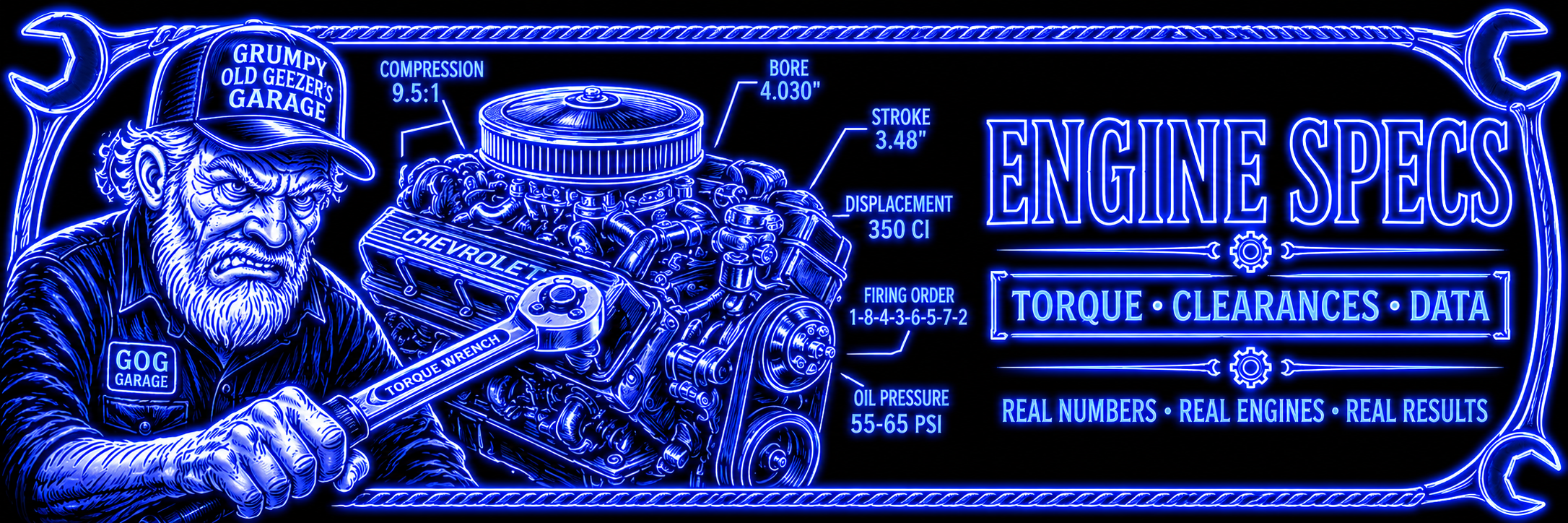
Mopar 340 Engine Specs
On This Page:
Engine Details: General Specs | Variants | Key Notes
Final Word: Bottom Line
Related: Related Links

Intro
➤ See the Family Page for specs common to all engines in this family.
The Mopar 340 is the LA small-block that showed up already tired of hearing how many cubic inches the other guy had. Introduced for 1968, it took Chrysler’s compact wedge-head architecture, kept the familiar 3.3125-inch short stroke, opened the bore all the way to 4.040 inches, and surrounded the result with the sort of performance hardware that made 340 cubic inches considerably more dangerous than the number suggested.
Chrysler needed it because the muscle-car war had moved into lighter cars. A Dart, Barracuda, Duster, Demon, or Challenger did not necessarily need a 383 or 440 hanging over the front wheels to become serious. What those cars needed was an engine that could breathe, rev, and make power without hauling big-block weight around while doing it. The 340 was Chrysler’s answer, and for once the advertising department had an engine underneath the decals that deserved the enthusiasm.
The bore is where the personality starts. At 4.040 inches, the 340 actually has the largest factory bore of the LA engines covered here. That gave Chrysler room for larger valves and better airflow while retaining the same basic short-stroke crank geometry used by the 273 and 318. Big bore, short stroke, decent compression, good heads, healthy cam timing, four-barrel induction, and dual exhaust made the early 340 an engine that liked rpm because the whole package had been invited.
That is why comparing it with a 318 by displacement alone misses the point. The 318 was built to survive normal life. The 340 was built to make normal life considerably shorter between gas stations. Same family, same general architecture, entirely different priorities. Chrysler did not discover performance by accidentally installing a larger carburetor on the workhorse.
The 1970 AAR ‘Cuda and Challenger T/A versions turned the volume up with Six Barrel and Six Pack induction and their own special factory hardware. Those engines deserve the attention they get. They also deserve proof, because three carburetors have spent fifty years migrating onto ordinary 340s while classified ads mysteriously improved the ancestry.
The later 1972–1973 engines need the opposite correction. Compression fell, emissions pressure increased, and horsepower ratings changed, but a later 340 did not stop being a real 340 because the party was winding down. The bore, architecture, and performance foundation were still there. What changed was the factory combination around them.
Even the crank and balance story changed by the end. Earlier forged-crank 340s are normally internally balanced, while 1973 cast-crank engines require their own external-balance hardware. That arrangement is not the same as the 360’s external balance, which means “weighted damper” is not a displacement identification system no matter how confidently somebody points at it.
Today, the 340 makes its strongest argument where its actual identity counts: a correct factory 340 car, a documented AAR or T/A, a period performance build, or a light Mopar that benefits from the engine’s sharp big-bore, short-stroke character. For somebody starting with an empty engine bay and shopping strictly for torque per dollar, a 360 can make the financial conversation considerably shorter.
The 340 does not need fake Six Pack ancestry, orange paint, or somebody else’s J-heads to justify itself. Chrysler built it as a real performance small-block, and the good ones earned the reputation honestly. The only thing left for the buyer to do is make sure the engine asking 340 money is actually a 340.
↑ Back to the Top, Before the Casting Numbers Start Lying

Overview
The 340 arrived for 1968 with one assignment the rest of the LA family did not have: be the serious factory performance small-block. The 273 had proved the architecture worked. The 318 had taken over the everyday chores. Chrysler could have left the small-block alone and kept selling big blocks whenever somebody wanted speed. Instead it built a 340 specifically for the buyer who wanted less weight over the nose and considerably more trouble under the throttle.
The basic dimensions explain most of the engine. Bore was 4.040 inches, stroke 3.3125 inches, bore spacing 4.460 inches, and deck height roughly 9.600 inches. The engine retained the LA family’s cast-iron block and heads, five main bearings, in-block camshaft, pushrods, wedge chambers, shaft-mounted rocker arms, and rear distributor.
The important number is that 4.040-inch bore. It is larger than the 318’s 3.910 inches and even slightly larger than the later 360’s 4.000 inches. Chrysler kept the same basic short-stroke geometry used by the smaller LA engines and created displacement mainly by opening the cylinders. That extra bore gave the valves more room and the heads more opportunity to breathe.
Chrysler then did the important part and actually used the breathing room. Early 340s received performance-oriented heads, healthy compression, four-barrel induction, aggressive cam timing, dual exhaust, and the supporting pieces needed to make the combination work. This is why the 340 became famous. The block did not contain magic. The factory simply resisted the traditional temptation to install one good part next to three cheap ones.
The short stroke helped give the engine its familiar rev-happy personality. In a relatively light A-body or E-body, the 340 could climb through the rpm range without making the car pay the weight penalty of a big block. Darts, Dusters, Demons, Barracudas, and Challengers were exactly the kind of machinery where that trade made sense.
A 340 therefore needs to be judged differently from a 318. The 318 is the general-purpose engine, normally mild because Chrysler intended it to idle quietly, last a long time, and pull normal vehicles through normal traffic. The 340 starts with more bore and arrives with far more factory performance intent. A modified 318 can run very well. It still does not retroactively receive the dimensions Chrysler gave the 340.
The same comparison with the 360 goes in another direction. The 360 uses a 4.000-inch bore and much longer 3.580-inch stroke. That longer crank throw naturally favors low- and midrange torque, especially in heavier vehicles. The 340 gives up displacement and crank leverage but retains the bigger bore, shorter stroke, and sharper high-rpm performance personality.
Neither engine makes the other obsolete. A heavy street car with ordinary gearing may prefer the 360’s extra shove. A light car built around rpm, airflow, and period performance character may make better use of the 340. Asking which is better without mentioning the car is how engine arguments remain alive long after useful information has left the room.
The 1968–1971 four-barrel engines established most of the 340’s reputation. These are the high-compression combinations people usually picture when the displacement comes up: serious induction, good heads, useful camshaft, dual exhaust, and enough compression to make the whole package respond the way Chrysler intended.
That early reputation is deserved, but it has also become contagious. A 340 block does not automatically establish which year’s compression, heads, camshaft, carburetor, crank, or exhaust happens to be attached. By now, half a century of swapping has given plenty of engines a collection of parts from several different birthdays.
Then came the 1970 AAR ‘Cuda and Challenger T/A versions. Plymouth called the induction Six Barrel. Dodge called it Six Pack. Both used three two-barrel carburetors and belonged to the Trans-Am homologation story, along with special application details that make genuine engines and cars particularly desirable today.
Those packages are exactly why authentication becomes serious. A real AAR or T/A claim needs the block, date, stampings, heads, induction, carburetors, linkage, air cleaner, exhaust, vehicle identity, drivetrain, fender tag, broadcast information, and documentation to cooperate. Anybody can buy three carburetors. Chrysler did not include retroactive factory provenance in the box.
A regular four-barrel 340 deserves no embarrassment next to the exotic version anyway. It was already one of Chrysler’s best street small-blocks. Turning every good 340 into a pretend AAR piece is like claiming every decent steak came from the winning cow at the county fair. The original product was already good enough.
For 1972 and 1973, the factory combination changed as compression dropped, emissions requirements tightened, and horsepower ratings moved into the net-rating era. These engines are still legitimate 340s, but they should be judged by their actual year rather than given the specifications of a 1968 engine through family inheritance.
A later 340 can still make an excellent street engine. The 4.040-inch bore remains, the LA architecture remains, and the engine can respond strongly when compression, heads, camshaft, induction, exhaust, ignition, and gearing are matched correctly. What it does not possess is the ability to grow its original compression ratio because somebody installed an early air cleaner.
The rotating assembly adds another year-specific wrinkle. Earlier 340s normally use forged crankshafts and internal balance. Late production moved to a cast crank and external balance, requiring the correct damper and corresponding transmission-side balance hardware.
That is especially important because the late 340 external-balance arrangement is not interchangeable with the 360’s. Both can use visible counterweighting and still require different hardware. Bolting the wrong damper or converter onto a fresh engine is an excellent way to make several thousand dollars worth of machine work shake like a washing machine full of brake drums.
The 340’s value creates another problem its less glamorous siblings do not face as often: people have financial incentive to improve the story. Orange paint, four-barrel intakes, J-heads, headers, 340 air cleaners, reproduction decals, and entire clone cars can all be assembled around another block. They may produce a perfectly enjoyable vehicle. They do not produce an original 340.
That makes block identity, stampings, dates, and vehicle context especially important when the price climbs. A correct 340 casting and proper bore establish far more than the heads bolted to it. Heads have been swapped among LA engines for decades. They identify themselves. The block still has to identify the engine.
The same goes for original-car claims. A partial VIN where applicable, engine assembly information, casting dates, vehicle VIN, fender tag, broadcast sheet, and surviving hardware can build a convincing chain. A freshly stamped pad and a seller explaining why all the dates are “close enough” can build something else.
Condition matters just as much as pedigree because performance engines tend to have experienced performance. A 340 may have spent decades being raced, over-revved, overheated, bored several times, decked, sleeved, re-headed, re-cammed, and generally treated exactly the way a desirable performance engine gets treated when nobody realizes it will someday be collectible.
Check bore size and remaining wall thickness carefully. Look for cracks, previous sleeves, deck cuts, lifter-bore wear, damaged main saddles, crankshaft condition, broken exhaust bolts, thread repairs, and evidence of previous machine work. The 4.040-inch factory bore is one of the engine’s advantages. It also means a block that has already been bored several times deserves more than a hopeful glance.
Completeness affects value as well. Correct heads, intake, carburetor, exhaust manifolds, distributor, brackets, pulleys, oil pan, air cleaner, and other original pieces can be worth keeping with a documented engine. A genuine block stripped of everything valuable may still be a real 340 while becoming a much more expensive restoration project.
For a correct factory 340 car, preservation usually makes sense. The engine is part of why the vehicle is desirable in the first place. Turning an original high-performance combination into a generic modern street engine can gain power while spending historical value to do it.
For a period-style performance build, the 340 still makes an excellent argument when its personality is what the builder wants. Compression, airflow, camshaft, carburetion, exhaust, ignition, gearing, and vehicle weight all need to agree. The engine rewards a matched combination and is perfectly capable of embarrassing a parts pile selected according to whichever catalog description used the most exclamation points.
For a clean-sheet street project with no originality requirement, the financial argument changes. A 360 generally offers more displacement and torque without the collector premium attached to a genuine 340. Paying extra for a 340 is sensible when the 340’s history, dimensions, or performance character are part of the goal. Paying extra because the number has better stories attached is simply nostalgia charging admission.
The 340 earned its place because Chrysler built the whole engine around performance rather than asking one heroic component to carry the rest of the combination. Big bore, short stroke, strong breathing, useful compression, camshaft, induction, exhaust, and light-car applications all worked together.
That is still the right way to treat one. Preserve the real special engines. Make expensive claims prove themselves. Build sound ordinary 340s around the personality Chrysler gave them. And remember that the reputation belongs to the engine because the parts earned it. Orange paint merely dries there.
↑ Back to the Top, Before the Casting Numbers Start Lying

General Specs
| Displacement | 340 cu in / 5.6L | Bore / Stroke | 4.040 in × 3.3125 in |
| Production / Use Era | 1968–1973 Mopar LA small-block performance era | Bore Spacing | 4.460 in |
| Engine Family | Chrysler / Mopar LA-series small-block wedge V8 | Deck Height | 9.600 in LA small-block baseline |
| Block Material | Cast iron | Rod Length | 6.123 in LA small-block baseline |
| Cylinder Head Material | Cast iron | Main Journal | 2.500 in |
| Factory Rating / Strength Lane | High-output small-block performance lane; early 4-barrel engines built the reputation, 1970 AAR / T/A Six Barrel and Six Pack pieces carry special proof requirements, and 1972–1973 versions need year-specific checking | Compression Ratio | Early high-compression versions, 1970 AAR / T/A packages, and later lower-compression versions need exact year, piston, head, cam, and application verification |
| Fuel / Induction | Gasoline; factory 4-barrel, plus 1970 Six Barrel / Six Pack AAR and T/A packages | Rod Journal | 2.125 in |
| Cam Location | In-block camshaft | Main Bearings | 5 |
| Valve Layout | OHV / pushrod, 2 valves per cylinder; wedge chambers | Firing Order | 1-8-4-3-6-5-7-2 |
| Common Main Caps | 2-bolt | Distributor Rotation | Clockwise |
| Rear Main Seal | 2-piece | Balance | Forged-crank engines are normally internal-balance; 1973 cast-crank engines need the correct external-balance parts |
| Weight | ~500–550 lb complete iron LA small-block with typical accessories | Dimensions | ~28H / ~26W / ~29L |
| Primary Identity Check | Verify 4.040-inch bore, block casting, pad stamping, date context, heads, crank type, intake, carburetion, and vehicle application before paying 340 money | Common Use | Performance-era A-body, E-body, and selected B-body Mopars; correct restorations, period street builds, and documented 340 cars |
Verify the block, bore, crank, heads, intake, carburetion, camshaft, compression, balance hardware, converter or flywheel fit, exhaust, stampings, dates, and vehicle application before ordering parts or believing the seller. A real 340 can justify real money. A dressed-up small-block with orange paint and a bedtime story can justify a long walk back to the truck.
↑ Back to the Top, Before the Casting Numbers Start Lying

Variants
The 340 did not become legendary because Chrysler accidentally bored a 318 and found horsepower hiding in the cylinder walls. Every 340 used the big 4.040-inch bore and short 3.3125-inch stroke, but the factory combinations changed enough to produce three useful hardware groups: the original high-compression four-barrel engines, the specialized 1970 AAR / T/A triple-carburetor package, and the later lower-compression 1972–1973 engines. By 1973 even the crankshaft and balance arrangement had changed, so the Geezer is keeping the years attached to the hardware where they belong.
1968–1971 340 — High-Compression Four-Barrel
What it was: This is the 340 that built the reputation: Chrysler’s purpose-built high-performance LA small-block before emissions rules started rearranging the party.
What changed: Chrysler combined the 4.040-inch bore with performance-oriented heads, healthy compression, aggressive cam timing, four-barrel induction, dual exhaust, and an early forged-crank, internally balanced rotating assembly.
What that did: The large bore gave the valves room to breathe while the short stroke let the engine climb through the rpm range without acting like it was dragging a plow. In a Dart, Duster, Demon, Barracuda, or Challenger, the whole package worked because Chrysler remembered the unusual trick of making the heads, cam, compression, carburetor, and exhaust agree with one another.
Where used: 1968–1971 factory 340 performance applications across Dodge and Plymouth A- and E-body cars.
Identification caution: A real early 340 claim needs the block casting, pad stamping, date codes, heads, intake, carburetor, exhaust, vehicle application, fender tag, broadcast sheet, and paperwork to cooperate. Orange paint has never successfully testified under oath.
1970 AAR ’Cuda / Challenger T/A 340 — Six Barrel / Six Pack
What it was: This was the specialized Trans-Am homologation branch of the 340 family. Plymouth called it Six Barrel. Dodge called it Six Pack. Everybody else noticed the three carburetors.
What changed: Chrysler replaced the ordinary single four-barrel setup with three two-barrel carburetors on dedicated induction hardware and matched the package with special application-specific engine and exhaust equipment.
What that did: The triple-carburetor system gave the 340 substantially more induction capacity while keeping the same big-bore, short-stroke personality underneath. It also created one of the easiest Mopar performance packages to imitate fifty years later, because carburetors continue to be held on with ordinary nuts instead of notarized documents.
Where used: 1970 Plymouth AAR ’Cuda and Dodge Challenger T/A.
Identification caution: A genuine AAR or T/A claim needs considerably more than six barrels of carburetor. Engine stamping, block date, heads, intake, carburetors, linkage, air cleaner, exhaust, transmission, rear axle, fender tag, broadcast sheet, VIN context, body details, and documentation all need to tell the same story.
1972 340 — Lower-Compression Performance Version
What it was: The 1972 engine was still a real 340, but Chrysler was now building performance machinery under lower compression, tighter emissions requirements, and net horsepower ratings.
What changed: Compression and calibration moved away from the earlier high-compression recipe while the 4.040-inch bore, short-stroke architecture, four-barrel performance identity, and basic 340 foundation remained.
What that did: Factory output softened, but the engine did not suddenly become useless because Washington had discovered tailpipes. The basic breathing room and LA performance architecture remained capable of making a strong street engine when compression, camshaft, induction, exhaust, ignition, and gearing were put back on speaking terms.
Where used: 1972 factory Dodge and Plymouth 340 applications.
1973 340 — Cast-Crank / External-Balance Version
What it was: The final-year 340 carried the late low-compression personality one step farther with a meaningful bottom-end change.
What changed: Late production moved from the earlier forged, internally balanced crankshaft arrangement to a cast crank requiring its own external-balance damper and corresponding transmission-side balance hardware.
What that did: The displacement and 4.040-inch bore did not change, but the rotating assembly now demanded the correct balance pieces. This is where somebody who thinks “all 340 parts fit all 340s” can turn a fresh rebuild into a very expensive paint shaker.
Where used: 1973 factory 340 applications.
Identification caution: Verify crank type and the matching damper, converter or flywheel, and balance hardware before mixing early and late components. The 1973 external-balance arrangement is also not the same as the 360 system just because both use visible counterweighting.
So the factory 340 ladder stays clean: 1968–1971 high-compression four-barrel, the special 1970 AAR / T/A triple-carburetor package, the lower-compression 1972 engine, and the 1973 cast-crank external-balance version. The 340 already earned enough reputation without turning every later engine into a 1969 clone or every triple-carburetor intake into an AAR birth certificate.
↑ Back to the Top, Before the Casting Numbers Start Lying

Key Notes
The LA 340 is the small-block Mopar people like to brag about, and for once the bragging has machinery behind it. This is the performance-minded LA small-block with the bore, airflow room, factory hardware, and collector baggage to make the number mean something. It deserves respect, not blind worship.
The basic fingerprint is 340 cubic inches from a 4.040-inch bore and 3.3125-inch stroke. The stroke matches the 273 and 318, but the bigger bore changes the attitude. More bore gives the heads room to breathe, gives the valves room to work, and gives the engine a higher performance ceiling than the smaller LA engines. That hot reputation wasn’t born from a decal and a loud air cleaner.
The 340’s value comes from the package. Early engines had the compression, cam, heads, induction, exhaust, and factory purpose to back up the badge. The 1970 AAR and T/A branch added its own special proof-heavy lane. Later 1972–1973 engines still count, but lower compression, emissions pressure, crank type, and balance details change the conversation. Same number, different evidence pile.
A real 340 can define the car it came in. A correct Dart, Duster, Demon, Barracuda, Challenger, or other factory 340 application may carry value because the engine, body, paperwork, and hardware all tell the same story. A loose 340 core can still be worth owning, but it shouldn’t be priced like a born-with drivetrain unless the evidence is standing there with clean hands.
The first buyer mistake is letting paint name the engine. Orange paint, a 4-barrel intake, finned valve covers, headers, a 340 air cleaner, or a seller’s favorite bedtime story can’t prove the block. Bore size, casting numbers, pad stampings, date codes, crank type, heads, intake, carburetion, exhaust, application, and documentation have to carry the claim. The air cleaner doesn’t get a vote just because it looks confident.
The second mistake is confusing the 340 with its LA relatives. A 318 can be a fine workhorse, but it doesn’t become a 340 because the top end got dressed for church. A 360 can make excellent street torque, but its longer stroke, larger main journals, and balance rules are different business. The 340 is the big-bore, short-stroke performance piece. Same family, different troublemaker.
The AAR / T/A / Six Barrel / Six Pack lane needs extra suspicion because the money jumps fast. A real claim needs the right car context, block, heads, induction, carburetors, linkage, air cleaner, exhaust, transmission pairing, dates, stampings, fender tag, broadcast sheet, and paperwork. Three carburetors can be cool. They can also be a costume with fuel lines.
As a build platform, the 340 is genuinely good. It likes compression, airflow, camshaft, ignition, exhaust, carburetion, and gearing that let it rev and pull like a performance small-block should. It doesn’t need big-block cubes to be mean, but it still needs a matched plan. Throw random “race” parts at it, and the engine will happily explain that famous numbers don’t fix bad math.
Money decides whether a 340 is the smart answer. If originality, documentation, period-correct value, or factory performance identity count, the 340 may be worth the premium. If the goal is cheap torque, a 360 can make more sense. If the goal is a mild cruiser, a 318 may do the job without dragging collector pricing into the garage. Paying 340 money is smart only when the 340 part of the answer actually matters.
Parts support is good compared with oddball early Mopars, but the details still need checking. Heads, intake, exhaust, crank, rods, pistons, balancer, flywheel or converter, oil pan, brackets, pulleys, timing cover, water pump, and year-specific pieces can affect fit and value. A pile of “340 parts” isn’t automatically a correct 340 engine. Mopar didn’t install your swap-meet assumptions at the factory.
Interchange needs discipline because LA parts tempt people into lazy combinations. Some 318 and 360 pieces can be useful when the whole build supports them, and some can hurt compression, airflow speed, balance, value, or rpm range. The 360’s external-balance parts don’t belong on a normal forged-crank 340, and 318 pieces don’t preserve 340 value just because the bolts line up.
A used 340 core needs serious inspection because optimism gets expensive fast. Check for cracks, freeze damage, thin cylinder walls from previous overbores, deck cuts, lifter-bore wear, bad main saddles, crank damage, broken exhaust bolts, missing original parts, VIN stamping issues, restamping suspicion, and machine work done by somebody who owned a grinder and too much confidence.
The 340 belongs in the performance-and-proof lane. If it’s correct, complete, documented, and tied to the right car or build, it can justify the money and attention. If it’s incomplete, overbored into danger, missing the valuable pieces, or wearing a story instead of proof, don’t let the price tag outrun the evidence. A real 340 is worth caring about. A fake or tired one is just an expensive lesson with small-block valve covers.
↑ Back to the Top, Before the Casting Numbers Start Lying

Bottom Line
The Mopar LA 340 earned its reputation the old-fashioned way: Chrysler built it as a real performance engine instead of hoping a decal would do the work. Big bore, good breathing, strong compression in the early years, serious factory induction, and the right lightweight cars gave it the sharp, high-revving personality that made small-block Mopar performance worth talking about.
That reputation also made the 340 valuable enough for stories to multiply. A genuine early high-compression engine, a later 1972–1973 version, and a real AAR or T/A Six Pack or Six Barrel package are not the same purchase. All can be legitimate 340s, but the hardware, history, and value live in different neighborhoods. Three carburetors and orange paint are parts. They are not a birth certificate.
The 340 makes its strongest argument in a car where its identity matters or in a performance build that actually benefits from its character. Correct Darts, Dusters, Demons, Barracudas, Challengers, AARs, and T/As deserve the right engine when restoration and history count. For an ordinary street project where originality does not matter, a 360 or stroker may make more torque for less money. Paying 340 prices just to avoid using more cubic inches is nostalgia doing the budgeting.
Condition matters just as much as pedigree. A complete, healthy, documented 340 can deserve serious money. A cracked, overbored, restamped, stripped, or mismatched core can become expensive before it becomes useful. The famous number does not repair cylinder walls, replace missing heads, straighten bad machine work, or make questionable paperwork suddenly become history.
So preserve the correct ones, build the sound ones, and make every valuable claim prove itself before the wallet gets excited. The 340 does not need fake AAR ancestry or borrowed Six Pack glory to be one of Mopar’s best small-blocks. A real 340 already has enough reputation. The seller still has to prove the engine sitting in front of you deserves to collect on it.
↑ Back to the Top, Before the Casting Numbers Start Lying

Related Links
Torque Specs
Common Factory Pairings
Carburetors
- Carter AFB — 4-bbl
- Carter AVS — 4-bbl
- Carter BBD — 2-bbl
- Carter Thermo-Quad — 4-bbl
- Holley 1920 — 1-bbl
- Holley 2209 / 2210 / 2245 — 2-bbl
- Holley 2280 / 6280 — 2-bbl
- Holley 2300 — 2-bbl
Transmissions
- A230 — 3-Speed
- A250 — 3-Speed
- A745 — 3-Speed
- A903 — 3-Speed
- A833 — 4-Speed
- A727 TorqueFlite — 3-Speed Automatic
- A904 TorqueFlite — 3-Speed Automatic
- A998 TorqueFlite — 3-Speed Automatic