Bob Glidden
He Made a Family Race Team Look Like a Factory Program
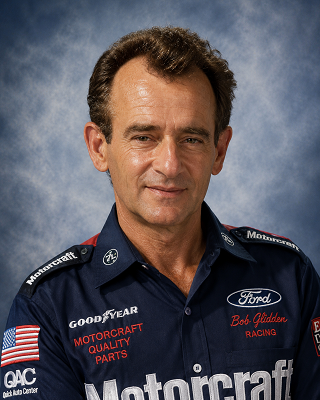
Bob Glidden spent much of his career making the rest of Pro Stock wonder whether he had more people, more money or a different rulebook.
Mostly he had Etta, the boys, a Ford and a willingness to work until the next round.
Glidden won 85 NHRA national events and 10 Pro Stock championships. He won the U.S. Nationals nine times. He became the first NHRA driver to reach 50 national-event victories and later the first to reach 75.
Those numbers belong to somebody who ought to have had an engineering department, a row of specialists and several fellows whose only job was worrying about cylinder heads.
For much of Glidden’s career, the engineering department was Bob Glidden. His great advantage was not merely that he worked hard. It was that he kept the entire race car close enough to understand every reason it was fast — and every reason it wasn’t.
He Started as the Mechanic
Bob Glidden was born in Whiteland, Indiana, in 1944. Before Pro Stock made him famous, he worked as a line mechanic at Ed Martin Ford and raced the same sort of Ford machinery ordinary customers could still recognize.
He campaigned 427 Fairlanes in Stock and Super Stock, then moved into 428 Cobra Jet Mustangs as Ford’s factory muscle hardened into serious drag-racing equipment.
That apprenticeship taught a fellow to look for horsepower in details because the rulebook deliberately limited the obvious answers. The block had a part number. The cylinder head had rules. The carburetor had rules. The car had a minimum weight.
If everybody has roughly the same pieces, the fellow who prepares them better starts becoming irritating.
Glidden became very irritating.
Then He Bought a Pro Stock Pinto
Late in 1972 Glidden sold his Super Stock Mustangs and bought a Ford Pinto Pro Stocker from Wayne Gapp and Jack Roush.
His introduction to professional racing did not take long. At the season-ending Supernationals he reached the final round in his Pro Stock debut before losing to Bill “Grumpy” Jenkins.
The following year Glidden went to Indianapolis. He qualified at the front of what was then the quickest Pro Stock field in history and defeated Wayne Gapp in the final.
The 1973 U.S. Nationals became Bob Glidden’s first NHRA national-event victory.
That location would become a habit.
Winning Was Expensive, So Losing Wasn’t in the Budget
Glidden won his first Pro Stock championship in 1974 and another in 1975. The championships established him as one of the class’s best drivers. The way he earned them established the rest of the reputation.
Glidden’s operation was intensely hands-on. He built and developed engines, worked on chassis and driveline combinations, tested, drove and came home to work on the thing again.
His wife Etta was not somebody standing behind the rope waiting for the race to end. She became a central part of the operation, organizing the team and working on the cars. Sons Billy and Rusty eventually became part of the crew as well.
It was a family race team operating in a category that was becoming increasingly professional and increasingly expensive.
Glidden’s answer was to work harder than the expense report.
There are racers who enjoy discovering a problem after dinner. Bob Glidden regarded dinner as the thing delaying the repair.
The Fairmont Became Almost Unreasonable
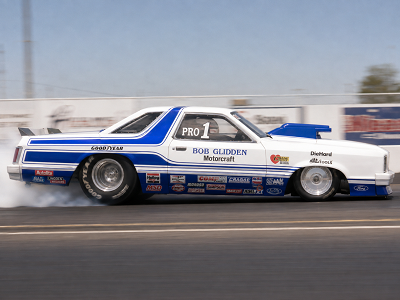
The 1978 season showed what happened when all that preparation lined up at once. Glidden began the year with his familiar Pinto, then introduced a Ford Fairmont that became one of the most dominant Pro Stock cars of the era.
He won seven NHRA national events that season and reached every final round. The Fairmont finished the year undefeated in national-event competition.
Then 1978 ended. The winning did not.
Glidden switched to a Plymouth Arrow for 1979 — the one season when the fellow most closely associated with Ford committed a temporary act of mechanical treason — and kept turning on win lights.
Across the two seasons he won nine consecutive NHRA national events, a streak stretching for a full calendar year. The Arrow won seven events in 1979 and another championship.
If anything proved Glidden was more than a Ford decal with a good reaction time, that season did it. Give him another manufacturer’s car and he still found the front of the field.
Then He Went Back Where Everybody Expected Him
The Plymouth year was an exception. Bob Glidden and Ford became nearly inseparable through the rest of his professional career.
Pintos gave way to Fairmonts. Fairmonts gave way to EXPs, Thunderbirds and eventually Probes. Body styles changed because Pro Stock kept changing underneath them.
The category became less like modified factory machinery and more like purpose-built race cars wearing recognizable sheet metal. Engine development became more specialized. Aerodynamics became more important. Chassis development became more sophisticated. The easy horsepower disappeared because everybody had already found it.
That suited Glidden. Easy horsepower was never going to keep him occupied very long anyway.
The 1980s Became His Decade
Glidden had already won five championships by the end of 1980. Then competitors such as Lee Shepherd and the Reher-Morrison operation showed that Pro Stock had no intention of remaining anybody’s private property.
Glidden went several seasons without another championship.
He did not go away.
Beginning in 1985, he won five consecutive NHRA Pro Stock championships.
Five in a row, in a class where another engine builder spends all winter trying to discover the horsepower you found last Tuesday.
During 1987 Glidden qualified No. 1 at every national event on the schedule. His qualifying streak eventually reached 23 consecutive races across 1987 and 1988.
The 1989 season may have been the most complete demonstration of all. Glidden won nine events and secured his tenth championship after leading the title fight from the beginning of the season.
He was forty-five years old. Nobody had convinced the race car that domination was supposed to get harder with mileage.
Indianapolis Knew the Glidden Family Well
If one race summarizes Bob Glidden’s career, it is the U.S. Nationals. His first NHRA national-event victory came there in 1973.
He won Indy again in 1974, 1978 and 1979, then returned to the winner’s circle in 1983. From 1985 through 1988 he won the race four consecutive times.
Nine U.S. Nationals victories altogether.
Even stranger, Glidden reached the final round at Indianapolis 13 consecutive times from 1977 through 1989.
Think about what that requires: different cars, different engines, different rules, different competitors. Thirteen years of somebody else arriving at the biggest drag race in the country hoping this would finally be the weekend Bob Glidden developed a problem before the final.
Usually he did not.
The Jacket Told You Everything
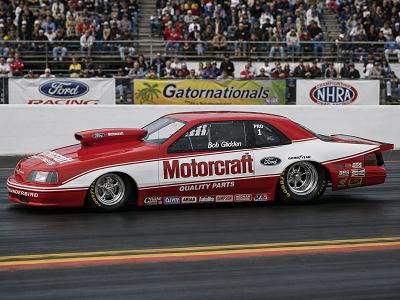
One of the most famous Bob Glidden stories does not involve a trophy.
At the 1986 Southern Nationals in Atlanta, Glidden won his semifinal round and deployed the parachutes on his Thunderbird. A gust of wind caught the car, and the Thunderbird went into a terrifying series of barrel rolls at more than 180 mph before finally stopping.
Glidden climbed out without serious injury.
Then he noticed that the wreck had exposed the intake manifold.
So he covered it with his fire jacket.
The man had just been through a multiple-roll crash and one of his first concerns was that another Pro Stock racer might see what he had been doing inside the engine.
That is ridiculous. It is also Bob Glidden in one scene.
Horsepower was expensive information. He had spent too many nights earning it to give the answer away because the car happened to be upside down.
Ford Had One Very Persistent Development Department
Glidden’s secrecy was not merely paranoia. Pro Stock lived on tiny advantages. A port shape, manifold idea, combustion-chamber change or a few horsepower nobody else had yet found could become the difference between No. 1 qualifier and first-round spectator.
That is why Glidden’s Ford loyalty became important beyond the blue oval painted on the car. For years he carried much of Ford’s competitive reputation in Pro Stock while developing the engines well beyond anything that had come out of a production automobile.
He was driver, engine developer and test department wrapped into the same operation.
By the time the Thunderbird gave way to the Ford Probe, Glidden was still finding enough to stay at the front. The Probe debuted in 1988 with a national elapsed-time record and helped secure his ninth championship.
In 1989 it carried him to championship number ten.
Eighty-Five Finally Became the Number
The championships stopped after 1989. The winning did not stop immediately.
Glidden won three times in 1990, then continued collecting national-event victories into the 1990s. At Englishtown in 1995 he defeated Jim Yates for his 85th and final NHRA national-event victory.
For fifteen years Glidden had stood as NHRA’s winningest driver. He had also become the first driver in the organization’s history to reach both 50 and 75 national-event victories.
NHRA later ranked him No. 4 among the greatest drivers of its first fifty years.
That is a driver’s honor. The pile of worn-out engine parts behind it belonged to the mechanic.
Retirement Still Involved Engines
Glidden retired from full-time Pro Stock racing early in 1997. One reason was sponsorship. Professional Pro Stock had reached the point where determination alone could no longer make the invoices disappear.
Another reason was that Ford had engine-development work waiting elsewhere. Glidden became involved with Ford’s NASCAR Winston Cup engine programs, which was about as close to retirement as anybody familiar with his work habits should have expected.
He occasionally returned to the driver’s seat in later years, but the great championship run was finished.
The workbench was harder to retire.
The Bottom Line
Bob Glidden died on December 17, 2017, at age 73.
The numbers are almost too large to be useful: 85 victories, ten championships, nine U.S. Nationals wins and five championships in a row.
But numbers alone make Glidden sound like the product of some giant racing organization. That misses the interesting part.
For much of his career the core of the operation was a family. Bob chased the horsepower. Etta kept the operation together and worked beside him. Billy and Rusty grew into the team. Everybody worked because there was another round coming and the other lane contained somebody who had worked all night too.
Pro Stock eventually became a world of large teams, specialized engine programs and enormous development budgets.
Bob Glidden did not make a family race team competitive with the factories. He made the factories figure out how to become competitive with the Gliddens.
↑ Back to the Top, Before Bob Notices Somebody Looking at the Intake