Dave Strickler
The Cars Said Old Reliable. The Fellow Driving Them Was Too.
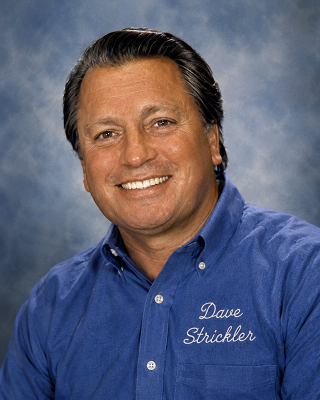
Dave Strickler had one of the better arrangements in early factory drag racing. Bill Jenkins made the car faster. Strickler made sure none of it was wasted between the starting line and the finish.
Their Old Reliable Chevrolets became some of the most famous Super Stock and Factory Experimental cars of the early 1960s. Jenkins understood engines, gearing and preparation. Strickler supplied quick reactions, clean shifts and something just as valuable to a tuner: he did the same job every time.
That made him more than the fellow holding the steering wheel. If Jenkins changed a cam, gear or chassis adjustment, Strickler could make a pass consistent enough to tell whether the car had improved.
National events were still rare, so he also became one of drag racing’s first genuine touring professionals, racing wherever promoters could put two factory hot rods beside each other and sell tickets.
Old Reliable was painted on the cars. Dave Strickler made the name believable.
The Dealership Supplied the Name
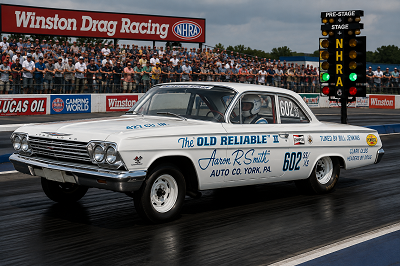
Strickler came out of York, Pennsylvania, where the Ammon R. Smith Chevrolet dealership became central to his racing career. He married Suzie Smith, Ammon R. Smith’s granddaughter, and the dealership backed his racing.
The dealership’s slogan was “The Old Reliable.” That was good advertising for a Chevrolet dealer and an even better name for a race car.
Then Bill Jenkins entered the picture.
The two discovered that their skills fit together unusually well. Jenkins could find horsepower and make the combination work. Strickler could drive it repeatably enough to prove whether Jenkins’s latest idea had helped.
A tuner cannot learn much from a driver who changes the experiment every pass.
Strickler did not.
The 409 Put Old Reliable on the Map
In 1961 Strickler drove a red Chevrolet Biscayne powered by the new 409. At York U.S. 30 Dragway, the car became the first national-record holder in NHRA’s new Optional Super Stock category, running 13.26 seconds at 107.65 mph.
The next car, Old Reliable II, was a white 1962 Chevrolet Bel Air with another 409. At the 1962 U.S. Nationals, Strickler won the Super Super Stock class championship. There was also Old Reliable III, an Impala used in Factory Experimental competition.
The pattern was established. Chevrolet supplied increasingly serious factory hardware, Jenkins kept finding ways to improve it, and Strickler kept making passes clean enough that everybody could see whether the improvements worked.
Old Reliable IV Had Very Few Excuses Left
For 1963 Chevrolet built the lightweight Z11 Impala, powered by a 427-cubic-inch development of the W-series engine. One went to the Ammon R. Smith operation and became Old Reliable IV.
The factory had already removed serious weight with aluminum body components and other special pieces. Jenkins went through the engine, transmission, gearing, cooling and chassis setup.
Then Strickler took it on the road.
He reportedly won more than 90 percent of roughly 200 match races with the car during 1963.
Two hundred match races. That was factory drag racing before carefully spaced national events made the sport resemble a normal occupation.
You raced Friday, towed somewhere else, raced Saturday, fixed whatever objected and went looking for Sunday’s purse. Reliability was not a slogan when another race was waiting tomorrow.
Indianapolis Settled the 1963 Argument
Match racing paid the bills. The U.S. Nationals were where everybody showed up at once.
At Indianapolis in 1963, Strickler won the A/Factory Experimental national championship with Old Reliable IV and then took Little Eliminator. The Z11 had already proved itself across the match-race circuit; now it had the national trophy.
It also marked the peak of the Chevrolet version of the Strickler-Jenkins partnership because General Motors had decided to withdraw official support from organized racing.
Strickler and Jenkins still intended to race.
Dodge had noticed.
The Chevy Boys Became the Dodge Boys
For 1964 Strickler and Jenkins switched manufacturers and took a factory deal with Dodge. The new operation became known as the Dodge Boys, a name that would considerably outlive the original racing partnership.
Strickler’s Dodge began with the 426 Max Wedge and soon gained Chrysler’s new Race Hemi. At the AHRA Winternationals at Bee Line Dragway, the combination won Top Stock Eliminator.
During the fall of 1964 Strickler also took the Dodge Boys car to England with the U.S. Drag Racing Team, helping introduce American-style drag racing to a new audience.
Then factory racing took another turn.
The Axles Started Moving
For 1965 Chrysler built altered-wheelbase cars with the front and rear wheels moved forward to improve weight transfer.
They looked odd. They worked.
Strickler raced one of the factory-built Dodge A/FX cars with an injected Hemi on the match-race circuit. The machines were still called factory cars because everybody was being generous. They were really another step toward Funny Car.
Strickler had gone from a full-size 409 Chevrolet to a lightweight Z11, then to a Race Hemi Dodge and finally an altered-wheelbase injected Hemi in only a few seasons.
The cars kept changing. His job did not.
Old Reliable Came Back Looking Very Strange
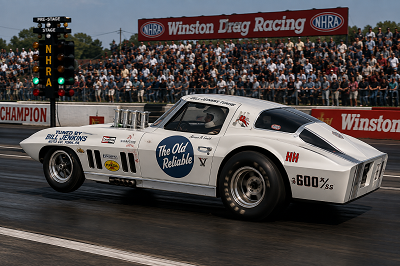
Strickler returned to Chevrolet racing in 1966. Old Reliable V was an extended-wheelbase Corvette match racer powered by a Jenkins Competition fuel-injected 427.
Calling it a Corvette required concentrating on the body shape and avoiding unnecessary questions about everything underneath.
That was how far factory drag racing had moved. Strickler had started the decade in cars recognizable as automobiles a Chevrolet dealer might sell. Five years later, little beyond the body was still pretending.
Rather than follow the movement all the way into blown nitro Funny Cars, Strickler eventually returned to cars with doors, carburetors and closer ties to production machinery.
Then He Beat Grumpy
By the late 1960s Strickler and Jenkins were working together again, although Strickler was no longer simply the driver attached to Jenkins’s tuning program.
One of Strickler’s best cars was a bronze 1968 Z/28 Camaro carrying the Old Reliable name and powered by Chevrolet’s 302-cubic-inch small-block.
At the 1968 NHRA World Finals, Strickler won the Super Stock championship.
The fellow in the other lane was Bill Jenkins, driving his Nova.
There is something pleasing about that result. Jenkins had spent years making race cars faster for Strickler. Eventually Strickler beat him for the championship.
Consistency Was Part of the Combination
Strickler was one of the excellent four-speed drivers of the factory-car era, but outright shifting speed explains only part of his value.
His greater gift was repeatability.
A slow shift cost elapsed time. A missed shift lost the round. But an inconsistent driver created another problem: he made the car difficult to understand.
Jenkins could change something and trust that Strickler would give him essentially the same driver on the next pass. That turned the stopwatch into useful information.
Strickler was not merely operating the machinery after the development work was finished.
He was part of the test equipment.
When the Racing Stopped Paying, He Stopped Racing
Strickler continued into the early Pro Stock years, driving his own Old Reliable Camaro and at times Jenkins machinery, including Grumpy’s Toy VIII. His final Old Reliable was a red, white and blue 1973 Chevrolet Vega.
By then professional drag racing was becoming a different business. Pro Stock machinery was increasingly specialized, national-event racing was becoming more important and the match-race economy that had supported touring factory stars was fading.
Strickler had always regarded racing as something that needed to support itself. When it stopped doing that, he kept his promise and quit.
He retired in 1974 after accumulating 16 national class championships in NHRA and AHRA competition and 41 national and world records.
The Bottom Line
Dave Strickler died of a heart attack on June 6, 1985, only weeks before his 45th birthday.
His racing career was concentrated into a relatively short period, but that period happened to cover the years when factory drag racing changed almost beyond recognition.
Strickler drove 409 Chevrolets, the Z11, Max Wedge and Race Hemi Dodges, an altered-wheelbase A/FX car, the strange later Old Reliables and finally the factory-bodied machinery leading into Pro Stock.
Through all of it, his real value remained remarkably consistent. Jenkins and the other tuners could change the machinery.
Strickler gave them the same driver back.
The dealership called the cars Old Reliable. Dave Strickler spent a career making sure the name was not false advertising.
Strickler spent plenty of time making Detroit’s idea of a “production car” look increasingly theoretical. Chevrolet’s aluminum-bodied Z11 Impala was one of the better examples.
➤ See the Chevrolet Z11 story in Racing Shenanigans
↑ Back to the Top, Before Strickler Makes Another Clean Pass