Warren “The Professor” Johnson
He Kept Finding Horsepower Until Pro Stock Ran Out of Speed Barriers
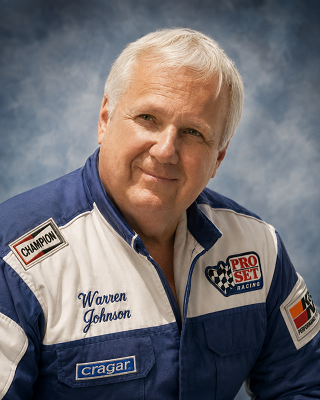
Warren Johnson earned the nickname “The Professor” because calling him “the fellow who keeps finding horsepower nobody else has yet” took too long to paint on the door.
He won six NHRA Pro Stock championships and 97 national events. He became the first Pro Stock driver through 180 mph, then 190, then 200, while accumulating 138 No. 1 qualifying positions, 140 low elapsed times and 220 event top speeds.
The driving was only part of it. Johnson designed cylinder heads, developed engines, worked on chassis combinations and lived around the dynamometer. He also helped develop Oldsmobile’s DRCE engine architecture, which became the basis for generations of Pro Stock engines.
Plenty of racers were faster than everybody else for a weekend. Warren Johnson spent decades trying to understand why.
Minnesota Was an Unlikely Place to Start
Warren Johnson was born July 7, 1943, in Virginia, Minnesota. Long before polished factory-backed Pro Stock programs arrived, he was another Midwestern racer trying to make a big-block Chevrolet run harder than the parts catalog said it should.
By the 1970s, his Chevy Vega was running the AHRA Grand American circuit against racers such as Bill “Grumpy” Jenkins, Dyno Don Nicholson and the Sox & Martin operation.
Johnson was never simply a driver who happened to know how the engine worked. He treated the whole car as a collection of problems waiting to be measured.
Pro Stock Rewarded Obsession
Pro Stock looked like showroom racing from the grandstands, but the resemblance ended quickly once the hood came off. The class rewarded cylinder-head work, intake design, combustion efficiency, gearing, clutch setup, chassis geometry and aerodynamic details worth only a few thousandths at a time.
That was Warren Johnson’s neighborhood. He became known for putting in hours other racers considered unreasonable, then looking mildly surprised when somebody suggested there should be another way.
The Professor had found his classroom.
He Left NHRA and Won Somewhere Else
Johnson did not build his early reputation entirely around NHRA trophies. During a break from regular NHRA competition from 1979 through 1981, he took his big-block Camaro into IHRA’s Mountain Motor Pro Stock wars.
Johnson won the IHRA Pro Stock championship in 1979 and then won it again in 1980.
The engines were enormous, the cars were violent and the racing suited him. By the time Johnson returned to regular NHRA competition, the Professor had acquired a considerably larger notebook.
Oldsmobile Found the Right Difficult Man
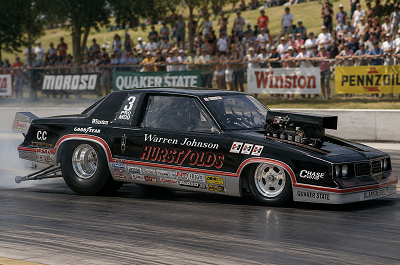
In 1979, Oldsmobile motorsports representative Dale Smith approached Johnson about becoming involved with the division’s racing program. The relationship became one of the defining manufacturer partnerships of the Pro Stock era.
Johnson initially raced an Oldsmobile Starfire with small-block power before moving toward the big-block combinations needed for NHRA competition.
Oldsmobile had found a development racer. Johnson had found a manufacturer willing to let him develop things.
That arrangement was dangerous for everybody in the other lane.
1982 Finally Put a Wally on the Shelf
Johnson had been racing Pro Stock for years before winning his first NHRA national event. At the 1982 Summernationals in Englishtown, New Jersey, he defeated Lee Shepherd in the final and collected victory number one.
Later that season, Johnson won at Fremont, where his Oldsmobile Starfire recorded Pro Stock’s first 180-mph pass. He finished the season by defeating Shepherd again at the World Finals.
Johnson entered 1982 without an NHRA national-event victory and left it with three wins and the first 180-mph ticket in the class.
The DRCE Wasn’t Supposed to Become a Dynasty
Oldsmobile’s involvement became much deeper in 1983 and 1984 as Johnson helped develop what became the Drag Race Competition Engine, or DRCE.
The architecture grew from big-block Chevrolet practice, but the block and cylinder-head castings were designed specifically for serious drag-racing development under the Oldsmobile banner. Johnson later described starting with the core-box design for a big-block Chevrolet head and correcting what he could in less than a week.
The first version was crude by later standards. It also worked.
The first DRCE combination went to Atlanta without even having been run on Johnson’s dyno and qualified No. 1. The design kept evolving through multiple generations and long outlived Oldsmobile itself.
There are worse engineering reports than “still racing decades later.”
Then Came 190
At the 1986 U.S. Nationals, Johnson’s Oldsmobile Firenza became the first Pro Stock car through 190 mph, running 190.07.
Four years earlier, he had broken 180. Now the next obvious target was 200.
That took another decade because Pro Stock was reaching the point where horsepower alone could not solve everything. Aerodynamics, chassis efficiency and extracting power from the 500-cubic-inch limit became increasingly important.
Johnson seemed reasonably comfortable with a problem that required more work.
Winning Indy Became a Habit
The U.S. Nationals is the race Pro Stock drivers want even when the rest of the résumé is already crowded.
Johnson first won Indianapolis in 1984. From 1992 through 1995, he won it four consecutive times, then returned in 1999 and won again by defeating former crew chief Greg Anderson in the final.
Six Indy victories. For a fellow whose reputation centered on engineering, Warren Johnson was remarkably good at collecting the trophy everybody wanted most.
The Championships Finally Arrived
Johnson had already accumulated years of wins and performance records before taking his first NHRA season championship in 1992.
Then he collected another immediately. Johnson won consecutive Pro Stock championships in 1992 and 1993, then added titles in 1995, 1998 and 1999. In 2001, he won championship number six at age 58.
The dyno had not told him he was old yet.
Kurt Broke Six Before Warren Broke 200
The Johnson operation eventually became a family rivalry. Warren’s son Kurt developed into one of NHRA’s strongest Pro Stock drivers and won 40 national events during his career.
At Englishtown in 1994, Kurt drove a Johnson-powered Oldsmobile Cutlass to a 6.988-second pass, the first official six-second run in NHRA Pro Stock history.
Warren considered that one of his favorite accomplishments. He was not driving the car that made the run; he had helped create the horsepower that did.
200.13
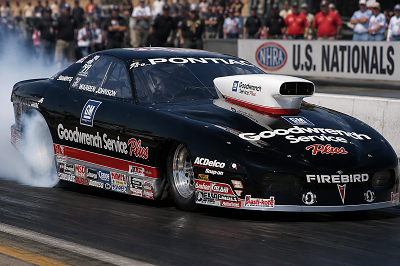
By 1997, Pro Stock was hovering near 200 mph, and everybody knew somebody was going to get there.
On April 25 at Richmond, Virginia, Warren Johnson’s GM Performance Parts Pontiac Firebird ran 200.13 mph. Johnson became the first NHRA Pro Stock driver beyond 200 and the inaugural member of the Speed-Pro 200-MPH Club.
Fifteen years earlier he had been first through 180. At Indy in 1986 he had been first through 190.
Now he had all three.
Fast Once Is Nice. Fast Everywhere Is Better.
Johnson’s performance numbers show why the nickname lasted. During 1999, he recorded the top Pro Stock speed at every event on the NHRA schedule.
Not most of them. All of them.
Over his career, Johnson recorded 220 event top speeds and 140 low elapsed times. Those totals say more about the engine builder than one spectacular pass ever could.
The Professor kept bringing the homework back correctly.
Ninety-Seven Took Almost Three Decades
Johnson’s first NHRA national-event victory came at Englishtown in 1982. His 97th came at St. Louis in 2010, when he defeated Jeg Coughlin Jr. in the final at age 67.
Twenty-eight years separated those victories. Johnson also accumulated 151 final-round appearances, 138 No. 1 qualifying positions and a streak of 303 consecutive event starts before that run ended in 2002.
The totals covered generations of engines, bodies, tires, competitors and rule changes.
The Professor Could Be Difficult
Warren Johnson did not build his reputation by trying to become everybody’s favorite person in the pits. He was blunt, impatient with questions he thought somebody should already know how to answer and willing to criticize rules, purse structures or officials when he thought something was wrong.
Younger racers could ask him technical questions. They were advised to make them good ones.
Over time, competitors understood that much of Johnson’s complaining had a purpose. He pushed for better racing conditions and better treatment of professional racers even when his delivery occasionally removed the decorative wrapping.
The Professor was there to solve problems. Being charming was somebody else’s department.
The Numbers Became the Lecture Notes
Johnson’s six NHRA championships came in 1992, 1993, 1995, 1998, 1999 and 2001. Add two IHRA championships, 97 NHRA national-event victories, six U.S. Nationals wins and the first Pro Stock passes beyond 180, 190 and 200 mph.
NHRA ranked him seventh among the greatest drivers of its first 50 years. Johnson entered the International Motorsports Hall of Fame in 2007 and the Motorsports Hall of Fame of America in 2015.
The honors recognized more than a driver with a large pile of trophies. Johnson had helped shape the machinery underneath an entire category.
The Bottom Line
Warren Johnson won six NHRA Pro Stock championships and 97 national events, including six U.S. Nationals. He became the first Pro Stock driver through 180 mph, the first through 190 and the first through 200.
But the Professor’s larger contribution happened between the runs. He developed engines, cylinder heads and combinations that pushed Pro Stock forward, then helped create the DRCE architecture that survived through generations of professional racing.
Other drivers could study Warren Johnson’s elapsed times. The difficult part was figuring out how he got them.
That was the Professor’s department.
↑ Back to the Top, Before the Professor Finds Another Horsepower Problem