Smokey Yunick
NASCAR Wrote the Rulebook. Smokey Kept Finding the Parts They Forgot.
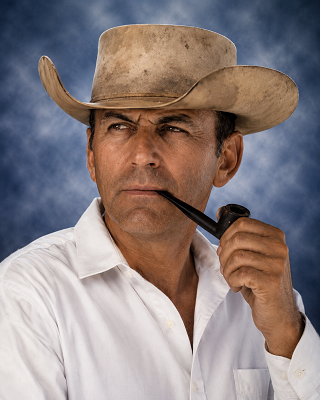
Smokey Yunick did not need to break every rule.
That would have lacked imagination.
The better approach was to read the rulebook closely enough to find what NASCAR had forgotten to regulate. Move something. Reshape something. Route something through a place nobody had considered. Find two horsepower in a piece everybody else regarded as plumbing.
Then make the inspector locate the sentence saying it could not be done.
That reputation became so large that Smokey stories eventually developed horsepower of their own. Cars shrank in the retelling. Fuel lines grew. Arguments acquired dialogue nobody had written down.
Some stories were true. Some were exaggerated. Some became considerably better stories after enough trips through the garage.
The mythology can hide the important part.
Smokey Yunick was an extraordinarily good mechanic and engineer before anybody needed a rulebook story to make him interesting.
The Daytona Garage Was a Working Shop
Henry Yunick was born in Pennsylvania in 1923. The nickname came early, and eventually almost nobody bothered with Henry.
During World War II, he served as a bomber pilot. He returned with a mechanical education acquired less from classrooms than from machinery that had to work when failure was a poor option.
Yunick eventually settled in Daytona Beach and opened the garage that became almost as famous as its owner.
It was not a polished display room built to sell nostalgia.
It was a place where parts were expected to justify their existence.
If something was not working well enough, Smokey wanted to know why. If everybody had built it the same way for twenty years, that merely meant the same question had gone unanswered for twenty years.
Accepted practice was evidence.
It was not proof.
Herb Thomas Supplied the First Big Answer
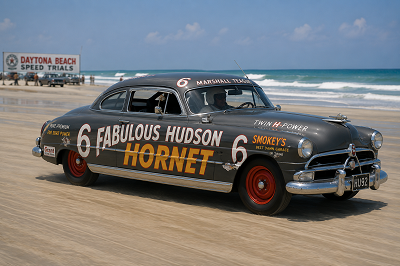
Yunick became one of the important mechanical minds of NASCAR’s first decade, and one of his strongest partnerships was with Herb Thomas.
Thomas was already an exceptional driver. Smokey gave him machinery worthy of the talent.
The combination became closely associated with the Fabulous Hudson Hornet. Its low center of gravity and strong straight-six already made the Hudson unusually effective on the rough tracks of early NASCAR.
Smokey’s assignment was the same one he applied to almost everything afterward.
Take a useful piece and discover what useful work it was still leaving on the table.
Thomas won NASCAR championships in 1951 and 1953 with Yunick serving as crew chief.
That is worth remembering whenever the conversation drifts toward oversized fuel lines. Before Smokey became famous for finding holes in NASCAR’s rules, he was building championship race cars.
Then Chevrolet Became Somebody Else’s Problem
Yunick never developed much loyalty to a badge when another manufacturer offered an interesting engineering problem.
In 1955, Herb Thomas arrived at the Southern 500 in a Chevrolet prepared by Smokey’s operation.
Chevrolet was still a newcomer to NASCAR Victory Lane. Thomas won at Darlington, giving Chevrolet its first major NASCAR speedway victory and demonstrating that the new small-block Chevrolet could do considerably more than haul groceries.
Manufacturers began learning something about Yunick.
If they wanted to know what their machinery could really do, his shop was a useful place to ask.
Whether they enjoyed the answer afterward was a separate matter.
Daytona Gave Him Two in a Row
By the beginning of the 1960s, Yunick was heavily involved with Pontiac. His primary driver was Fireball Roberts, one of NASCAR’s fastest and most mechanically aware stars.
The 1961 Daytona 500 did not follow the obvious plan.
Roberts had the stronger factory-backed Pontiac. Marvin Panch was a late addition to Yunick’s team and wound up in a year-old 1960 Pontiac.
Roberts dominated much of the race before his engine failed.
Panch won.
The following year Smokey returned with Roberts. This time the favorite stayed together. Fireball started from the pole and won the 1962 Daytona 500.
Two years. Two Daytona 500 victories. Two different drivers.
The common fellow in the garage was wearing the battered hat.
Smokey Read the Blank Spaces
NASCAR in the 1950s and 1960s had no shortage of inventive mechanics. Junior Johnson understood an unfinished rule as well as anybody, and he had plenty of company.
Smokey became the fellow most closely associated with the practice because he approached it like engineering.
The rulebook described what NASCAR had already considered.
Yunick was interested in what it had not considered yet.
If wheel width was controlled, what about tire height? If fuel-tank capacity was specified, what about the plumbing attached to it? If production-body dimensions had to remain within limits, how much could be repositioned, lowered or cleaned up before somebody built a new template?
The objective was not mischief for its own sake.
Every worthwhile change needed to buy something: less drag, better weight distribution, more fuel range, better cooling, more horsepower or more speed.
Smokey did not search the blank spaces because the argument was entertaining.
He searched them because the stopwatch did not care whether NASCAR had remembered to write another paragraph.
The Chevelle Became Bigger Than the Truth
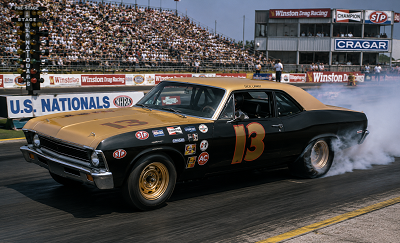
No Smokey Yunick car produced more mythology than his black-and-gold Chevrolet Chevelles of the late 1960s.
The famous version says Smokey built a seven-eighths-scale Chevelle.
He did not.
The real car was clever enough without requiring him to shrink Detroit.
The body and chassis were heavily manipulated for racing. The body position helped weight distribution. Aerodynamic details were cleaned up. The floor and bodywork were altered. The bumper, roof and rear body received attention.
In 1967, Curtis Turner put one of Yunick’s Chevelles on the Daytona 500 pole before engine trouble ended the race.
Then Smokey built another one.
The 1968 version arrived at Daytona with enough creative engineering underneath it that NASCAR refused to approve the car without major changes.
The important point was not that Smokey had built a miniature Chevrolet.
He had built a much more sophisticated race chassis and body combination than NASCAR wanted hiding underneath something still called a production stock car.
The car never competed in a NASCAR Grand National race.
It became one of NASCAR’s most famous race cars anyway.
That is an impressive return from failing inspection.
And Then There Was the Fuel Line
The same Chevelle supplied the most repeated Smokey story of all.
NASCAR limited fuel-tank capacity. Yunick found another place gasoline could live.
The story says he installed an unusually long, oversized fuel line capable of holding additional fuel. During inspection, officials removed the fuel tank while compiling a list of changes they wanted made.
Smokey then supposedly started the car and drove away without the tank installed.
It is an excellent story.
It is also one of those Yunick stories whose dimensions and details improve according to how many garages they have passed through.
The useful conclusion is simpler. Smokey had noticed that the rulebook was very specific about the fuel container and less specific about the plumbing connected to it.
NASCAR noticed afterward.
The rulebook became more complete.
This happened around Smokey rather often.
Clever Did Not Mean Invincible
The mythology can make Yunick sound as though every idea worked and every inspector lost.
Neither was true.
Cars broke. Experiments failed. Officials caught things. NASCAR rejected cars. Smokey argued with Bill France Sr. and other officials often enough that the arguments became part of his reputation.
That friction eventually helped push Yunick away from NASCAR, and his final Cup entries as an owner came in 1969.
But reducing the entire relationship to clever Smokey repeatedly defeating foolish inspectors does a disservice to both sides.
NASCAR was trying to define what a stock car was.
Builders such as Yunick kept demonstrating all the definitions it had forgotten.
It was an engineering contest conducted with rulers, templates, welding torches and increasingly detailed paperwork.
Everybody learned.
He Was an Engineer Without Waiting for the Diploma
Yunick’s mechanical interests extended far beyond NASCAR. He worked in Indianapolis racing and experimented with turbocharging, combustion, cooling, aerodynamics, lubrication and engine efficiency.
He accumulated patents and built equipment when the tool he wanted did not exist.
Long after his regular racing career ended, engineers and hot rodders kept paying attention because Smokey never stopped asking whether accepted practice was actually correct.
That habit explains him better than the word cheater ever could.
Anybody can hide something illegal and hope inspection misses it.
Smokey’s interesting work began when he understood the system well enough to see an advantage nobody had yet decided was illegal.
The Hat Became a Warning Label
Eventually Yunick required very little introduction.
The battered cowboy hat, work clothes and cigar or pipe became part of the package, along with the expression suggesting that whatever question somebody had just asked probably was not the useful one.
The character became famous enough to overshadow the résumé.
So count the hardware again.
Two NASCAR championships with Herb Thomas. Consecutive Daytona 500 victories from Yunick’s shop. Two Southern 500 victories while working with Thomas.
Championship Hudsons. Winning Chevrolets. Winning Pontiacs. Technical ideas that NASCAR sometimes prohibited only after Smokey demonstrated why another rule was necessary.
The fellow could build race cars.
The Hall of Fame Argument Is Still Going
Yunick died in 2001, but his place in NASCAR history did not become easier to categorize.
As of 2026, he still had not been inducted into the NASCAR Hall of Fame.
The debate itself fits the man. Some argue that the mythology surrounding Yunick has grown larger than his NASCAR record. Others point to the championships, Daytona victories, mechanical influence and the difficulty of telling NASCAR’s early technical history without eventually arriving at his garage.
Both sides accidentally demonstrate the same thing.
Twenty-five years after his death, Smokey Yunick can still start an argument in a NASCAR garage without being there.
The Bottom Line
Smokey Yunick did not invent racers looking for advantages in a rulebook.
That probably began shortly after somebody wrote the first rule.
What separated Smokey was the quality of the thinking behind it. He understood engines, chassis, airflow and combustion, and he understood that a regulation can control only what it actually regulates.
Sometimes NASCAR accepted the idea.
Sometimes NASCAR banned it.
Sometimes NASCAR went back to the office and wrote another paragraph.
Smokey went back to the garage and looked for the next question nobody had answered yet.
The rulebook showed him where NASCAR had built the fence.
Smokey Yunick’s first instinct was to find out whether there was any fast ground left on the other side.
Smokey’s relationship with NASCAR inspection produced enough arguments, inventions and carefully interpreted rules to supply Racing Shenanigans for years.
➤ See Smokey’s Chevelle and the troublesome NASCAR template in Racing Shenanigans
➤ See Smokey’s eleven-foot fuel line in Racing Shenanigans
↑ Back to the Top, Before Smokey Finds Another Blank Spot in the Rulebook