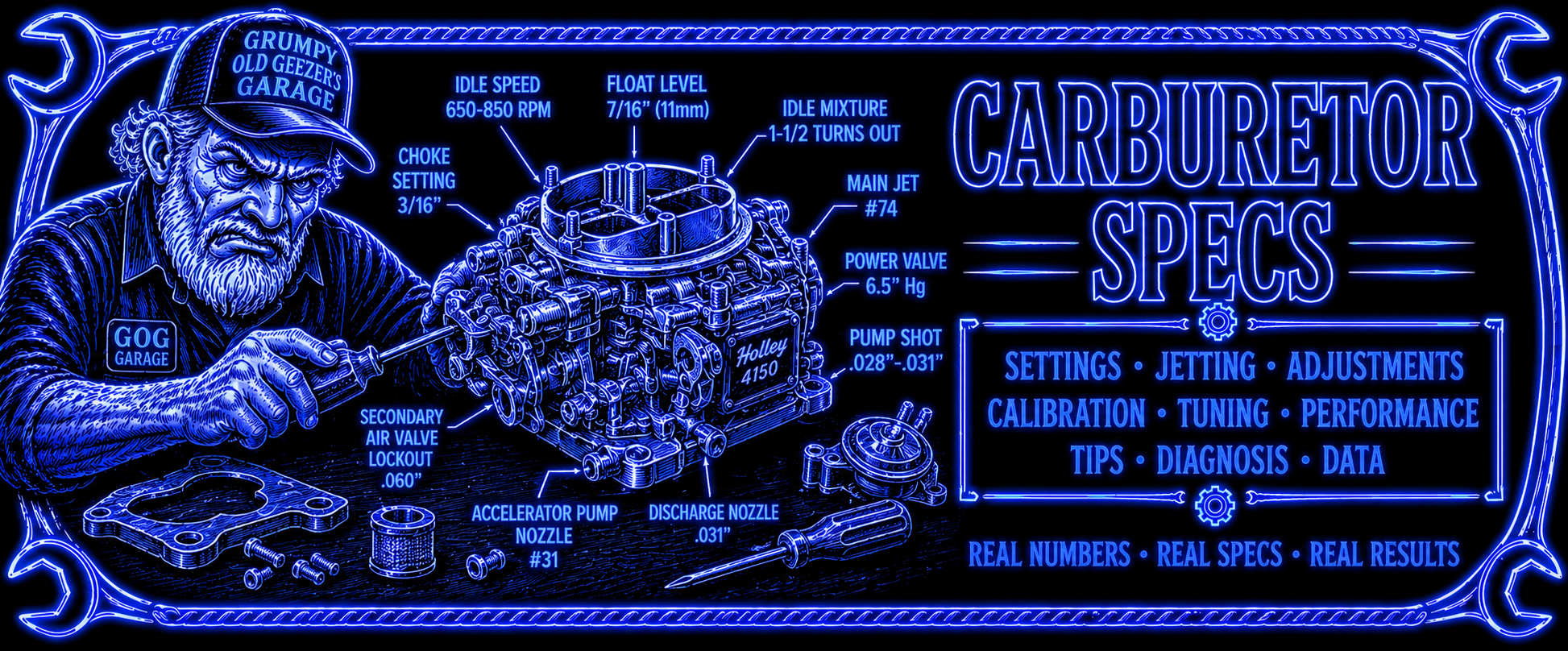
Carter YF-YFA Carburetor Specs
On This Page:
Basics: Intro | Overview | What Makes This Carb Different? | General Specs
Details: Variants | Key Points
Warnings: Common Problems | Common Misconceptions | Compatibility Notes | Bottom Line
Related: Related Links

Intro
The Carter YF and later YFA are single-barrel downdraft carburetor families used heavily on Jeep, AMC, Ford, Chevrolet, GMC, International Harvester, Kaiser, Nash, industrial, utility, and light-duty truck applications.
These carburetors were not built for performance theater. They were built for engines expected to start, idle, pull, crawl, commute, work in bad weather, tolerate questionable maintenance, and keep running after the owner decided a tune-up meant “it still starts, doesn’t it?”
The YF became one of Carter’s respected one-barrel utility carburetors because it delivered stable low-speed operation, simple serviceability, decent fuel economy, and reliable throttle response on inline engines and workhorse vehicles.
The later YFA continued that basic idea with design revisions, shorter packaging in many applications, emissions-era hardware, and feedback-controlled versions on some Ford and AMC applications. Same basic job, more years of federal paperwork hanging off the side.
Covers: Carter YF and YFA single-barrel downdraft carburetors, including early YF utility versions, Jeep / AMC inline-six versions, Ford inline-six versions, YFA emissions-era versions, YFA feedback-controlled versions, industrial / truck versions, and service-replacement versions.

Overview
The Carter YF / YFA uses a one-barrel downdraft layout with a single throttle bore, single booster / venturi arrangement, integral fuel bowl, idle circuit, main metering circuit, accelerator pump, choke hardware, and application-specific linkage.
The YF family became common because it hit the practical target. It was simple enough to service, durable enough for utility work, and responsive enough for inline engines that needed clean low-speed behavior more than airflow bragging rights.
Jeep and AMC inline-six applications made the YF familiar to generations of owners who expected their engines to crawl, idle, pull, and keep working instead of acting like fragile performance equipment. Ford also used YF and YFA carburetors heavily on inline engines, including later 200, 240, and 300 six-cylinder applications.
The YFA was the later development of the family. It used updated packaging and application-specific revisions, and some late versions became feedback-controlled carburetors with electronic mixture control. Those versions are still one-barrel carburetors, but they live inside a bigger emissions-control system. Ignore that system and the carburetor gets blamed for every missing hose and bad wire under the hood.
Most surviving YF and YFA carburetors today are found on Jeep inline-sixes, AMC applications, Ford inline-sixes, older utility engines, industrial equipment, Chevrolet / GMC trucks, and light-duty work vehicles where reliability and easy serviceability still matter more than horsepower advertising.
Identification depends heavily on Carter number, base pattern, linkage arrangement, choke system, throttle-bore size, fuel inlet, emissions configuration, feedback hardware, and original application.
↑ Back to the Top, Before the Kickdown Rod Gets Bent

What makes it different
Compared with Carter BBS and RBS one-barrels, the YF / YFA became especially known for broad utility use, Jeep / AMC inline-six service, Ford six-cylinder use, and long-running service replacement support. It is the practical one-barrel that kept showing up where engines had to work for a living.
Compared with Carter BBD two-barrels, the YF / YFA is simpler and lower-flowing. The BBD gives more airflow and two-barrel distribution. The YF gives fewer parts to fight, strong low-speed signal, and less temptation for someone to pretend a work engine needs race-carb behavior.
Compared with Carter four-barrels such as the AFB, AVS, WCFB, and ThermoQuad, the YF / YFA lives in a completely different world. It is not about secondaries, high airflow, dual-quad history, or top-end performance. It is about start, idle, crawl, cruise, and get the job done.
Compared with later electronic fuel injection, the feedback YFA shows the carburetor world trying to survive emissions rules with electronics attached. Some of those systems worked when complete. Hacked up, they become exactly the kind of under-hood spaghetti that makes people blame the carburetor after they already cut the wires.
The YF / YFA’s strength is dependable low-speed drivability and practical service. Its weakness is that so many of them have been swapped, converted, hacked, remanufactured, cloned, or rebuilt badly that the carburetor on the engine may not be the carburetor the engine was supposed to have.
↑ Back to the Top, Before the Kickdown Rod Gets Bent
General Specs
| Type | 1-barrel downdraft carburetor | Bore Layout | Single throttle bore |
| Venturi / CFM | Commonly estimated at 180-300 CFM | Mounting Pattern | Carter single-barrel flange; base pattern varies by application |
| Primary Metering | Single-barrel main metering system with idle and accelerator-pump circuits | Secondary Metering | None |
| Secondary Types | None | Fuel Pressure | 4-5 PSI |
| Booster Styles | Single booster / venturi arrangement | Fuel Bowls | Integral fuel-bowl layout |
| Fuel Feed | Single feed with application-specific inlet routing | Choke Types | Manual, hot-air, divorced, automatic, electric, feedback-era, or converted depending on version |
| Main Material | Zinc alloy / metal castings depending on version | Typical Uses | Jeep, AMC, Ford, Chevrolet, GMC, International Harvester, Kaiser, Nash, industrial, inline-engine, utility, and light-duty truck applications |
Exact specifications depend on Carter number, throttle-bore size, base pattern, choke arrangement, linkage configuration, fuel inlet, emissions package, feedback hardware, calibration, and original application. Published CFM ratings are not always listed consistently for YF / YFA applications, so this page uses the commonly estimated 180-300 CFM range as a practical comparison guide, not as a substitute for identifying the exact Carter number.
↑ Back to the Top, Before the Kickdown Rod Gets Bent

Variants
The variants below are grouped by meaningful design and use differences, not by every Carter number or catalog suffix. CFM matters, but a YF / YFA is usually identified more safely by Carter number, original application, base pattern, linkage, choke hardware, fuel inlet, emissions equipment, and calibration.
YF Early Utility / Multi-Make Versions
| Series | YF early utility / multi-make | Venturi / CFM | Commonly estimated at 180-300 CFM |
| Secondary Type | None | Metering | Single-barrel utility metering with application-specific calibration |
| Booster Style | Single booster / venturi arrangement | Fuel Bowls | Integral fuel-bowl layout |
| Fuel Feed | Single feed with utility-routing variations | Choke Types | Manual, hot-air, divorced, or application-specific setup depending on version |
| Typical Applications | Early Jeep, Willys, Kaiser, Nash, Chevrolet / GMC truck, International Harvester, Ford, and utility applications | Operating Character | Simple low-speed utility behavior with strong dependence on linkage, choke, and base-pattern match |
Version Notes: Early YF versions covered a wide spread of utility and passenger-car applications. That range is useful, but it also means “Carter YF” is not enough information. Base pattern, choke style, linkage, fuel inlet, and calibration still decide whether it belongs.
YF Jeep / AMC Inline-Six Versions
| Series | YF Jeep / AMC inline-six | Venturi / CFM | Commonly estimated at 180-300 CFM |
| Secondary Type | None | Metering | Inline-engine single-barrel metering with Jeep / AMC calibration |
| Booster Style | Single booster / venturi arrangement | Fuel Bowls | Integral fuel-bowl layout |
| Fuel Feed | Single feed with Jeep / AMC routing variations | Choke Types | Manual, hot-air, divorced, automatic, or electric depending on version |
| Typical Applications | Jeep 232 / 258, AMC 232 / 258, Jeep CJ, Wagoneer, utility, and passenger-car applications | Operating Character | Stable low-speed and utility behavior when linkage, choke, idle circuit, and vacuum routing are correct |
Version Notes: Jeep and AMC YF versions became respected because they worked well on engines that spent their lives idling, crawling, pulling, and surviving neglect. They also became victims of decades of wrong kits, dirty passages, worn shafts, and owners who believed vacuum routing was a suggestion.
YF / YFA Ford Inline-Six Versions
| Series | YF / YFA Ford inline-six | Venturi / CFM | Commonly estimated at 180-300 CFM |
| Secondary Type | None | Metering | Ford inline-engine single-barrel calibration with application-specific linkage and choke setup |
| Booster Style | Single booster / venturi arrangement | Fuel Bowls | Integral fuel-bowl layout |
| Fuel Feed | Single feed with Ford routing variations | Choke Types | Hot-air, automatic, electric, feedback-era, or converted depending on version |
| Typical Applications | Ford and Mercury inline-six applications, including 200, 240, 250, and 300 six-cylinder engines depending on year and version | Operating Character | Durable Ford six-cylinder drivability with strong dependence on base pattern, linkage, choke, and emissions hardware |
Version Notes: Ford YF and YFA units are common, but not universal. Some later YFA versions use different base patterns or feedback hardware. A Ford 300 six carburetor that looks close can still be wrong enough to make cold starts, idle, linkage, and emissions behavior miserable.
YFA Late Emissions-Era Versions
| Series | YFA late emissions-era | Venturi / CFM | Commonly estimated at 180-300 CFM |
| Secondary Type | None | Metering | Emissions-era single-barrel metering with vacuum-control and drivability calibration |
| Booster Style | Single booster / venturi arrangement | Fuel Bowls | Integral emissions-era fuel-bowl layout |
| Fuel Feed | Single feed with emissions-era routing | Choke Types | Automatic, hot-air, electric, or emissions-control setup depending on version |
| Typical Applications | Late-1970s and 1980s Ford, AMC, Jeep, and inline-engine emissions-era applications | Operating Character | System-sensitive single-barrel behavior where vacuum routing, choke setup, and emissions hardware matter heavily |
Version Notes: Late YFA versions can work fine when complete, but they do not enjoy half-deleted emissions systems. Vacuum controls, thermal switches, delay valves, choke pull-offs, solenoids, and calibration parts were not installed as hood ornaments. Remove them randomly and the carburetor will take the blame for your wire-cutting hobby.
YFA Feedback-Controlled Versions
| Series | YFA feedback-controlled | Venturi / CFM | Commonly estimated at 180-300 CFM |
| Secondary Type | None | Metering | Computer-trimmed single-barrel mixture control on equipped versions |
| Booster Style | Single booster / venturi arrangement | Fuel Bowls | Integral fuel-bowl layout with feedback-era hardware |
| Fuel Feed | Single feed with feedback-era routing | Choke Types | Electric, automatic, or feedback-era setup depending on version |
| Typical Applications | 1980s Ford and AMC cars and trucks with computer-controlled single-barrel carburetion | Operating Character | Carbureted drivability tied to sensors, wiring, feedback controls, vacuum routing, and emissions hardware |
Version Notes: Feedback YFAs are system carburetors. The carburetor, wiring, sensors, vacuum controls, solenoids, ignition controls, and emissions hardware all matter. If half the system is missing, do not act shocked when the remaining half behaves like it was abandoned in a field.
YF / YFA Service-Replacement Versions
| Series | YF / YFA service replacement | Venturi / CFM | Commonly estimated at 180-300 CFM |
| Secondary Type | None | Metering | Original, service, replacement, or clone calibration depending on source and history |
| Booster Style | Single booster / venturi arrangement | Fuel Bowls | Integral fuel-bowl layout |
| Fuel Feed | Single feed with service or replacement routing | Choke Types | Manual, hot-air, divorced, automatic, electric, feedback-era, converted, or clone-specific depending on version and service history |
| Typical Applications | Rebuilt cores, aftermarket replacements, import clones, Jeep swaps, Ford swaps, AMC service work, industrial repairs, and utility engine replacements | Operating Character | Depends heavily on whether the replacement matches base pattern, linkage, choke, fuel inlet, calibration, and emissions hardware |
Version Notes: Service-replacement YF and YFA units are common because the family stayed useful for decades. That also means the market is full of rebuilt cores, offshore replacements, missing tags, converted chokes, wrong linkage arms, and “fits Jeep/Ford/AMC” claims that deserve a raised eyebrow. Similar is not the same as correct.
↑ Back to the Top, Before the Kickdown Rod Gets Bent

Key Points
- The Carter YF and YFA are one-barrel downdraft carburetor families, not one single carburetor.
- The YF family became widely used on inline engines, utility vehicles, Jeeps, trucks, and workhorse applications.
- The YFA is a later development with updated packaging and emissions-era versions.
- YFA feedback versions were used on some 1980s Ford and AMC cars and trucks.
- The family is commonly estimated around 180-300 CFM depending on version and application.
- Jeep and AMC inline-six applications are among the best-known YF uses.
- Ford inline-six applications are also a major part of the YF / YFA story.
- Carter number, base pattern, linkage, choke setup, fuel inlet, emissions hardware, and calibration matter heavily.
- Many YF / YFA problems are caused by vacuum leaks, dirty passages, worn shafts, wrong kits, missing emissions parts, or mismatched replacements.
- A good YF / YFA is not glamorous. It just works, which is more than can be said for plenty of shiny “upgrades.”
↑ Back to the Top, Before the Kickdown Rod Gets Bent
Common Problems
- Throttle-shaft wear – Common on high-mileage YF and YFA carburetors and often causes unstable idle or lean low-speed operation.
- Base-gasket leaks – Vacuum leaks create idle instability, hesitation, and poor throttle response.
- Vacuum-hose deterioration – Especially common on later YFA emissions versions and feedback-controlled applications.
- Warped mounting surfaces – Overtightening can distort the carburetor base and create sealing problems.
- Incorrect float adjustment – Causes flooding, lean stumble, inconsistent fuel delivery, or hard starting.
- Dirty idle circuits – Small passages clog easily after stale fuel or long storage periods.
- Needle-and-seat leakage – Common on neglected or poorly rebuilt carburetors.
- Accelerator-pump wear – Causes hesitation during throttle opening.
- Improper choke adjustment – Creates cold-start problems, rich operation, or unstable warm-up behavior.
- Sticky choke linkage – Dirt, varnish, bent linkage, and corrosion create poor choke behavior.
- Vacuum-control confusion – Later YFA systems added vacuum hardware that many owners disconnected without understanding the consequences.
- Emissions-device failure – Thermal switches, delay valves, solenoids, pull-offs, and related hardware often deteriorate with age.
- Incorrect hose routing – Common on vehicles repaired by people who believed vacuum diagrams were optional reading.
- Feedback-system faults – Feedback YFA versions depend on sensors, wiring, controls, and emissions hardware. The carburetor cannot make the missing system disappear.
- Wrong rebuild kit – Carter number differences matter for floats, gaskets, needles, seats, accelerator pumps, linkage pieces, and calibration parts.
- Mixed cores – Common on rebuilt utility carburetors assembled from multiple worn units.
- Incorrect linkage setup – Jeep, AMC, Ford, industrial, and truck applications may use different throttle linkage geometry.
- Wrong base pattern – Some later YFA versions look similar but use a different base pattern. Measure before declaring victory.
- Improvised repairs – The YF family spent decades on vehicles owned by people who considered fence wire a legitimate engineering material.
Back to the Top, Before the Kickdown Rod Gets Bent
Common Misconceptions
- “Single-barrel means primitive.” No. The YF family delivered excellent drivability for the engines and vehicles it was designed to serve.
- “Every hesitation needs richer jetting.” No. Vacuum leaks, float level, ignition condition, accelerator pump, and dirty circuits are often the real problem.
- “All YFs interchange.” No. Carter numbers, base patterns, linkage systems, choke hardware, fuel inlets, emissions equipment, and calibration vary significantly.
- “YF and YFA are always identical.” No. The YFA is a later development with design, packaging, emissions, and application differences.
- “The emissions hardware does nothing.” No. Many YFA drivability problems come directly from disconnected or damaged emissions-control systems.
- “Feedback YFA versions are just regular carburetors with a wire.” No. The feedback system is part of how those versions control mixture and drivability.
- “A bigger carburetor automatically improves performance.” No. Many inline engines drive worse when oversized carburetors weaken fuel signal and low-speed response.
- “Utility carburetors are impossible to tune.” No. Most problems come from neglect, vacuum leaks, incorrect rebuild work, wrong replacement parts, and missing hardware.
- “A new replacement YF / YFA must be correct.” No. Some replacements and clones may bolt on while still having the wrong linkage, base pattern, choke setup, fuel inlet, or calibration.
↑ Back to the Top, Before the Kickdown Rod Gets Bent

Compatibility Notes
YF and YFA interchange depends heavily on Carter number, throttle-bore size, base pattern, linkage geometry, choke arrangement, emissions package, feedback hardware, fuel inlet routing, and original vehicle application.
Jeep, AMC, Ford, Chevrolet, GMC, International Harvester, industrial, truck, and emissions-era versions often use different linkage systems, vacuum hardware, base patterns, and calibration settings even when the carburetors appear externally similar.
Vacuum routing, transmission linkage compatibility, intake flange matching, choke setup, fuel-line routing, and emissions controls all matter on YFA installations.
Feedback YFA versions should be treated as system carburetors. The carburetor, wiring, sensors, vacuum controls, ignition controls, solenoids, and emissions hardware all affect drivability.
A YF or YFA that physically bolts onto the intake may still run terribly if the base pattern, vacuum systems, linkage geometry, choke system, fuel inlet, and calibration do not match the original application.
Service-replacement and clone carburetors should be checked carefully. A box that says it fits does not mean the linkage, choke, base, jetting, vacuum ports, and fuel inlet are right for the vehicle in front of you.
↑ Back to the Top, Before the Kickdown Rod Gets Bent
Bottom Line
The Carter YF and YFA earned their reputation through dependable real-world drivability, long service life, and stable low-speed operation on engines expected to work every day.
They were not glamorous performance carburetors, but they were effective utility carburetors when properly maintained and matched to the correct application.
The YF made its name on practical inline-engine service. The YFA carried the idea forward into later packaging, emissions, and feedback-controlled versions.
Most modern trouble comes from vacuum leaks, worn shafts, dirty idle circuits, incorrect float settings, missing emissions hardware, feedback-system faults, poor rebuild work, wrong replacement carbs, and decades of improvised repairs performed by people who thought vacuum-routing diagrams were polite suggestions.
Matched right, a YF or YFA quietly does its job. Matched wrong, it will remind you that “simple one-barrel” is not the same thing as “interchangeable with whatever showed up in the mail.”
↑ Back to the Top, Before the Kickdown Rod Gets Bent
Related Links
Common Factory Pairings
Engines
- AMC modern inline-six
- 199
- 232
- 252
- 258
- Ford big six
- 240
- 300
- Ford flathead six
- 226
- Ford Mileage Maker / OHV inline-six
- 215
- 223
- 262
- Ford small six
- 144
- 170
- 200
- 250
- Willys / Kaiser six-cylinder
- 161
- 226
- 230
- Willys Hurricane
- 134 F-head