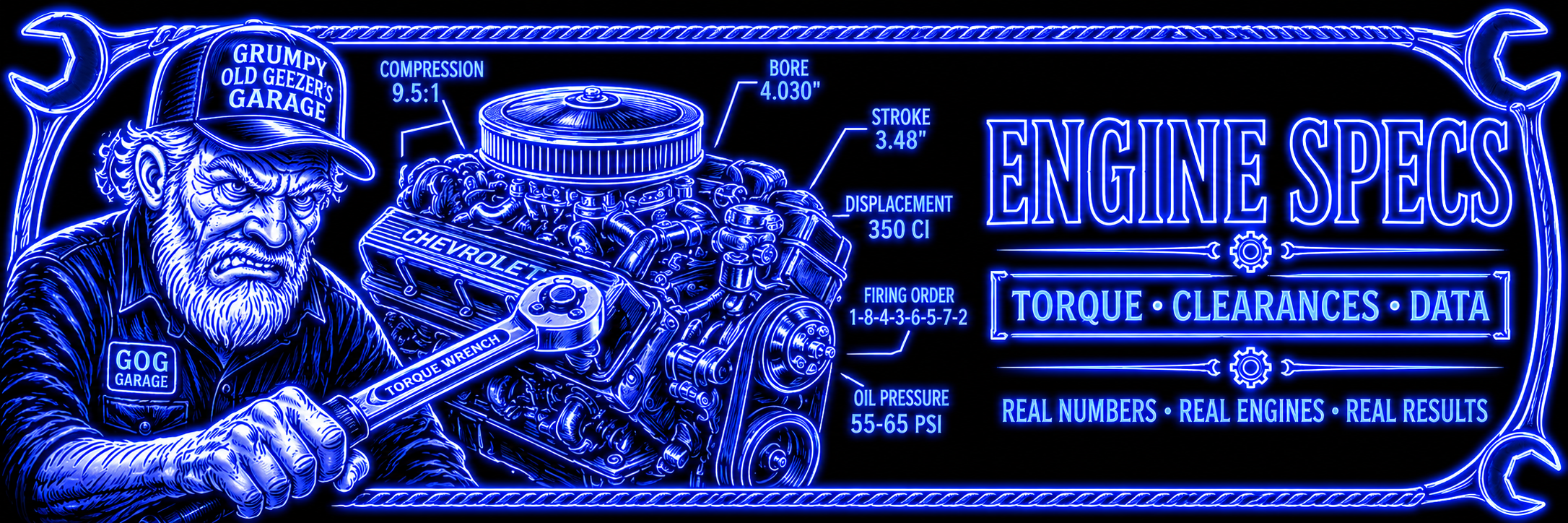
Mopar 440 Engine Specs
On This Page:
Basics: Intro | Overview | What Makes This Engine Different?
Details: General Specs | Variants | Key Points
Warnings: Common Problems | Common Misconceptions | Upgrade Limitations | When It Actually Makes Sense | Compatibility Notes | Reality Check | Bottom Line
Related: Related Links

Intro
The Mopar RB 440 is the big wedge everybody remembers because it managed to be both common enough to matter and strong enough to deserve the noise. Introduced for 1966, the 440 was Chrysler’s largest regular-production RB wedge, using the raised-block architecture, 4.32-inch bore, and 3.75-inch stroke to make the kind of torque that didn’t need a courtroom argument before it moved the car. It wasn’t the 426 Hemi. It wasn’t the 426 Max Wedge. It was the big-cube wedge that did the everyday heavy lifting and still knew how to get ugly when Chrysler gave it the right parts.
The 440 existed because Chrysler needed one big RB engine that could cover a lot of ground. The 413 had opened the raised-block wedge story, and the 426 wedge had carried the Max Wedge fight into Super Stock territory. The 440 took that RB foundation and turned it into a broader production answer: big Chryslers, Imperials, Dodge and Plymouth muscle cars, police packages, towing-heavy cars, marine use, and later work-duty applications. That’s the 440’s strength. It wasn’t just a rare race package. It was a large-production torque engine with enough performance hardware available to make it dangerous.
That broad use also creates the usual Mopar confusion. A 440 in a New Yorker, a 440 Magnum in a Charger, a 440 Super Commando in a Road Runner, a Chrysler TNT, a Six Pack or Six Barrel engine, a police 440, and a late smog-era 440 don’t all tell the same story. Same displacement doesn’t prove compression, camshaft, carburetion, exhaust, heads, crankshaft, year, application, or value. The number is famous. The hardware still has to testify.
In its best-known muscle-era form, the 440 was the practical brute. It didn’t have the Hemi’s exotic heads, price, or race mystique, but it made huge torque, fit the production world better, and could make a street Mopar brutally quick without acting like every grocery run needed a pit crew. The Six Pack and Six Barrel versions gave it a sharper reputation, but even the single-four-barrel performance versions were serious engines when the package was right.
The plain-English identity is this: the Mopar RB 440 is Chrysler’s big, broad-use raised-block wedge that became the practical king of Mopar street torque. It’s not a Hemi consolation prize, and it’s not automatically a Six Pack legend. It’s the engine that proved a wedge could be common, durable, nasty, and useful all at the same time.
↑ Back to the Top, Before the Casting Numbers Start Lying

Overview
The Mopar RB 440 sits at the top of Chrysler’s regular-production raised-block wedge family. The 413 established the RB layout, the 426 wedge carried it into Max Wedge drag-racing territory, and the 440 turned the RB idea into Chrysler’s long-running big-cube workhorse. That position explains why the 440 has such a wide reputation. It showed up in luxury cars, muscle cars, police cars, big cruisers, marine applications, and later lower-compression duty. Few engines can be both common and legendary without making a mess of the conversation, but the 440 managed it.
Architecturally, the 440 kept the RB family’s 3.75-inch stroke and enlarged the bore to 4.32 inches. That gave it more displacement than the 413 and 426 wedge while staying in the same raised-block wedge family. It wasn’t a Hemi, and it didn’t need to be. The wedge heads, big cubes, long stroke, and broad torque curve made the 440 a strong street and highway engine. It could pull heavy cars, make serious midrange power, and feel less fussy than the more exotic 426 Hemi. That’s not an insult to the Hemi. That’s admitting the 440 knew its job and didn’t need a parade float to prove it.
In regular big-car use, the 440 was about smooth authority. Chrysler, Dodge, and Plymouth used it where weight, comfort, highway speed, and effortless passing power were part of the sales pitch. In performance trim, it became the 440 Magnum, Super Commando, or TNT depending on which division was dressing it up. Those versions gave the engine real muscle-era credibility without requiring Hemi money. A properly equipped 440 could make a Charger, GTX, Coronet, Road Runner, or big Chrysler move with the kind of confidence that made smaller engines start checking the exit signs.
The Six Pack and Six Barrel versions added the loudest wedge headline. Three two-barrel carburetors, stronger supporting hardware, and a sharper factory package gave the 440 a near-Hemi level of intimidation in a more street-usable wedge form. That deserves respect, but it also needs proof. A six-barrel air cleaner, orange paint, or a seller’s memory from 1973 doesn’t make a real V-code engine. Carburetion, intake, block, year, application, rotating assembly, and documentation still decide what’s actually there.
The 440’s long production life is also why version control matters. Early high-compression engines, muscle-era performance versions, police engines, marine engines, motorhome engines, cast-crank later engines, and low-compression emissions-era versions are not the same animal. Later 440s can still be useful, but they don’t automatically carry 1969 Magnum manners. Earlier engines can be excellent, but age, rebuild history, wrong parts, and swapped components can ruin a good story fast. The valve covers don’t know what happened inside the block after fifty years.
Compared with the 383, the 440 gives up some of the shorter-stroke, quicker-feeling personality but brings more torque and displacement. Compared with the 400, it’s the taller RB brute rather than the later low-deck big-bore platform. Compared with the 426 Hemi, it’s simpler, cheaper in period, more common, and often easier to live with, but it doesn’t get to borrow hemispherical-head mythology.
The biggest bad assumption is thinking the 440 is one thing. It isn’t. It can be a luxury-car torque engine, a muscle-car Magnum, a Super Commando, a TNT, a Six Pack bruiser, a police engine, a boat engine, or a smog-era puller. Same 440 badge doesn’t prove which one you have. Compression, heads, camshaft, induction, exhaust, crankshaft, year, application, and documentation decide whether the engine is a hero, a hauler, or a tired old lump with a loud story.
The Mopar RB 440’s real place is as Chrysler’s great big-cube wedge workhorse: common enough to find, strong enough to respect, and famous enough to attract plenty of nonsense. Respect it for torque, broad usefulness, and real performance when the hardware proves it. Treat every 440 like a Six Pack prize or every late 440 like junk, and the parts bill will start correcting your vocabulary.
↑ Back to the Top, Before the Casting Numbers Start Lying

What makes it different
The Mopar 440 RB is the big raised-deck wedge that became the default answer when somebody wanted Mopar torque without buying Hemi trouble. Put it in the proper lane: taller than the low-deck 383 and 400 B engines, broader than the 426 Max Wedge story, and separate from the Elephant even though it lives in the same loud neighborhood. The 440 is the big production hammer: common enough to build, big enough to scare parts downstream, and famous enough that sellers still try to charge extra for air cleaner memories.
Compared with the 413 RB, the 440 is the later, larger, easier-to-recognize version of the same raised-deck idea. The 413 got there first and did the early heavy lifting in big Chryslers, Imperials, long-ram cars, and Max Wedge history. The 440 brought more bore, more displacement, more availability, and the name most people remember. That doesn’t make every 413 second-rate. It means the 440 became the RB wedge people could actually find, build, and explain without giving a family-history lecture before breakfast.
Compared with the 426 wedge, the 440 gives up some early Super Stock sharpness and gains street usefulness by the bucket. A real 426 Max Wedge is factory race history with nasty hardware, narrow purpose, and proof requirements that should make the room get quiet. The 440 is broader. It lived in muscle cars, big cars, police work, towing, marine and heavy-duty use, and enough street builds to wear out every “my buddy had one” story in town. A 426 Max Wedge is the earlier fight piece. A 440 is the big RB that kept showing up for work.
Compared with the 426 Hemi, the 440 is the practical brute standing next to royalty. The Hemi has the halo, the heads, the width, the cost, and the kind of mythology that makes wallets act drunk. The 440 has displacement, torque, availability, and fewer reasons to hire a priest before buying parts. A real Hemi is special. Nobody honest argues that. But for a driver, street bruiser, big-car build, or budget that still needs a roof over it, the 440 often makes more sense. The Elephant gets the crowd. The 440 gets the car moving without asking for tribute first.
Compared with the low-deck B engines — especially the 383 and 400 — the 440 lives on the taller RB side of the family. Deck height, intake width, stroke package, and parts fitment all need checking before somebody starts stacking parts like all Mopar big blocks share one closet. The 383 has the lighter, sharper, period street identity. The 400 has the big-bore low-deck stroker argument. The 440 has the longer RB stroke and easy cubic-inch torque. Pick the job before worshiping the number.
Compared with the 440 Six Pack / Six-Barrel versions, a regular 440 doesn’t get the same badge just because somebody bolted extra carburetors on the intake. The high-performance 440s earned their reputation with the right induction, cam, compression, exhaust, application, and supporting parts. A basic 440 can still be a strong engine, but it doesn’t become a factory Six Pack because the air cleaner got crowded. If the price smells like a real A12 or factory Six-Barrel claim, the numbers, parts, dates, and paperwork need to stand up straight.
Compared with smog-era 440s, the earlier high-compression engines carry more factory bite, but the later ones shouldn’t be dismissed like scrap just because the factory tune got strangled. Compression dropped, emissions rules tightened, and rating methods changed, so the paper story got uglier fast. That doesn’t mean the architecture forgot how to make torque. It means the engine may need compression, cam, heads, exhaust, and tune before it stops acting like it was raised by accountants.
That’s the 440’s place. It’s the big RB wedge most people mean when they talk Mopar big-block torque: more common than the rare stuff, cheaper than Hemi worship, stronger in the real world than the smog-era jokes suggest, and still not a magic answer for every car. Verify the version, match the parts, and don’t let “440” do all the thinking. The engine brought the inches, but if the combination is lazy, it’ll still hand you the bill with greasy fingerprints on it.
↑ Back to the Top, Before the Casting Numbers Start Lying

General Specs
| Displacement | 440 cu in / 7.2L | Bore / Stroke | 4.320 in × 3.750 in |
| Production / Use Era | 1966–1978 Mopar RB-series passenger-car, performance, and truck big-block era | Bore Spacing | 4.800 in |
| Engine Family | Chrysler / Mopar RB-series raised-deck big-block wedge V8 | Deck Height | 10.725 in |
| Block Material | Cast iron | Rod Length | 6.768 in |
| Cylinder Head Material | Cast iron | Main Journal | 2.750 in |
| Fuel / Induction | Gasoline; carbureted, 2-barrel, 4-barrel, or Six Barrel / Six Pack by version | Rod Journal | 2.375 in |
| Cam Location | In-block camshaft | Main Bearings | 5 |
| Valve Layout | OHV / pushrod, 2 valves per cylinder | Firing Order | 1-8-4-3-6-5-7-2 |
| Common Main Caps | 2-bolt | Distributor Rotation | Counterclockwise |
| Rear Main Seal | 2-piece | Weight | ~670–720 lb complete iron RB big-block, depending on accessories/configuration |
| Balance | Internal balance on forged-crank versions; external balance on cast-crank versions |
↑ Back to the Top, Before the Casting Numbers Start Lying

Variants
The Mopar 440 RB wedge needs a variant map that keeps fame from turning into slop. The 440 was everywhere Chrysler needed big torque, but that doesn’t make every 440 the same engine. Standard passenger-car 440s, TNT / Magnum / Super Commando engines, Six Barrel / Six Pack engines, police and heavy-duty versions, and motorhome / truck / service cores all belong in different lanes.
That split matters because value, hardware, build logic, and proof burden change fast. A standard 440 can be a terrific street engine. A real HP 440 can be more valuable. A real Six Pack or Six Barrel engine is another level. A police engine can be useful or tired. A motorhome core can be a bargain or a rebuild bill hiding under greasy optimism. The Geezer doesn’t let the number 440 do all the talking.
Standard Passenger-Car 440s
The standard 440 arrived for 1966 as Chrysler’s biggest regular-production RB wedge. It used the raised-deck block, 3.750-inch stroke, and 4.320-inch bore to make smooth, heavy-car torque without needing Hemi drama. In big Chryslers, Imperials, Dodges, Plymouths, wagons, and luxury cruisers, that was the job: move weight, pass with authority, and make the driver feel like the right pedal had a backbone.
A standard 440 deserves respect because it did real work. It can be a fine cruiser engine, a strong street foundation, or the right original engine for the car it came in. It just isn’t automatically an HP, Magnum, Super Commando, TNT, police, or Six Pack engine because the displacement badge looks important.
This is where sellers start polishing the fog machine. A 440 with orange paint and a 4-barrel doesn’t prove performance-package hardware. The year, application, stampings, heads, camshaft, compression, intake, carburetor, exhaust manifolds, distributor, and documentation decide what the engine is. A standard 440 can be plenty good. It doesn’t need to steal someone else’s résumé.
TNT / Magnum / Super Commando 440s
The high-performance 4-barrel 440s are the versions that made the wedge famous for people who wanted big Mopar muscle without buying Hemi trouble. Chrysler used TNT language, Dodge used Magnum, and Plymouth used Super Commando. Different division names, same basic lesson: these were hotter factory 440 packages, not every 440 with a carburetor and a loud air cleaner.
A real HP 440 had stronger factory intent behind it. Carburetion, camshaft, exhaust, compression, distributor curve, application, and supporting hardware made the difference between ordinary big-car torque and the kind of 440 that made B-bodies, C-bodies, and E-bodies feel properly rude. That’s why correct examples matter.
The name also needs year context. Late-1960s high-compression 440 performance identity isn’t the same as later low-compression emissions-era reality wearing familiar words. The badge may survive longer than the bite. The parts still have to tell the truth.
A TNT, Magnum, or Super Commando claim needs proof beyond decoration. Check the pad stamping, casting date, application, carburetor, intake, exhaust manifolds, heads, distributor, compression, vehicle context, tags, broadcast sheet, and paperwork. If the story says HP and the parts say regular passenger-car 440, believe the parts. They’ve lied less than sellers.
440 Six Barrel / Six Pack Engines
The 440 Six Barrel / Six Pack is the loudest wedge chapter, and it deserves the attention. Plymouth called it Six Barrel. Dodge called it Six Pack. Three two-barrel carburetors on a factory-backed big RB wedge gave Chrysler a street and strip package that could scare tires, passengers, and insurance agents in roughly the same afternoon.
A real Six Barrel / Six Pack engine is not just a standard 440 with three carburetors bolted on later. Factory identity depends on the engine, induction, application, codes, drivetrain, and documentation. The intake and carbs matter, but they don’t get to testify alone. Six Pack parts can be bought. Factory Six Pack identity has to be proven.
The 1969 A12 cars need special caution because the reputation is strong and the money knows it. Road Runner and Super Bee A12 packages were serious factory efforts with lift-off hood treatment, 440 Six Barrel / Six Pack power, heavy-duty drivetrain pieces, and a drag-strip attitude that didn’t waste much time pretending to be subtle.
That reputation attracts clones, swapped parts, and seller poetry. A real V-code or A12-related claim needs the right engine stamping, car code, intake, carburetors, linkage, air cleaner, exhaust, transmission, axle, hood, tags, broadcast sheet, and history. Three carbs on a 440 can be fun. They don’t automatically make the car born that way.
Police and Heavy-Duty 440s
Police and heavy-duty 440s had a real job. They lived in cars that idled hot, ran hard, carried weight, chased trouble, and got maintained by budgets that weren’t always overflowing with mercy. Some had better cooling, charging, exhaust, drivetrain, or fleet hardware than soft civilian versions. Some also lived like they owed the city money.
A police 440 can be a useful engine, especially when the supporting equipment is complete and the condition checks out. But police doesn’t mean pampered. It often means heat, idle time, hard acceleration, cold starts, and long service intervals that make normal wear look polite.
Heavy-duty claims need the same proof as performance claims. Cooling pieces, oil pan, exhaust, distributor, charging system, pulleys, brackets, carburetion, application tags, broadcast sheet, and vehicle history should support the story. A big radiator and a seller in sunglasses don’t make a pursuit package.
Motorhome, Truck, Marine, and Service 440s
The 440 lived long after the muscle-car posters stopped pretending everything was 1969. Motorhomes, trucks, marine use, industrial service, and replacement engines kept the 440 in hard-working places where torque mattered more than quarter-mile legend.
Those engines can be useful cores, but the Geezer checks them before celebrating. Motorhome and truck engines may have lived hot, heavy, slow, loaded lives. They may bring low compression, odd manifolds, different oil pans, special cooling pieces, unusual accessory drives, governor equipment, service parts, or missing passenger-car hardware that costs more than the bargain ever saved.
Marine and industrial pieces can be even trickier. Cooling systems, manifolds, crank or flywheel details, reverse-rotation possibilities, front dress, and application-specific hardware need checking before the engine gets dragged home like found treasure. A 440 block is useful. A weird takeout with half the wrong pieces isn’t automatically cheap.
Service and replacement 440s should be described honestly. A replacement block can be a good engine. A built 440 can outrun a factory one. A correct driver engine can be worth owning. None of that makes it numbers-matching, factory HP, police, Six Pack, or born-with unless the evidence proves it.
The right variant question isn’t “is it a 440?” That’s barely the hood latch. The real question is which 440, from what year, in what application, with which crank, balance package, heads, compression, camshaft, induction, exhaust, stampings, and documentation. That answer decides whether the engine is a standard cruiser, a real HP wedge, a Six Pack prize, a fleet survivor, or a motorhome core trying to dress for Saturday night.
↑ Back to the Top, Before the Casting Numbers Start Lying

Key Points
The Mopar 440 RB is the raised-deck big block everybody thinks he understands, which is exactly why it gets people in trouble. It’s famous, common enough to build, strong enough to respect, and popular enough that every seller with orange paint starts practicing his “HP engine” voice. A 440 can be a great engine. A 440 can also be a regular big-car core wearing somebody else’s muscle-car attitude.
The basic fingerprint is 4.320-inch bore and 3.750-inch stroke in Chrysler’s RB architecture. That separates it from low-deck B engines like the 361, 383, and 400, and from the smaller-bore 413 and 426 wedge RB engines. The 440 is the biggest regular-production RB wedge, not a universal “big-block Mopar” blob where every intake, piston, pan, bracket, and balance part magically agrees.
The 440’s biggest advantage is displacement with support. It starts with real cubic inches, has strong parts availability, and can make serious street torque without exotic hardware. That’s why it became the default Mopar big-block answer for so many builds. But default doesn’t mean automatic. The engine still needs the right compression, camshaft, heads, induction, exhaust, ignition, cooling, converter or clutch, and rear gear.
Factory 440s came in a wide spread, and that spread is where the trouble starts. A standard luxury-car 440, TNT, Magnum, Super Commando, Six Barrel, Six Pack, police engine, motorhome pullout, marine piece, service replacement, and later low-compression smog-era engine don’t carry the same hardware or value. Carburetion, heads, cam, compression, exhaust manifolds, HP stampings, application, dates, and documentation need to agree before the price starts puffing its chest.
Six Barrel and Six Pack claims need hard proof. A real triple-carb 440 package had specific induction, linkage, air-cleaner hardware, calibration, application context, and documentation. Three carburetors sitting on an intake don’t automatically create a factory Six Pack engine. Sometimes they create history. Sometimes they create a tuning problem with an ego.
HP stamping claims need the same discipline. A factory HP 440 can be worth more in the right car, but the letters alone don’t finish the story. The pad stamping, casting date, assembly date, vehicle application, heads, manifolds, intake, carburetor, distributor, transmission pairing, and documentation all need to agree. A stamped pad without context is not a permission slip for muscle-car pricing.
The 440 needs separation from the 383 and 400 because people love comparing them badly. The 383 is the shorter-stroke low-deck practical hero. The 400 is the big-bore low-deck stroker darling. The 440 is the long-stroke raised-deck torque default. Those are different build lanes. Bigger is useful. It isn’t always smarter.
The 440 also needs separation from the 426 Hemi and 426 wedge. The Hemi lives in a different hardware, value, and proof universe. The 426 wedge shares RB family logic but carries its own early performance and Max Wedge baggage. A 440 can be powerful and desirable without pretending to be either. If the sales pitch starts borrowing Hemi or Max Wedge glory, the Geezer starts looking for what the engine actually is.
Cast-crank and forged-crank differences matter. Early and performance-era 440s are often discussed like all of them share one rotating story, but later cast-crank engines and externally balanced combinations need the correct damper, converter, flexplate, flywheel, and balance parts. Mix balance pieces by guesswork and the big wedge will shake like it’s trying to confess something.
Truck, motorhome, marine, and industrial-service 440s deserve inspection before celebration. Some are good foundations. Some lived hot, loaded, under-maintained lives with odd accessories, different manifolds, special pans, heavy-duty cooling, governor equipment, or application-specific front dress. A cheap takeout can be a bargain, or it can be a greasy lesson in why “ran when parked” should be printed on warning labels.
Interchange helps because the RB family has real support, but it won’t save lazy parts mixing. Heads, intakes, cams, timing parts, oil pans, accessories, exhaust, ignition pieces, converters, balance parts, and transmission combinations need to match the year, application, and build. A 440 has enough support to make building easier than the oddballs. It also has enough versions to punish people who stop reading after “RB.”
A used 440 needs identification before bragging starts. Check block casting, pad stamping, bore size, crank, heads, intake, carburetion, exhaust pieces, date codes, vehicle application, HP markings, crank type, balance hardware, and previous machine work. These engines have been swapped, stroked, overbored, raced, worked hard, de-smogged, cloned, painted, and rebuilt badly for decades. Orange paint and big valve covers don’t make the story true.
Block condition still matters. The 440 is popular enough that people assume any core is worth dragging home, but cracks, excessive overbore, damaged decks, worn main saddles, tired heads, bad threads, and ancient machine work can still turn a desirable block into a bill pile. Measure it, inspect it, and stop acting like displacement makes rust and abuse apologize.
Build judgment depends on purpose. A mild 440 can be a great street engine with compression, decent heads, proper cam, good ignition, strong exhaust, enough converter or gear, and a cooling system that isn’t trying to retire. A serious 440 can make plenty of power. But if the plan is all cam, no compression, bad exhaust, lazy gearing, and a carb big enough to drown the combination, the 440 will still run like a parts catalog had a seizure.
The Mopar 440 RB deserves its reputation because it’s one of Chrysler’s best big-block street engines. It has cubes, torque, strength, support, and real muscle-era history. It doesn’t need fake Six Pack claims, Hemi envy, or mystery HP stamps to matter. Verify the RB identity, version, application, dates, heads, induction, exhaust, crank type, balance package, block condition, and documentation before spending money. A 440 can be the right hammer, but the block, parts, and proof still have to survive the swing.
↑ Back to the Top, Before the Casting Numbers Start Lying
Common Problems
The 440 RB’s trouble starts because it’s the Mopar big-block everybody thinks he understands. Big cubes, big torque, big reputation, easy story. That reputation is earned, but it also makes people lazy. Not every 440 is a Six Pack. Not every 440 is an HP engine. Not every motorhome core is a bargain muscle engine. The number is famous. The parts still have to prove the claim.
- Six Pack / Six Barrel Claims Without Proof
The 440 Six Pack and 440 Six Barrel engines are real Mopar royalty. Three two-barrels, big torque, factory muscle-car swagger, and enough reputation to make sellers start smiling before the hood is open.
That doesn’t make every 440 with extra carburetors a real Six Pack or Six Barrel engine. A real claim needs the right year, application, intake, carburetors, linkage, air cleaner, exhaust, HP markings, date context, transmission pairing, body/VIN context, and documentation. A regular 440 with a three-deuce setup is not automatically factory Six Pack hardware. It may just be an expensive intake trying to write the whole résumé. - HP / Magnum / Super Commando Inflation
The 440 wore several strong names, and those names get abused. HP, Magnum, Super Commando, TNT, and related performance labels can matter when the engine, application, and hardware back them up. They don’t turn every 440 block into premium muscle-car iron.
Camshaft, exhaust manifolds, carburetion, intake, air cleaner, distributor, stampings, dates, vehicle context, and paperwork all need checking. A plain 440 can be a strong engine. A correct HP 440 can be worth more. A dressed-up regular 440 doesn’t get to charge muscle-car money just because the air cleaner learned a fancy word. - Motorhome and Truck-Core Reality
The 440 lived long enough and worked hard enough to show up in motorhomes, trucks, and other heavy-duty use. Those cores can be useful. They can also be worn, heat-soaked, low-compression, odd-equipped, or missing the pieces needed for a passenger-car build.
Compression, heads, camshaft, manifolds, oil pan, mounts, cooling pieces, front dress, accessories, transmission-related hardware, and prior abuse need checking early. A motorhome 440 can be a good foundation. It is not automatically a cheap Road Runner engine with a heavier vacation story. - 440 / 426 Hemi Comparison Trouble
The 440 gets dragged into 426 Hemi comparisons constantly. Sometimes that makes sense: the 440 was the practical torque monster most owners could actually live with. Sometimes it turns into nonsense, with people pricing, building, or bragging like the wedge automatically borrowed Hemi identity.
The 440 is a wedge RB engine. It doesn’t need Hemi mythology to matter. It also doesn’t get Hemi value, Hemi parts, or Hemi proof standards just because it can make serious torque. Judge the 440 as a 440 before Hemi mythology starts pricing the parts. - Big Torque Hiding Bad Condition
A 440 can feel strong even when it is tired. That is part of the problem. Big displacement and torque can hide low compression, worn rings, tired valve guides, sloppy timing, poor cooling, and old rebuild sins long enough for a buyer to get impressed.
Do not let one smoky burnout write the inspection report. Oil pressure, compression, leakdown, cooling behavior, sludge, casting/stamping checks, carburetion, ignition, and prior machine work still matter. A tired 440 can still move a car. It can also empty a wallet while everyone stands around admiring the torque.
For broader Mopar RB-series problems shared across the engine family, use the Mopar RB-series family page under Common Family Problems.blems shared across the engine family, use the Mopar RB-series family page under Common Family Problems.
↑ Back to the Top, Before the Casting Numbers Start Lying

Common Misconceptions
The 440 RB gets misunderstood because it really is good. That is the dangerous part. It has enough torque, parts support, muscle-era history, and street reputation to make bad assumptions sound reasonable. The 440 doesn’t need fake Six Pack stories, Hemi comparisons, or dressed-up HP claims to be worth building.
- “Every 440 is a Six Pack or Six Barrel engine.”
No. Six Pack and Six Barrel were specific high-performance induction packages, not a blessing stamped on every 440 block. Most 440s were not factory three-deuce muscle engines.
A real Six Pack or Six Barrel claim needs the right hardware and documentation. Intake, carburetors, linkage, air cleaner, exhaust, dates, vehicle context, stampings, and paperwork all need to agree. The extra carburetors don’t get to testify by themselves. - “All 440s are HP engines.”
No. Chrysler built plenty of 440s for luxury cars, big cars, police use, towing, motorhomes, and regular passenger-car duty. Some were HP, Magnum, Super Commando, TNT, or Six Pack / Six Barrel engines. Many were not.
That difference matters. A plain 440 can be excellent. A correct HP 440 can be more valuable. A dressed-up regular 440 with a loud air cleaner is still a regular 440 until the proof shows up. - “A motorhome 440 is the same as a muscle-car 440.”
No. A motorhome or truck 440 may share the RB family and big displacement, but it can bring different compression, camshaft, heads, manifolds, cooling parts, oil pan, mounts, accessories, and wear history.
It can be a good core. It can also be a tired workhorse that spent its life hot, heavy, and overloaded. Work-duty survival doesn’t automatically equal muscle-car value. - “The 440 is basically a 426 Hemi.”
No. The 440 is a wedge RB engine. The 426 Hemi is a different engine with different heads, architecture, parts, value, and factory role.
The 440 can make serious street power and torque. It doesn’t need fake Hemi identity to matter. Calling it basically a Hemi is how wrong expectations and stupid prices show up wearing matching shirts. - “The 440 is always the smartest Mopar big-block build.”
Not always. The 440 is often a smart choice because it has displacement, torque, support, and street manners. But the best choice still depends on the car, goals, parts on hand, budget, and originality.
A correct 383 car may deserve its 383. A real 426 wedge or Hemi car has its own argument. A 400 stroker plan may make more sense for some builds. The 440 is a big answer. That doesn’t mean every Mopar question needs all 440 cubic inches.
For broader Mopar RB-series misconceptions shared across the family, use the Mopar RB-series family page under Common Family Misconceptions.
↑ Back to the Top, Before the Casting Numbers Start Lying

Upgrade Limitations
The Mopar 440 RB wedge is the big-block people reach for when they want the easy answer. That’s the first problem. The 440 is common enough, strong enough, famous enough, and supported enough that people start treating it like it can fix any bad plan by leaning on cubic inches. It can cover a lot of mistakes. It can’t cover all of them. A lazy combination with 440 valve covers is still lazy. It’s just louder while it disappoints you.
The 440 is a raised-deck RB wedge big-block with a 4.32-inch bore and 3.75-inch stroke. It shares RB architecture with the 413 and 426 wedge, but the larger bore gives it more displacement, more torque potential, and more build popularity. It is not a 426 Hemi. It is not a low-deck 383 or 400. It is not automatically a Six Pack, Magnum, Super Commando, TNT, police, motorhome, or HP engine just because the displacement is right. The number starts the conversation. The hardware finishes it.
The first upgrade limitation is version spread. A 440 might be a high-compression performance engine, a mild passenger-car engine, a later emissions-era low-compression engine, a police package, a truck or motorhome workhorse, a Six Pack engine, or a swapped mystery lump with three generations of parts mixed into it. Those are not the same build. “440” alone doesn’t tell you crank type, balance package, compression, camshaft, heads, induction, exhaust, cooling, or application hardware.
Compression is where many 440 builds get exposed. Early performance engines had stronger factory attitude. Later engines often carried lower compression, softer cams, emissions calibration, heavier vehicles, and net-rating reality. A big cam in a low-compression 440 can still be a dog. It may bark louder than a smaller engine, but it’s still pulling against weak cylinder pressure, lazy timing, and mismatched parts. The 440 has torque, but torque isn’t a permission slip to ignore compression.
Camshaft choice needs adult supervision. A mild 440 can tolerate more cam than a smaller engine, but that doesn’t mean it wants every cam in the catalog. Too much duration with low compression, a tight converter, highway gears, weak exhaust, or a heavy car can make a big engine soggy and annoying. Street 440s need the cam, compression, converter or clutch, rear gear, ignition, intake, exhaust, and vehicle weight to agree. Otherwise the engine is just moving air around while the car waits for the plan to show up.
Cylinder heads and airflow matter, but the 440 doesn’t need random hero parts to be good. A well-matched 440 with sensible heads, compression, cam, intake, exhaust, and tune can make excellent street torque. Better heads can help. So can a good valve job, correct springs, proper quench, and real exhaust. But giant ports, wrong chamber volume, weak compression, and a cam chosen by bragging rights can turn a strong RB into a fuel-hungry argument with poor manners.
Six Pack and HP claims need proof. A real 440 Six Pack or 440-6 setup is not a regular 440 with three carburetors and a story. The same goes for Magnum, Super Commando, TNT, police, or other performance-package claims. Blocks, stampings, dates, heads, intake, carburetors, linkage, air cleaner, exhaust manifolds, camshaft, distributor, transmission pairing, and vehicle context all matter. Dress-up parts don’t create factory identity. They create a more expensive lie if nobody checks.
Cast crank and balance issues can bite hard. Not every 440 uses the same rotating package. Later cast-crank engines and externally balanced combinations need the right damper, converter, flexplate, flywheel, and balance parts. Mix forged-crank and cast-crank assumptions because “it’s a 440,” and the engine will shake like it’s trying to warn the neighborhood. Verify the crank, year, balance, and transmission parts before the engine ever fires.
Block and core condition still matter. The 440’s reputation doesn’t repair cracks, corrosion, worn lifter bores, damaged threads, previous overbores, tired main saddles, bad decks, or cooling passages packed with old neglect. Motorhome and truck cores can be useful, but they may have lived hot, heavy, slow lives under load. A cheap 440 core isn’t cheap if every part that made it run has to be replaced.
The honest upgrade plan starts with the actual 440 in front of you. A correct performance 440 should be preserved and verified. A mild street 440 needs compression, cam, intake, exhaust, ignition, converter or clutch, and gear matched to the car. A low-compression emissions-era engine needs a realistic compression plan before the cam gets stupid. A truck or motorhome core needs inspection before excitement. The 440 is one of the best Mopar big-blocks, but even the good ones don’t reward lazy thinking.
↑ Back to the Top, Before the Casting Numbers Start Lying

When It Actually Makes Sense
The 440 makes sense when the goal is strong Mopar torque with broad parts support and real street usefulness. It has enough displacement to move heavy cars, enough aftermarket support to build almost any sane combination, and enough factory history to matter in restoration and performance settings. A good 440 doesn’t need to pretend it’s a Hemi. It has its own job, and it does that job very well.
It makes excellent sense in a correct factory 440 application where the engine is part of the car’s identity. A correct Magnum, Super Commando, TNT, police, Six Pack, or other factory 440 package can be worth preserving when the hardware, dates, stampings, and vehicle context support the claim. The right 440 can define the car. The wrong story can just define the seller.
It also makes sense as a street performance foundation. A properly built 440 can make the kind of low- and mid-range torque that makes an old Mopar feel alive without needing race-car manners. It likes compression that fits the fuel, a cam that fits the converter and gear, heads that match the RPM range, exhaust that can breathe, and cooling that can keep up. Give it that, and the engine can feel strong without acting stupid.
The 440 can make sense when a heavier vehicle needs torque. Big Chryslers, Chargers, Road Runners, GTXs, trucks, tow rigs, and full-size cruisers all remind you why displacement exists. A smaller engine can be built to work, but a good 440 starts with the shove already baked in. That’s useful, not magic.
It makes less sense when originality points somewhere else. A correct 383 car, 426 wedge car, 413 long-ram car, or real Hemi car doesn’t automatically become better because somebody stuffed in a 440. It may become faster or easier to service, but it may also lose the identity that made the car interesting. Bigger is not always smarter when the car’s story matters.
It also makes less sense when the engine is just a bad core with a famous number. A cracked, overbored, overheated, incomplete, or badly mixed 440 can cost more than starting with a cleaner engine. The 440’s support is excellent, but support isn’t the same as a free rebuild.
Plain answer: build the 440 when you want real RB torque, strong parts support, and a Mopar big-block that can do serious street work without needing excuses. Verify the exact version, fix the compression, match the cam and drivetrain, and respect balance parts. Don’t worship it blindly, and don’t use it to erase a car’s correct engine story unless that’s truly the mission.
↑ Back to the Top, Before the Casting Numbers Start Lying

Compatibility Notes
Family identity.
Family identity.
The 440 is a raised-deck Mopar RB wedge big-block. Its identity stays separate from the 426 Hemi, separate from low-deck 361, 383, and 400 B engines, and separate from the small-block 360 even when the numbers make people careless. It shares RB architecture with the 413 and 426 wedge, but bore size, crank, balance, heads, induction, year, and application still decide compatibility.
Bore and stroke proof.
Verify the actual engine before trusting the badge. The 440 uses a 4.32-inch bore and 3.75-inch stroke. Check pad stampings, casting numbers, bore, crank, pistons, heads, date codes, exact year, vehicle context, and documentation before calling it HP, Six Pack, Magnum, Super Commando, TNT, police, motorhome, or factory original.
440 versus 413 and 426 wedge.
The 440 shares raised-deck RB architecture and the 3.75-inch stroke family with the 413 and 426 wedge, but the larger bore changes displacement, pistons, compression, valve clearance, head choice, airflow planning, and build expectations. A 413 or 426 wedge recipe can point in a direction. It doesn’t get to order parts for the 440 without checking the actual engine.
440 versus low-deck B engines.
The 440 is not a low-deck B engine. Intake manifolds, valley width, block height, pushrod length, some accessory relationships, and swap details can differ from 361, 383, and 400 engines. A 440 intake doesn’t fit a 383 just because both people at the counter said “big-block Mopar.”
440 versus 426 Hemi.
The 440 wedge and 426 Hemi are different engines. Heads, pistons, valvetrain, induction, exhaust, oiling expectations, packaging, and value categories differ. A 440 can be powerful, valuable, and correct. It doesn’t become Hemi-adjacent because it lives in the same brand mythology.
HP, Six Pack, Magnum, Super Commando, and TNT claims.
Not every 440 is a factory performance engine. A real Six Pack, Magnum, Super Commando, TNT, HP, or police-package 440 needs proof. Verify stampings, dates, heads, intake, carburetors, linkage, air cleaner, exhaust manifolds, camshaft, distributor, transmission pairing, and vehicle context. Reproduction parts, swapped intakes, decals, and loud seller confidence don’t create factory identity.
Passenger-car, truck, and motorhome differences.
A 440 may come from passenger-car, truck, or motorhome service depending on exact year and application. Those engines can carry different heads, manifolds, cooling pieces, oil pans, mounts, accessory drives, carburetion, governors, flywheels or converters, and balance parts. Don’t assume a motorhome 440 drops into a B-body like it came dressed for Saturday night.
Compression, pistons, and heads.
Plan pistons, chambers, deck clearance, compression ratio, cam timing, quench, fuel, and heads together. Don’t assume every 440 has muscle-era compression, and don’t assume a big cam fixes a low-compression engine. The 440 can make torque, but it doesn’t cure bad math by being large.
Crank, balance, and rotating parts.
Verify forged versus cast crank, crank register, damper, flexplate, flywheel, converter, rod and piston package, and external or internal balance requirements by exact engine. Later cast-crank and externally balanced 440 combinations need the right matching parts. Mixing balance pieces by guesswork is how a big-block tries to shake the car into a confession.
Transmission and drivetrain fit.
Verify the exact year, crank flange, crank register, transmission, converter, flexplate, flywheel, starter location, bellhousing or case pattern, linkage, mounts, driveshaft, kickdown, rear gear, and drivetrain strength. A 440 swap that ignores converter, kickdown, cooling, exhaust, and rear axle survival is just spending torque before the rest of the car can cash the check.
Restoration-correct versus driver-correct versus performance-correct.
For a restoration-correct car, the right 440 and supporting hardware can define the vehicle. For a driver, a matched 440 can be strong, reliable, and satisfying without turning the car into a temper tantrum. For a performance build, choose the version, compression plan, heads, induction, cooling, balance parts, and drivetrain before the parts list starts acting like cubic inches solved everything.
↑ Back to the Top, Before the Casting Numbers Start Lying

Reality Check
The 440 RB wedge is famous because it earned the reputation, not because every 440 is a muscle-car prize. Chrysler built enough of them for luxury cars, performance cars, police work, motorhomes, trucks, marine use, and service replacements that the badge alone doesn’t prove much. The number 440 starts the conversation. It doesn’t tell the Geezer which parts are inside.
The best 440s are serious engines. A correct TNT, Magnum, Super Commando, or HP 440 can be a terrific factory performance package. A real Six Barrel or Six Pack engine is another level. But those claims need proof: stampings, dates, induction, heads, exhaust, carburetion, application, drivetrain context, tags, broadcast sheet, and documentation. Without that, the seller has a story, not a verdict.
A standard 440 isn’t something to sneer at. It can make excellent street torque, move a heavy car with authority, and build into a strong driver without needing Hemi worship or triple-carb theater. The mistake is pretending a regular 440 is automatically the rare version, or acting like a good standard engine is worthless because it doesn’t have the sexy air cleaner.
Late, work-duty, and motorhome 440s need a colder eye. Some are useful cores. Some are heat-soaked, low-compression, odd-equipped, worn-out lumps that spent their lives hauling weight and collecting neglect. A cheap 440 can still be expensive if the block, heads, crank, balance parts, cooling pieces, manifolds, and front dress all need correction before the real build even starts.
The 440 is usually one of the smartest Mopar big-block choices when the goal is street torque, support, and broad usability. It isn’t always the right choice when originality points to a 383, 413, 426 wedge, 426 Hemi, or low-deck 400 stroker plan. Bigger can be better, but only when the car, budget, and purpose agree. Otherwise the engine is just carrying extra cubic inches into the wrong argument.
The hard truth is simple: the 440 can be a brute, a cruiser, a correct restoration engine, a police survivor, a Six Pack legend, or a tired workhorse with a famous number. Verify the version before the wallet gets sentimental. A real 440 is easy to respect. A fake story wrapped around a 440 is still a fake story, even when it makes good torque.
↑ Back to the Top, Before the Casting Numbers Start Lying

Bottom Line
The Chrysler 426 Hemi is the Elephant for a reason. It was built from racing pressure, proved itself in NASCAR and drag racing, became the Street Hemi for 1966–1971 production cars, and turned the word “Hemi” into one of the loudest names in American performance history.
Its best role is honest Hemi identity with proof behind it. In a real Street Hemi car, documented race package, A-990 / Super Stock context, serious restoration, high-end tribute, or purpose-built Hemi project, the 426 can be exactly the right engine. It has history, size, airflow, strength, intimidation, and enough cultural weight to stand on its own without borrowing anything from the 392 or the modern Gen III world.
Its weakest role is pretending to be every other Mopar big block. The 426 Hemi isn’t a 426 wedge, isn’t a Max Wedge, isn’t a 331, isn’t a 354, isn’t a 392, and isn’t a modern crate-Hemi identity just because the badge survived. It’s a second-generation Chrysler Hemi with its own block, heads, valvetrain, parts rules, fitment problems, value lanes, and expensive ways to punish guessing.
The buying rule is proof first. Identify the block, heads, stampings, casting dates, engine assembly details, induction, exhaust, rocker gear, oil pan, transmission context, car documentation, service-block history, race history, clone status, and previous machine work before the money leaves your hand. A born-with Street Hemi, a race engine, a service replacement, a crate build, a restamped engine, and a tribute-car powerplant are different conversations.
The build rule is purpose first. A restoration Hemi needs correctness. A race Hemi needs rules, safety, oiling, valvetrain stability, and chassis support. A street Hemi needs cooling, drivability, gearing, plug access, exhaust clearance, fuel quality, and service planning. A clone or tribute needs honesty. If the goal is cheap horsepower per dollar, the 426 Hemi is usually the wrong hammer with the most expensive handle in the shop.
Plain verdict: the 426 Hemi is worth saving, documenting, and building when the engine, car, budget, and mission justify the Elephant. It doesn’t need fake race history, clone fog, restamp magic, wedge confusion, or auction-block vocabulary to be important. Verify the iron, verify the paperwork, respect the parts bill, and let the 426 be what it already is: the Mopar Hemi that made the name dangerous.
↑ Back to the Top, Before the Casting Numbers Start Lying
Related Links
Specifications and Reference
Common Factory Pairings
Carburetors
- Carter BBD Carburetor Specs
- Carter ThermoQuad Carburetor Specs
Transmissions
- Mopar A727 TorqueFlite Transmission Specs
- Mopar A904 TorqueFlite Transmission Specs
- Mopar A833 4-Speed Manual Transmission Specs