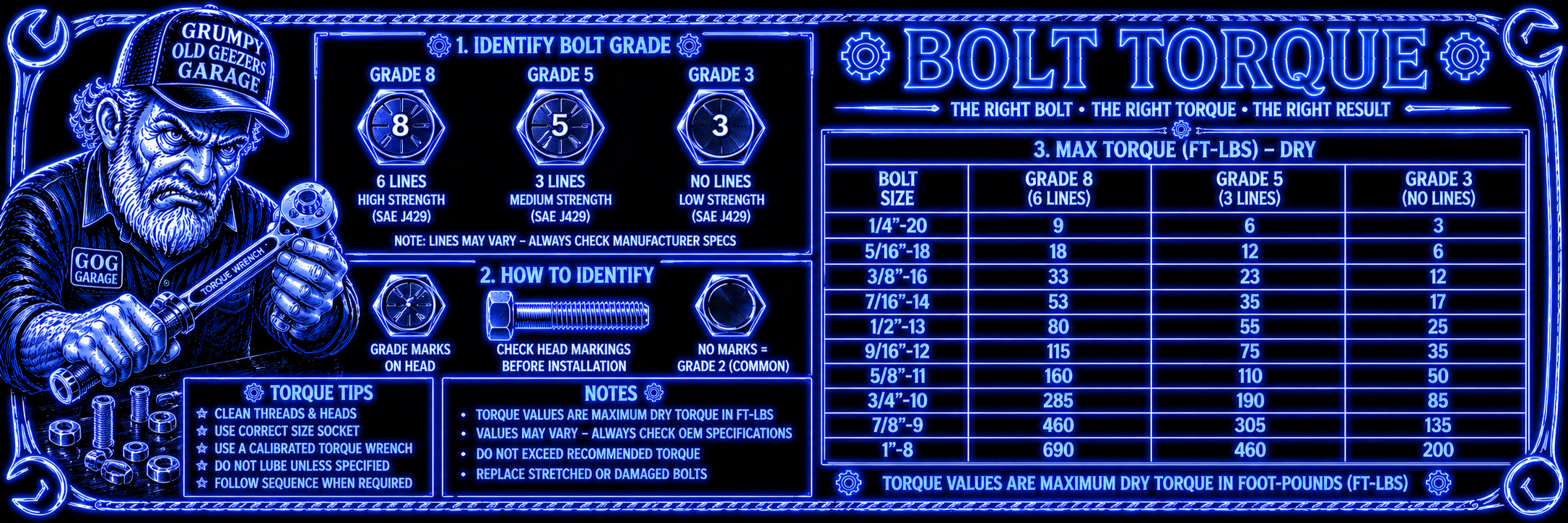
Torque Specs
You don’t torque engine parts by guessing, leaning harder, or tightening until your elbow clicks. You use the right spec for the right engine family, the right component, the right fastener, and the right procedure.
That’s what this section is for: torque values and fastener guidance tied to the engine family, not folklore dressed up like shop confidence. Fasteners, materials, gasket design, main cap layout, head-bolt procedure, thread condition, lubrication, and torque-angle rules change from family to family.
Start with the manufacturer, then the engine family. The right number only helps when it is used on the right engine, with the right fastener, in the right order.
Reality Check: A correct number used the wrong way can still wreck the job.

Manufacturers

Ford torque specs vary by engine family, fastener design, and era. A Y-block, Windsor, FE, Cleveland, 385-series, and MEL don’t all follow the same chart.
GM torque specs follow the engine family, not just the badge on the fender. Chevrolet, Buick, Oldsmobile, Pontiac, Cadillac, and GMC hardware all need the correct family before the wrench comes out.
Mopar torque specs depend on the engine family, hardware, and production era. Small-block, big-block, Poly, LA, B, RB, and Hemi work needs the right family before the wrench comes out.
↑ Back to the Top, Before the Parts Start Arguing

Torque Guidelines
Torque specs are grouped by manufacturer and engine family because fasteners, materials, gasket design, main cap layout, head-bolt procedure, and torque-angle rules change from family to family.
Use these pages as family-level reference guides. For exact year, application, gasket, aftermarket hardware, aluminum part, torque-to-yield fastener, or critical service procedure, confirm the factory manual before leaning on the wrench.
A correct number used the wrong way can still wreck the job. Thread condition, lubrication, bolt grade, fastener length, tightening sequence, and whether the bolt is reusable all matter.
Know What You Are Working On
Confirm the engine family, component, fastener, and application before using any torque value. Same brand doesn’t mean same spec.
Use the Correct Fastener
Wrong bolt, wrong grade, wrong length, reused stretch bolt, or mystery hardware changes the clamping force. If the hardware is wrong, the number is wrong.
Check Thread Size and Pitch
Don’t assume every old bolt uses the thread pitch you expect. Some antique engines used thread sizes and pitches that can surprise you, including coarse oddballs like 1/2-12 where later habits may expect something else. If the pitch is wrong, the bolt may start, feel almost right, and then ruin the threads before you realize the part was telling the truth.
Do Not Mix SAE and Metric
Some SAE and metric fasteners are close enough to fool you for the first turn or two. That doesn’t make them compatible. If a bolt starts but tightens oddly, binds early, feels gritty, or gets hard before it seats, stop. You may be cross-threading the wrong system into a part that was fine ten seconds ago.
Clean Threads Matter
Dirt, rust, old sealant, damaged threads, and bad thread engagement give false readings. Clean the threads and check the holes before blaming the spec.
Lubrication Changes Torque
Dry threads, engine oil, assembly lube, sealant, and anti-seize don’t act the same. Use the condition required by the spec or hardware maker.
Use the Right Units
lb-ft, lb-in, and Nm aren’t interchangeable. Getting the unit wrong is not a small mistake. It is a different job.
Follow the Sequence
Heads, mains, intakes, covers, pans, and housings often need a tightening pattern. If a sequence is given, follow it. If not, work evenly and don’t pull one corner down first.
Use Staged Passes
Don’t jump straight to final torque on critical parts. Build the load in steps so gaskets, caps, heads, and mating surfaces settle evenly.
Torque-to-Yield Means Procedure
If the spec calls for torque plus angle, the angle is part of the spec. If the bolt is torque-to-yield, assume it may not be reusable unless the service information says otherwise.
Stop When Something Feels Wrong
A bolt that tightens too easily, bottoms out, keeps turning, squeaks, binds, or feels soft is telling you something. Stop and check before you strip threads, crack parts, or snap hardware.

Shared Family Notes
During the 1960s and 1970s, Holley gained major visibility through factory muscle car programs at Ford, Chevrolet, Mopar, AMC, and other manufacturers. High-performance Mustangs, Camaros, Chevelles, Mopars, and specialty performance packages frequently used Holley carburetors because they offered strong airflow capability and aggressive fuel delivery characteristics.
By the emissions era, Holley also produced spread-bore and feedback-style carburetors designed to compete in a market increasingly dominated by fuel economy requirements, emissions controls, and computer-assisted tuning systems.
Today, Holley remains heavily represented in street performance builds, drag racing, circle track racing, marine applications, hot rods, restomods, aftermarket crate-engine packages, and traditional muscle car builds.
Some Holley families are simple and rugged. Others are highly tunable and extremely sensitive to improper setup.
Holley carburetors also became popular because racers could modify them easily. Jets, power valves, accelerator pumps, secondary springs, and linkage systems could all be changed without redesigning the entire carburetor. That flexibility made Holley legendary — and also helped create an endless supply of badly tuned street cars.
Holley carburetors became popular largely because the designs are modular and serviceable. Metering blocks, jets, power valves, accelerator-pump systems, secondary springs, shooters, floats, linkage systems, and other components can often be changed individually without redesigning the entire carburetor.
That modularity made Holley extremely attractive to racers and performance enthusiasts because tuning changes could be made quickly and repeatedly at the track, in the shop, or in the driveway.
Holley also built carburetors for dramatically different applications. Some models were intended for basic transportation and fuel economy. Others were intended for heavy towing, marine service, circle-track durability, drag racing, or high-RPM street performance.
The important thing to understand is that Holley flexibility is not magic. The carburetor still has to match the engine’s airflow demand, camshaft behavior, vacuum signal, gearing, vehicle weight, and intended use.
A street engine usually wants clean signal, good throttle response, and predictable fuel delivery. A race engine may tolerate or require a completely different setup. Confusing those two worlds is how a good carburetor gets blamed for a bad combination.
Parting Shot
Right engine. Right fastener. Right process.
Miss any one of those, and the number doesn’t save you.
Look up the family, check the procedure, and tighten it like the parts have to live afterward.