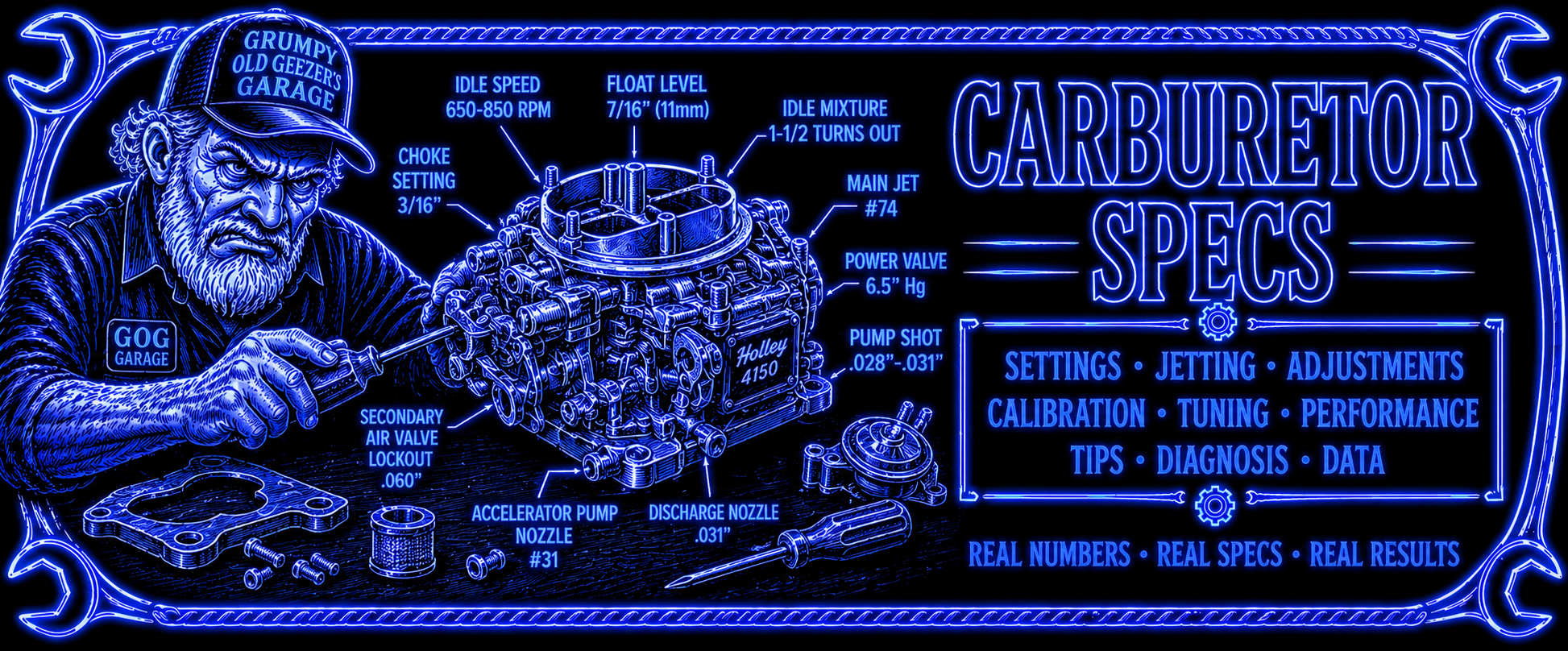
Carburetor Specs
You don’t identify a carburetor by the story that came with it. You identify it by the manufacturer, model family, tag, stamping, casting clues, throttle bore layout, choke hardware, linkage, fuel inlet style, calibration clues, and physical configuration.
That’s what this section is for: hard carburetor identification and family-level reference, not swap-meet folklore dressed up like experience. Holley, Rochester, Carter, Autolite, Motorcraft, and the rest all used families, subfamilies, calibrations, and applications that matter. Guess wrong, and the engine gets blamed for a carburetor that never belonged there in the first place.
Start with the carburetor name, number, tag, stamping, or physical layout, then work down to the specific family before tuning, rebuilding, selling, or bolting anything on.
Reality Check: “Came off a running engine” only proves it came off something. It does not prove it belongs on yours.

Holley covers everything from basic service carburetors to modular street, race, emissions-era, and Dominator hardware. The name is not enough. Model, list number, metering, secondary type, CFM rating, booster style, choke hardware, and application do the real talking.
Rochester means Model B, Monojet, Dualjet, 2G / 2GC / 2GV, 4GC, Quadrajet, Varajet, and E4ME / CCC electronic Quadrajets. GM used them everywhere, and calibration matters more than whatever story came with the carburetor.
Carter covers BBS, BBD, WCFB, AFB, AVS, ThermoQuad, YF / YFA, and other street-focused designs used across Mopar, AMC, Jeep, GM, Ford, and restoration applications. Smooth manners do not mean simple identification.
Autolite and Motorcraft cover Ford-focused OEM carburetors including 1100, 1101, 2100, 2150, 4100, 4300, 4350, and Variable Venturi families. Some are beautifully simple. Some are emissions-era puzzles. All deserve more than “it came off a Ford.”
Reference Notes
Carburetors do not stay neatly inside one brand or one vehicle line. The same broad carburetor family may appear across different vehicle makes, engine families, factory applications, aftermarket swaps, emissions packages, and service replacements.
CFM Is Not a Guessing Game
Too small and the engine is restricted. Too large and you lose signal, drivability, throttle response, and fuel control. Bigger numbers impress people. Engines are harder to fool.
That is why this section starts with carburetor manufacturer and model family. Vehicle application still matters, but a vehicle story cannot replace the physical evidence sitting on the bench.
Factory Carburetor Does Not Mean Original Carburetor
A carburetor may be correct for the engine family, correct for the era, or correct for nothing except the last guy’s parts shelf.
Numbers Matter
Tags, list numbers, stampings, casting marks, and physical features are there for a reason. Read them before trusting the name on the air horn.
Condition Matters
Worn shafts, dirty passages, warped bodies, missing parts, bad gaskets, stuck floats, and butchered linkage change everything. A worn carburetor will not tune correctly just because someone keeps turning screws.
Identification Beats Guessing
Use the number first. Use the story last. The carburetor does not care what someone told you it was.
Parting Shot
Start with the carburetor manufacturer, model family, number, and physical features.
Use the vehicle application to support the identification, not replace it.
Identify it before you tune it, rebuild it, sell it, or bolt it on. Guess first and the carburetor will teach you the expensive way.
Verify first. Wrench second.