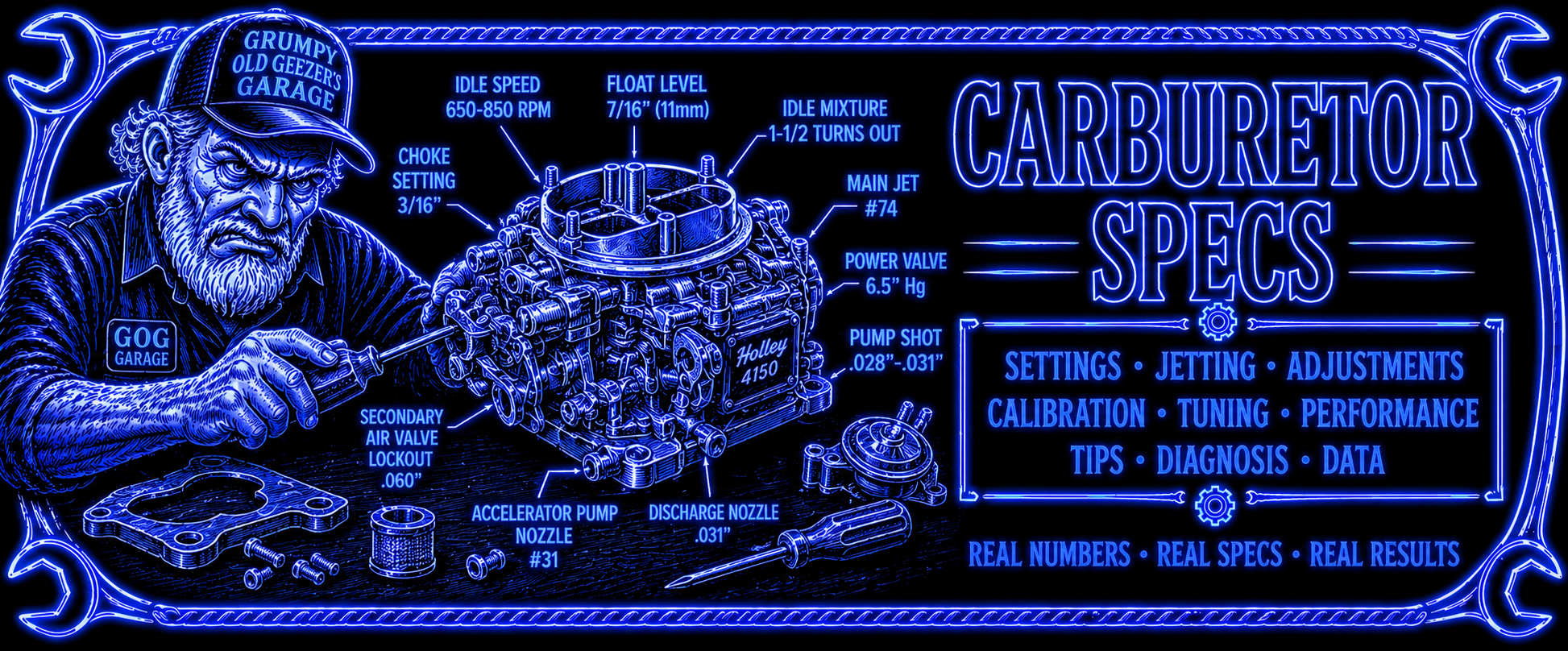
Autolite/Motorcraft Carburetor Specs
Autolite and Motorcraft carburetors are welded tight to Ford history, but that does not mean every Ford carburetor is the same lump of cast metal with a different tag.
These carburetors showed up on economy inline engines, work trucks, Broncos, Mustangs, big cars, emissions-era V8s, utility vehicles, and factory performance applications across several decades of American production.
Saying “it has a Motorcraft on it” tells you almost nothing by itself. The family, production era, venturi size, choke setup, emissions equipment, linkage arrangement, and calibration all matter.
This page organizes the major Autolite and Motorcraft carburetor families so you can identify the correct model before rebuilding, tuning, diagnosing, or assuming every Ford carburetor was interchangeable because the mounting studs line up.

Autolite / Motorcraft Carburetor Models

Single-barrel Autolite carburetor family used heavily on Ford inline engines and economy applications where reliability, simplicity, and stable street operation mattered more than pretending a six-cylinder grocery-getter needed race hardware.
Larger single-barrel Autolite carburetor family commonly associated with inline-six and utility applications requiring more airflow than the standard 1100 without turning a simple inline-six into somebody’s over-carbureted experiment.
Two-barrel Autolite carburetor family known for simple construction, strong booster signal, clean throttle response, and excellent real-world drivability on Ford V8s, trucks, and utility vehicles. Not glamorous, which is probably why it kept working while fancier parts were busy being impressive on paper.
Motorcraft two-barrel carburetor family that evolved from the 2100 idea with later emissions-era features, altitude compensation on some versions, and more application-specific hardware. Still a good street carburetor when complete. Still a headache when somebody “simplified” half the system into the trash.
Four-barrel Autolite carburetor family widely respected for smooth drivability, strong booster signal characteristics, and factory high-performance use during the Ford muscle car era. Not as flashy as some aftermarket carbs, which is probably why it often worked better than the show-off parts people replaced it with.
Spread-bore Ford carburetor family developed during the emissions transition era in an attempt to balance airflow capability, fuel economy, emissions compliance, and drivability. Their reputation depends heavily on who tuned them last, which is not always comforting.
Large spread-bore Motorcraft carburetor family used on trucks, big blocks, and emissions-era performance applications where higher airflow capability and emissions compliance had to coexist whether they liked each other or not.
Motorcraft variable-venturi carburetor family developed during the fuel-economy and emissions era to improve efficiency and drivability through dynamically changing airflow characteristics. Often misunderstood because most people stopped trying to understand them sometime around 1987.
↑ Back to the Top, Before the Parts Start Arguing

Identification Notes
Autolite carburetors became widely used across Ford products during the 1950s and 1960s before Motorcraft branding expanded through the emissions-controlled 1970s and 1980s.
These carburetors earned a strong reputation because many of them did the thing a street carburetor is actually supposed to do: start cleanly, idle steadily, transition smoothly, and keep the engine happy without acting like a race part looking for attention.
That does not mean every Autolite or Motorcraft carburetor behaves the same. Ford used multiple families with very different airflow characteristics, booster designs, vacuum systems, metering strategies, venturi sizes, linkage layouts, and emissions configurations.
Two carburetors may look nearly identical externally while functioning very differently once installed on the engine. One may belong on a mild street cruiser. Another may belong on a truck. Another may belong on an emissions-era engine held together by vacuum hoses and optimism.
Exact identification belongs on the model-specific pages and future identification-reference pages. For this parent page, the lesson is simple: carburetor family first, venturi or airflow version second, original application third.
A “Motorcraft 2100” is not a complete identification. Ford produced countless variations across different engines, emissions calibrations, venturi sizes, transmission applications, and vehicle platforms.

Shared Family Notes
Most Autolite and Motorcraft carburetors were built for OEM street use, drivability, cold starts, reliability, fuel economy, emissions compliance, and broad compatibility. That sounds boring until you realize boring is exactly what you want when the engine starts cold, idles clean, pulls smoothly, and does not demand a screwdriver every weekend.
The Autolite 2100 and 4100 families became especially respected because they combined relatively simple architecture with good booster signal behavior, predictable street manners, and strong real-world drivability.
Unlike many aggressive aftermarket carburetors, most Autolite and Motorcraft designs focused heavily on practical street operation. Smooth transition circuits, stable idle quality, vacuum-operated systems, and fuel metering consistency mattered more than impressing people with giant airflow numbers at the burger stand.
That is why some relatively small Autolite carburetors often outperform larger aftermarket carburetors in real-world driving situations where clean signal behavior matters more than giant airflow numbers on paper.
As emissions regulations tightened during the 1970s and 1980s, Motorcraft carburetors became increasingly complex. Additional vacuum controls, feedback systems, thermal switches, electronic controls, and emissions calibration strategies created carburetors that were often far more sophisticated than people gave them credit for.
That complexity also created plenty of trouble once owners started yanking hoses, blocking ports, swapping parts, and “simplifying” systems they did not understand. A missing vacuum line can make a good carburetor look guilty in a hurry.
That does not make every hose, switch, solenoid, and thermal widget sacred forever. It does mean you should understand what it does before removing it. Cutting vacuum lines because the diagram looks ugly is not diagnostics. It is vandalism with side cutters.
Today, Autolite and Motorcraft carburetors remain common in Ford restorations, trucks, Broncos, Mustangs, utility vehicles, factory-correct builds, and traditional street-driven classics.
Some Autolite and Motorcraft carburetors are extremely durable and forgiving. Others become difficult to diagnose once vacuum leaks, emissions deletions, worn linkage, warped housings, and decades of “adjustments” start piling up.
Common Problems
Vacuum Leaks
Aging vacuum hoses, worn throttle shafts, dried gaskets, cracked fittings, and warped housings create many drivability problems blamed on the carburetor itself.
Emissions-System Confusion
Many emissions-era Ford carburetors depended on networks of vacuum controls, thermal switches, delay valves, and feedback systems. Missing or incorrectly routed components can create endless drivability problems, usually after somebody proudly announces he “cleaned up all that junk.”
Incorrect Venturi Size
Many Autolite and Motorcraft carburetors use different venturi sizes within the same family. Assuming every 2100 or 2150 flows the same amount of air is a good way to create tuning problems and then blame the carburetor for following physics.
Warped Housings
Repeated heat cycles, overtightened fasteners, and poor rebuild practices commonly distort mating surfaces and create internal leakage problems.
Variable Venturi Misdiagnosis
Variable-venturi carburetors often get blamed for problems caused by vacuum leaks, failed controls, incorrect adjustments, or owners who never understood how the system operated in the first place.
Owner-Created Problems
A large percentage of “bad Motorcraft carburetors” are really just decades of vacuum-hose deletion, random adjustments, incorrect rebuilds, emissions bypasses, and people fixing things until they stopped working completely.
Parting Shot
Autolite and Motorcraft carburetors earned their reputation through strong drivability, practical street behavior, durable OEM design, and broad compatibility across generations of Ford vehicles.
When properly rebuilt and correctly matched to the engine, many of these carburetors perform far better than modern enthusiasts expect.
When vacuum systems are butchered, emissions controls deleted, and adjustment screws turned blindly by three generations of owners, even a good carburetor can become a rolling argument with gravity and gasoline.
Find the family, confirm the venturi or airflow version, match the application, and understand the vacuum system before blaming the carburetor.