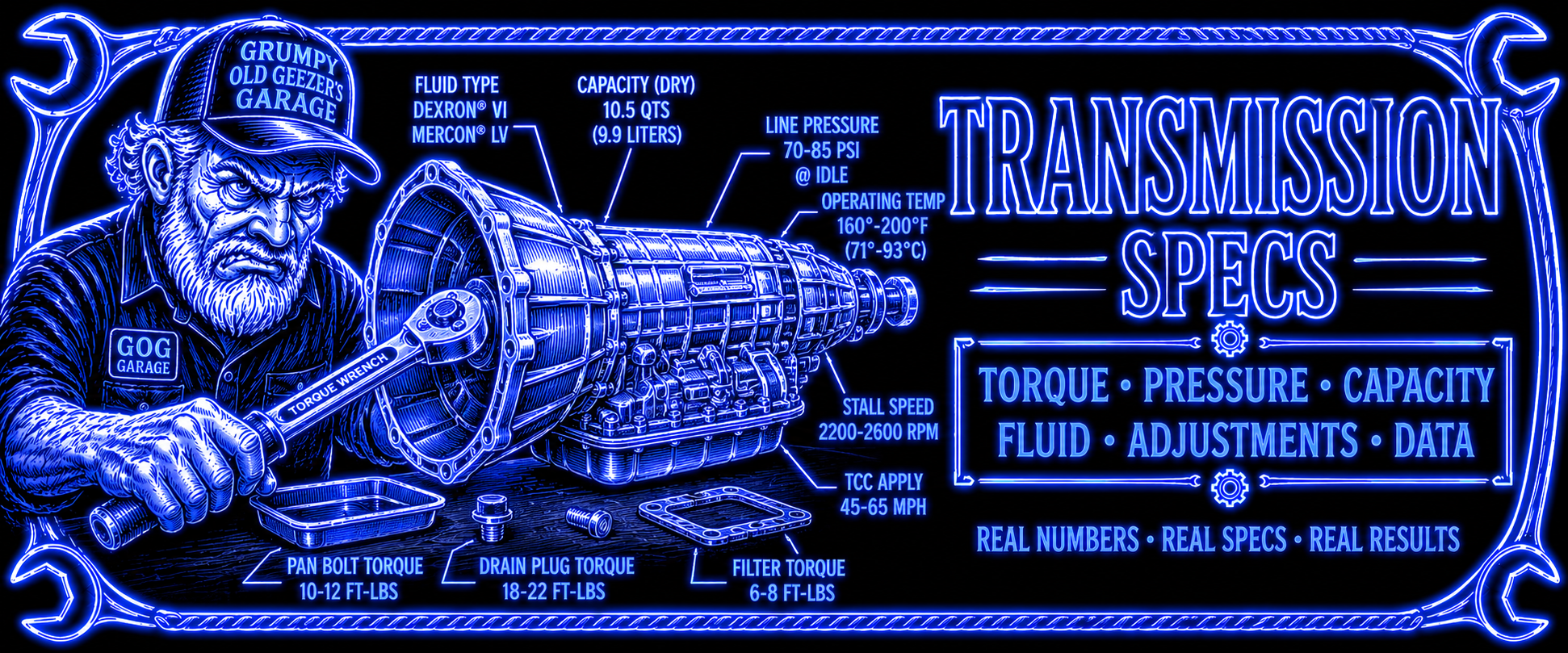
GM Transmission Specs
You don’t identify a GM transmission by calling everything a Turbo 350, Turbo 400, Muncie, or Powerglide and hoping the parts counter sorts out the mess. You identify it by the transmission family, case shape, pan shape, tag, casting, bellhousing pattern, tailhousing, output shaft, gearset, electronics, and application.
That’s what this section is for: GM transmission reference, not badge guessing dressed up like drivetrain knowledge. Chevrolet, Buick, Oldsmobile, Pontiac, Cadillac, and GMC used shared transmission families, but bolt patterns, internal versions, duty ratings, converters, valve bodies, electronics, and applications still matter.
Start with automatic or manual, then narrow down the actual transmission. After that, confirm the physical evidence before ordering parts, planning a swap, or believing some seller’s story because the pan shape looked familiar from ten feet away.
Reality Check: “GM transmission” isn’t an identification. It’s the beginning of the argument.

GM Automatic Transmissions

Aluminum Powerglide specs cover GM’s later two-speed automatic family. Simple doesn’t mean identical. Case pattern, cooling setup, gearset, output, converter, and application still matter.
TH350 specs cover GM’s medium-duty three-speed automatic. It’s common, useful, and swap-friendly, but case pattern, tailhousing, output, converter, kickdown setup, cooling, gearing, and application still need to match the job.
TH400 specs cover GM’s heavy-duty three-speed automatic. Strong reputation doesn’t erase case pattern, converter, output, tailhousing, switch-pitch, TH375, TH475, and application differences.
GM Manual Transmissions
Borg-Warner Super T10 specs cover later GM-used four-speed applications where case design, ratios, input, output, shifter position, and application need to be checked before calling it just another T10.
Muncie four-speed specs cover M20, M21, and M22 identification, ratios, case details, input and output differences, shifter setup, and the parts that separate a real Muncie from a hopeful story.
Saginaw three-speed specs cover common GM manual transmission use where light-duty expectations, case clues, linkage, input shaft, output shaft, and application need checking before parts get ordered.
Saginaw four-speed specs cover GM’s common light-duty four-speed family. It can be useful in the right car, but it isn’t a Muncie because the shifter has four forward gears.
Parting Shot
Know the GM transmission family.
Know the version.
Know the case, pattern, output, ratios, electronics, and application before you build around it.
GM reused names, patterns, parts, and assumptions for decades. Identify the transmission first, then spend money.